

















BHP’s Olympic Dam copper and uranium mine in South Australia. Photo by Michael Clayron-Jones Fairfax Media via Getty Images
Fairfax Media via Getty Images
Weakening commodity prices and a worsening industrial relations climate in Australia is draining investor enthusiasm for the world’s biggest mining company, BHP.
Over the past month the company’s share price has sagged by 10% with most investment banks tipping a continuation of the decline.
Australia bank Macquarie and British bank Barclays continue to rate BHP as a stock to hold but both have share price targets for the stock below the latest sales.
Sliding share price
UBS has also modestly downgraded its price target, leaving U.S. bank Morgan Stanley as the most optimistic about the outlook for the stock which is entering a period of heavy capital investment.
The latest bank research reports on BHP followed last week’s release of strong production numbers for the company’s financial year which ended on June 30 and ahead of the financial results scheduled for release on August 18.
Macquarie said the company’s iron ore engine room performed well despite a tough year which resulted in flat production of 291 million tons of material shipped mainly to China.
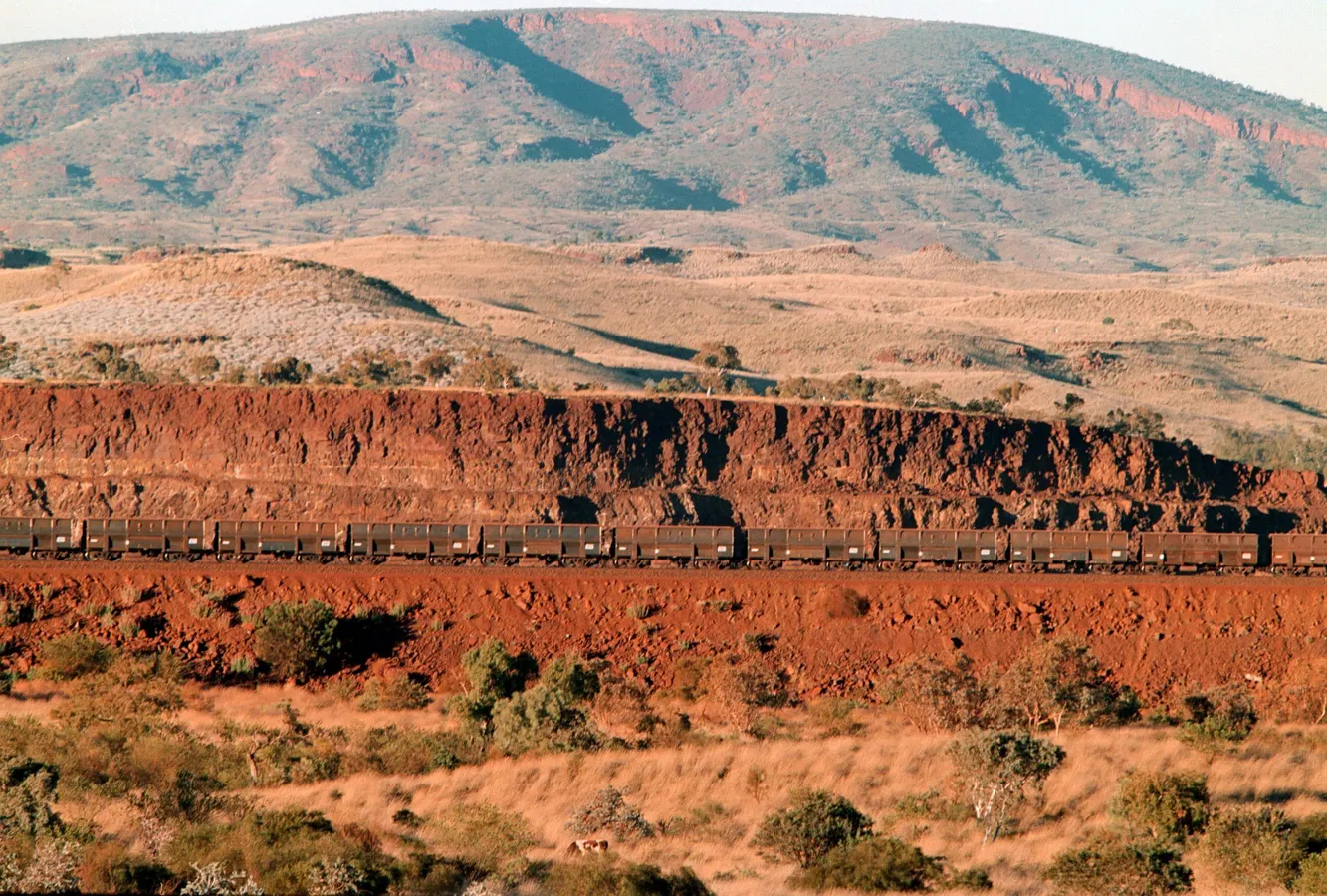
BHP iron ore train at Port Hedland Photo by Glenn Campbell (Fairfax Media via Getty Images
Fairfax Media via Getty Images
Much the same is expected in the new financial year, the bank said despite the risk of workforce industrial action at the company Port Hedland export facilities in Western Australia.
A largely unsuccessful first strike last week by workers at the port is seen as a possible precursor to more widespread industrial action, the first in the Australian iron ore industry for 26 years.
Analysts in the London office of Barclays said in a research note that BHP had delivered a solid finish to its 2026 financial year.
But declining volumes and rising capital expenditure meant the stock is close to peak value while rising merger and acquisition (M&A) risk means retention of an equal-weight (hold) investment recommendation.
“We estimate that BHP has scope to declare a dividend of 92 cents a share for the second half of 2026, for a 70% payout ratio,” Barclays said.
It’s what comes next for BHP which has bank analysts wary of the stock which is rotating its focus away from iron ore towards copper with several new projects in the design and development stage.
Copper Heavy Future
Timing the shift to a copper-heavy future is seen as a challenge, along with successfully executing multiple construction projects at the same time when the company has been struggling with one major new project, the Jansen potash development in Canada.
Adding to the concern of bank analysts is BHP’s strong share price over the past 12-months (up 40%) which could encourage a share-swap takeover offer for arch-rival, and copper rich, Anglo American.
“BHP made a brief last-effort approach to the Anglo American board in November,” Barclays said.
“This suggests that BHP’s board sees its own copper growth pipeline as less compelling in terms of returns, risks and timeline to delivery compared to acquiring Anglo and its (copper) pipeline plus material synergies – a prognosis we agree with.”
But BHP’s strong share price could encourage the use of the company’s shares in an M&A approach which would result in issuing new shares which would weaken the share price.
Source: Original Article