


























- On 27 June 2026, Tidewater Inc. (NYSE: TDW) was removed from several Russell value benchmarks while being added to the Russell 2000 Defensive and Russell 2000 Growth-Defensive indices, reshaping its index footprint.
- This shift from value-oriented to growth-defensive index classifications could alter how quantitative and passive investors view Tidewater’s role in portfolios.
- We’ll now examine how Tidewater’s reclassification into growth-defensive indices could influence its existing investment narrative and future investor expectations.
Uncover the next big thing with 20 elite penny stocks that balance risk and reward.
Tidewater Investment Narrative Recap
To own Tidewater, you need to believe that tight offshore support vessel supply and a solid multi‑year offshore project pipeline can support healthy utilization and margins, even as the sector stays cyclical and fossil‑fuel exposed. The June 27 shift from Russell value to Russell 2000 Growth‑Defensive indices may influence which funds hold the stock, but it does not materially change the near‑term demand and cycle‑risk drivers for the business.
In that context, Tidewater’s May 4 guidance reaffirming 2026 revenue of US$1.43 billion to US$1.48 billion is particularly relevant. It anchors the growth narrative that underpins the new growth‑defensive index classification, while also sitting against a softer Q1 2026 earnings print, reminding investors that vessel demand, project timing, and offshore volatility remain the practical catalysts and risks to watch as the shareholder base potentially shifts.
Yet while the reclassification sounds positive, investors should be aware that it also sharpens the focus on Tidewater’s exposure to…
Read the full narrative on Tidewater (it’s free!)
Tidewater’s narrative projects $1.8 billion revenue and $325.2 million earnings by 2029.
Uncover how Tidewater’s forecasts yield a $86.57 fair value, a 17% upside to its current price.
Exploring Other Perspectives
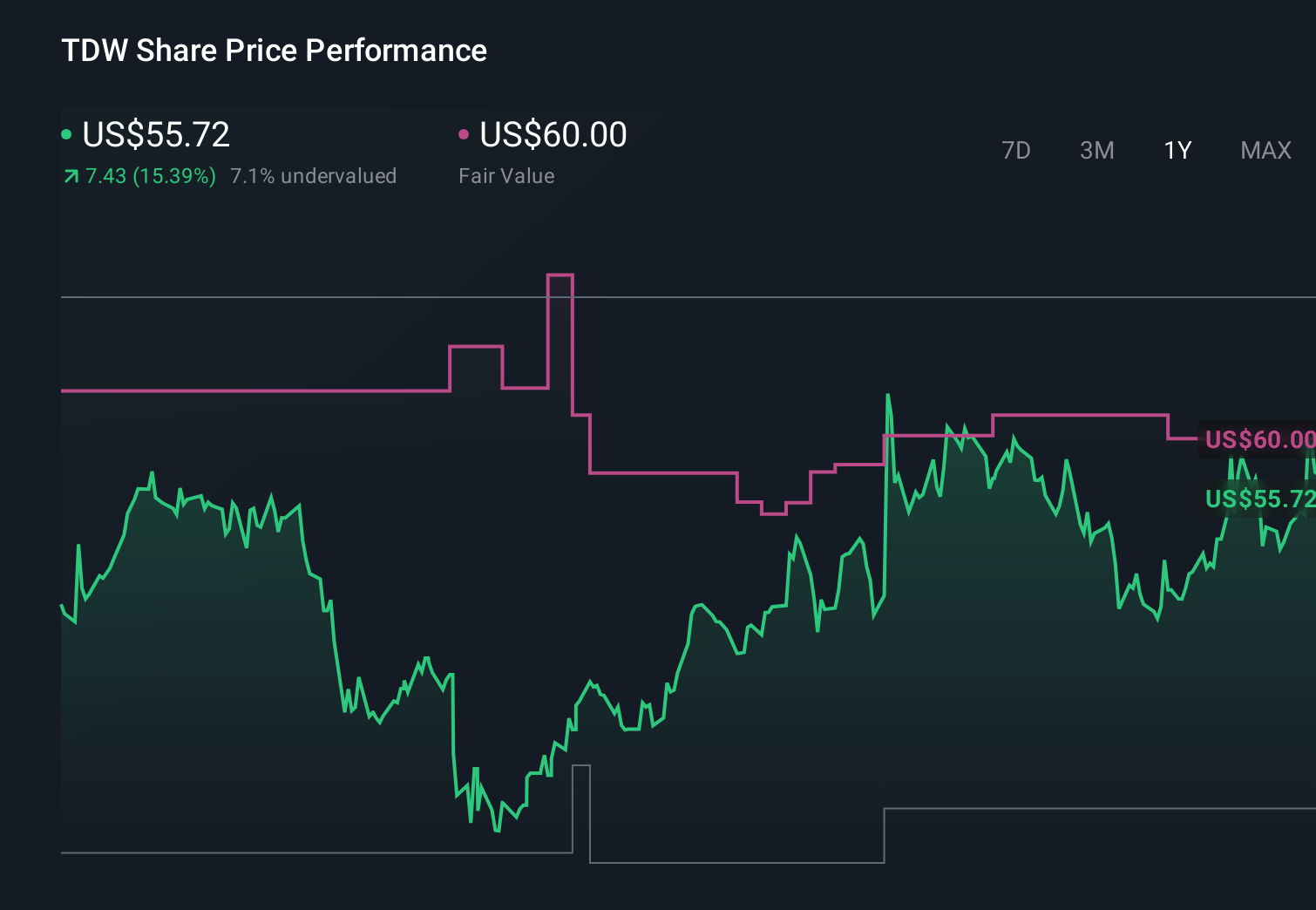
By contrast, the most pessimistic analysts were already modeling slower growth, with revenue reaching only about US$1.6 billion and earnings near US$247 million by 2029, so this index shift could either reinforce their caution or prompt a rethink of how Tidewater’s risk and return profile is evolving.
Explore 2 other fair value estimates on Tidewater – why the stock might be worth as much as 29% more than the current price!
Decide For Yourself
Disagree with existing narratives? Extraordinary investment returns rarely come from following the herd, so go with your instincts.
- A great starting point for your Tidewater research is our analysis highlighting 4 key rewards that could impact your investment decision.
- Our free Tidewater research report provides a comprehensive fundamental analysis summarized in a single visual – the Snowflake – making it easy to evaluate Tidewater’s overall financial health at a glance.
Curious About Other Options?
Don’t miss your shot at the next 10-bagger. Our latest stock picks just dropped:
This article by Simply Wall St is general in nature. We provide commentary based on historical data
and analyst forecasts only using an unbiased methodology and our articles are not intended to be financial advice. It does not constitute a recommendation to buy or sell any stock, and does not take account of your objectives, or your
financial situation. We aim to bring you long-term focused analysis driven by fundamental data.
Note that our analysis may not factor in the latest price-sensitive company announcements or qualitative material.
Simply Wall St has no position in any stocks mentioned.
Valuation is complex, but we’re here to simplify it.
Discover if Tidewater might be undervalued or overvalued with our detailed analysis, featuring fair value estimates, potential risks, dividends, insider trades, and its financial condition.
Have feedback on this article? Concerned about the content? Get in touch with us directly. Alternatively, email [email protected]
Source: Original Article