















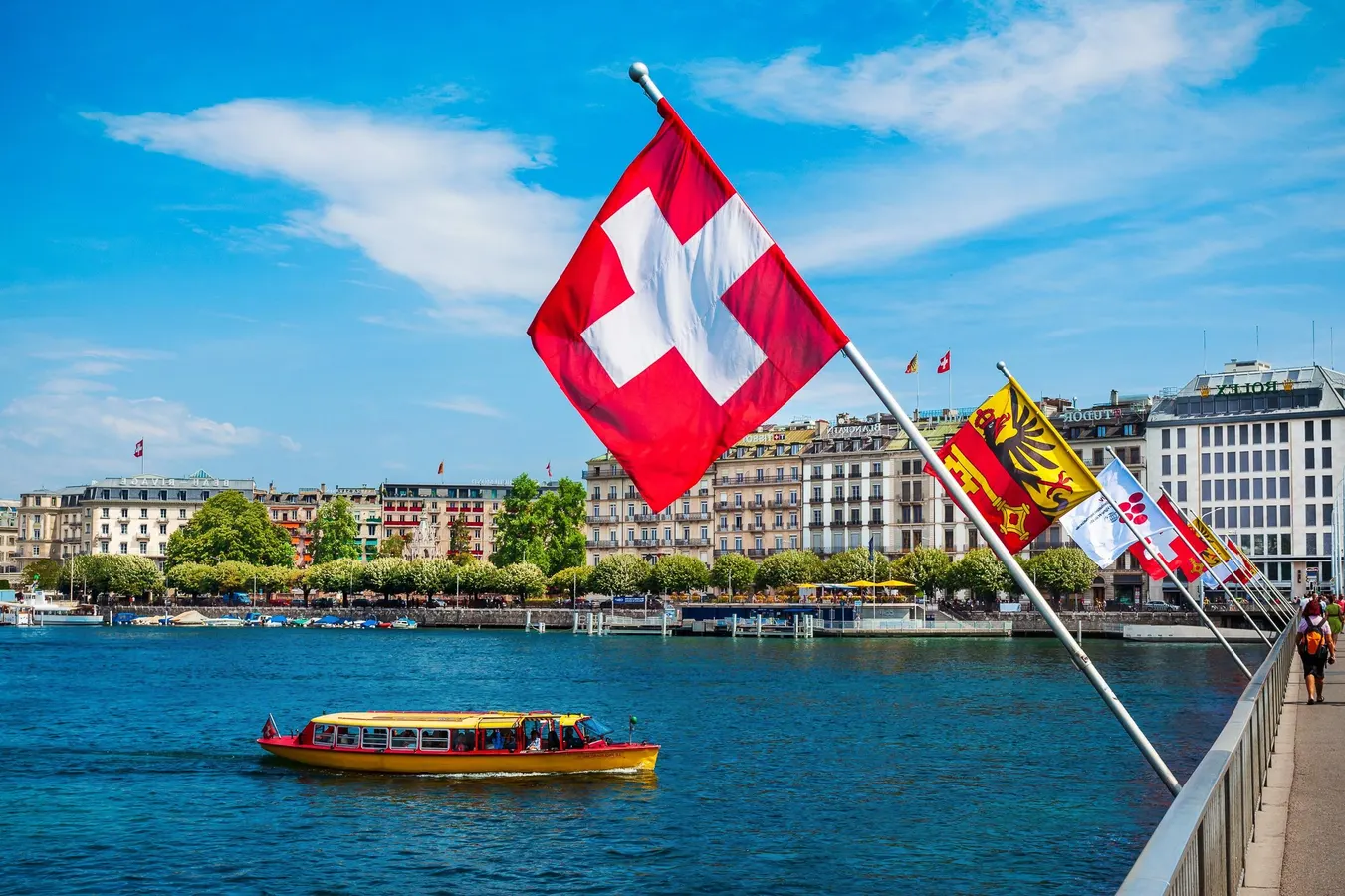
Geneva—where culture and commodities connect. Switzerland’s banking infrastructure continues to attract global talent, and the lifestyle markers they expect.
Shutterstock
In an era defined by geopolitical uncertainty and supply-chain disruption, control of physical commodities has never been more crucial. Despite its modest size, Geneva (pop. around 200,000) has become one of the planet’s leading bases for commodity trading.
The city’s rise began in the 1970s, when innovative trade-finance structures developed by Geneva bankers transformed the financing of physical commodities. One of the key figures was Christian Weyer, a young French banker at the Geneva branch of Banque de Paris et des Pays-Bas (Paribas), who pioneered the use of letters of credit secured against physical goods. This allowed traders to finance enormous commodity flows with limited equity, creating the foundations for a new model of global trading and helping establish Geneva as the operational nerve center of the industry.
As Sébastien Gentilini, director of operations at luxury property agency FGP Swiss & Alps, notes, “The banking infrastructure preceded and attracted the traders—not the other way around.”
With a permanent resident population of just over 200,000, Geneva punches well above its local weight in international influence and wealth migration.
Shutterstock
Today, Swiss-based commodities firms such as Cargill, Vitol, Trafigura, Mercuria and Gunvor handle roughly one-third of global oil trading, around 60% of metals trading and significant shares of agricultural commodities. Many of them are based in a relatively compact stretch of offices around the famous lake.
And together, these firms anchor a dense trading ecosystem. The Geneva Trading & Shipping Association represents more than 400 member companies alone, while the Commodity Trading Club, led by Julien Arbace, brings together around 60 companies active across commodity trading, trade finance, shipping and logistics.
Between 2021 and 2024, a commodities boom… pushed global trading margins to nearly $150 billion in 2022.
Between 2021 and 2024, a commodities boom, partly caused by pandemic disruption and the war in Ukraine, pushed global trading margins to nearly $150 billion in 2022. In Geneva, that surge was best illustrated by Vitol, whose profits rose from $2.3 billion in 2019 to a record $15.1 billion in 2022. For its part, Trafigura generated around $7 billion in its 2022 financial year.
The economic spillover has been profound, generating tax revenues, high-value jobs—and creating one of Europe’s wealthiest urban economies. And that concentration of capital and talent has reshaped daily life in the city.
The Woodward, an Auberge hotel, opened in 2021 as an all-suite five-star property. Its exclusive Club Woodward private club offers three membership tiers across spa, dining and social events.
©Romain Réglade
An influx of entrepreneurs and expat wealthy families have flocked here, attracted by a stunning lifestyle destination and the remarkable volume of luxury hospitality in residence here. The city offers 13 five-star hotels and 14 Michelin-starred restaurants, alongside high-end real estate, private aviation, elite private schools—including the International School of Geneva (Ecolint), Florimont and Collège du Léman—and a growing network of premium wellness and private clubs. Destinations such as Club Woodward at The Woodward hotel even combine wellness, fine dining and discreet social spaces for an international clientele. Naturally, there’s world-class skiing nearby too.
The result: a hybrid culture that seamlessly integrates business and leisure – a serious financial nerve center that also delivers an exceptional quality of life and some impactful networking. For those dealing in billions and earning millions, the bar is high.
For Cathelene Gelin, a real estate agent with FGP Swiss & Alps, the impact has been particularly visible in Geneva’s residential market. “In the high-end property segment, my clients are primarily senior executives, entrepreneurs and professionals working in finance, family offices and commodities trading.”
Geneva’s famous Jet d’Eau fountain is a symbol of life on the lake. Outdoor living is easy here, with some of the world’s top boat and golf clubs. And take your pick of nearby high-end ski resorts.
Shutterstock
Geneva recorded CHF284 million in residential transactions above CHF20 million by 2023, with commodity traders accounting for roughly one-third of buyers.
The importance of Lake Geneva as a favored location cannot be understated: beyond its natural beauty, it connects business districts, luxury hotels, residential neighborhoods, sailing clubs, golf clubs, promenades and restaurants. Combined with more than 300 hectares of green space and extensive greenery across the wider urban area (not for nothing is Geneva known as “the City of Parks”), it creates a rare balance between commercial influence and everyday tranquility.
The Promenade de la Treille invites quiet moments and impromptu meet-ups on the world’s longest wooden bench.
Shutterstock
“We’re witnessing a marked shift towards quiet luxury,” says Gelin. “Clients are moving away from ostentation and placing greater value on comfort, privacy, security and ease of management.”
Geneva is also in a growth phase. The canton’s economy is forecast to grow 1.2% in 2026, while inflation is expected to remain under control at 0.4%. The city is investing CHF 50 million up to 2029 in ecological infrastructure and upgrading green mobility via the Léman 2030 rail project.
“Clients are moving away from ostentation and placing greater value on comfort, privacy, security and ease of management.”
Tourism momentum is surging too, not least because Geneva hosted five matches at UEFA Women’s Euro 2025, while the city is expanding even further into luxury watchmaking, fine jewelry and artificial intelligence. “It makes Geneva a serious candidate for a new role—a capital of digital trust,” says Gelin.
The cradle of watchmaking, Geneva is home to the world’s finest timepiece brands, including Patek Philippe, Vacheron Constantin and Franck Muller—renowned for its innovative designs, exceptional craftsmanship and high complications. A stalwart in an emerging “capital of digital trust.”
Shutterstock
The geographical advantages remain equally compelling. Geneva Airport provides access to 297 ski resorts, including Chamonix, Megève, Verbier and Zermatt, with several leading destinations reachable within 90 minutes.
“New residents can operate at the center of major international and economic issues while enjoying a calm daily life, close proximity to the lake and mountains, excellent schools, political and legal stability and a highly protected private life,” says Gelin.
For her, Geneva represents “a rare paradox, a city with global influence that retains a human scale… in my view, this ability to evolve without losing its identity is the very essence of Geneva’s enduring appeal.”
FGP Swiss & Alps is a founder member of Forbes Global Properties, the invitation-only network of top-tier brokerages worldwide and the exclusive real estate partner of Forbes.
Source: Original Article