





















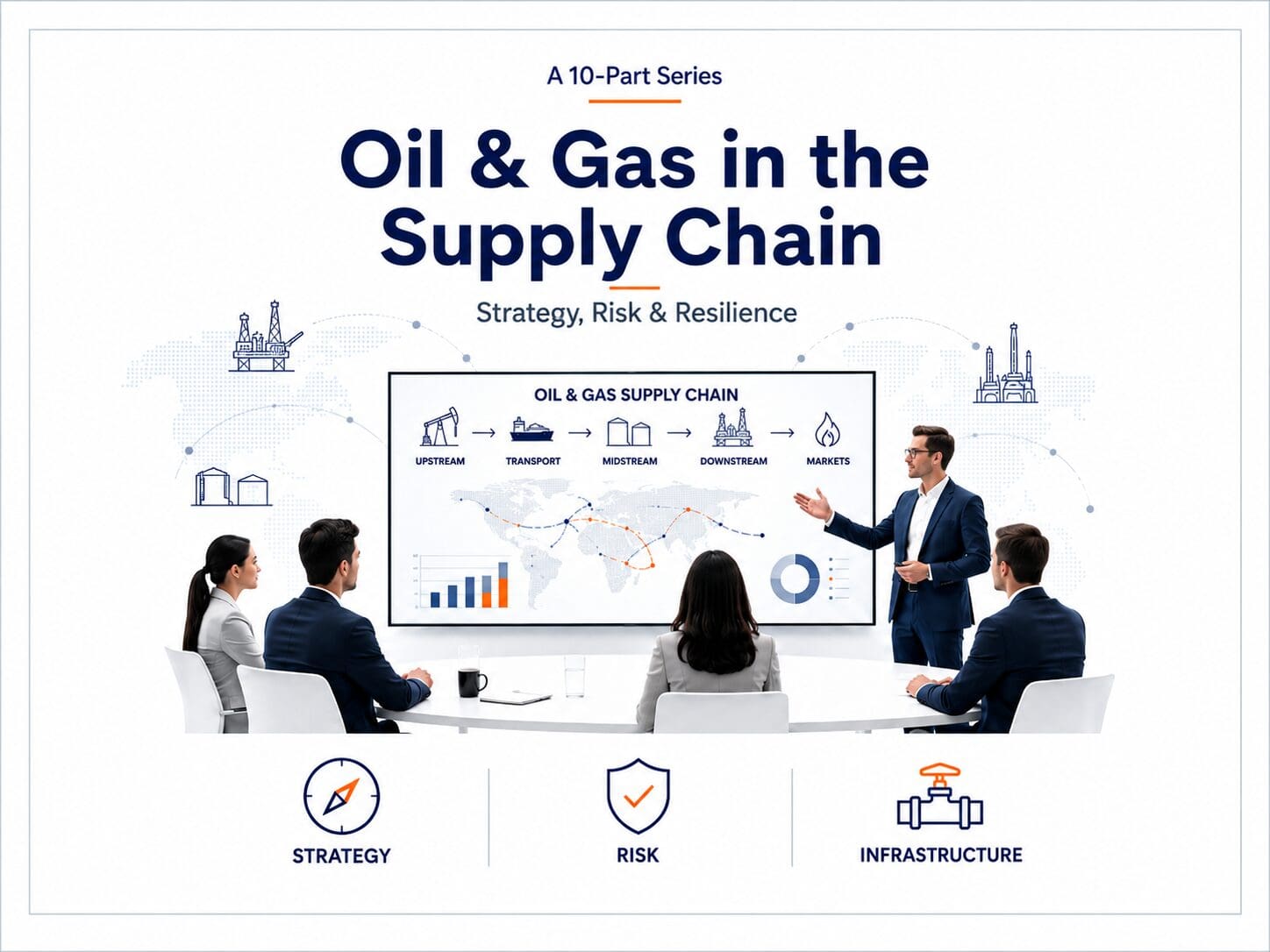
Oil and gas supply chains are entering a new stage of competition. The industry will continue to produce, process, transport, store, and deliver molecules. But the basis of advantage is changing. The winners will not be defined only by reserves, assets, or access to capacity. They will be defined by their ability to command the supply chain as an integrated system.
That shift matters because oil and gas networks sit at the intersection of energy security, industrial productivity, financial performance, environmental accountability, and geopolitical resilience. A disruption in one part of the network can quickly affect production, refining, terminal operations, customer fulfillment, and commercial exposure. A gap in emissions measurement can limit market access or weaken customer confidence. A lack of logistics optionality can turn volatility into lost margin.
The future belongs to companies that can see across the network, understand constraints in real time, act before disruptions escalate, and connect operating decisions with commercial and environmental outcomes.
The New Lens of Competitiveness
Oil and gas supply chain competitiveness now has four reinforcing dimensions: economic, operational, environmental, and strategic.
Economic competitiveness is still fundamental. Companies must lower cost, improve margin capture, strengthen inventory control, preserve optionality, and respond faster to commercial opportunities. In volatile markets, the ability to redirect flows, rebalance inventories, or use alternate logistics paths can protect value that would otherwise be lost.
Operational competitiveness is equally important. Higher uptime, more reliable scheduling, faster disruption response, better maintenance planning, and more dependable customer fulfillment are now central to supply chain performance. The operating network must be managed as a connected system rather than as a sequence of handoffs.
Environmental competitiveness is becoming a market requirement. Lower emissions intensity, rigorous methane control, credible product-level carbon data, and regulatory readiness are no longer separate sustainability initiatives. They are increasingly tied to customer requirements, investor expectations, and license to operate.
Strategic competitiveness links supply chain performance to trust. Customers want reliable supply. Investors want disciplined risk management. Regulators and communities want measurable performance. Policy uncertainty and market fragmentation make resilience and transparency more valuable. The companies that master these dimensions will not merely endure volatility; they will use volatility to their advantage.
Digital Control Towers Become Operating Infrastructure
The digital control tower is becoming the command system for the oil and gas supply chain. In many industries, control towers began as visibility tools. In oil and gas, the concept is evolving into a broader operating infrastructure that connects production, processing, pipelines, storage, refining, terminals, marine logistics, rail, truck distribution, maintenance, inventory, emissions, commercial exposure, and customer commitments.
This integrated view changes the management model. Instead of reacting to late signals from disconnected functions, leaders can understand what is happening, what matters, what is constrained, what is at risk, and what options are available. A control tower does not eliminate volatility. It allows the enterprise to respond with more discipline and precision.
The practical value lies in decision quality. If a pipeline constraint emerges, what are the downstream implications for storage, refinery feedstock, customer delivery, and commercial positions? If weather threatens marine logistics, what alternate routing or inventory actions are available? If a facility experiences a maintenance issue, what is the effect on emissions, throughput, and contractual commitments? These questions require more than dashboards. They require connected data, cross-functional workflows, and decision support.
What Leaders Do Differently
Leading oil and gas companies are not treating supply chain modernization as a series of isolated technology projects. They are building the organizational capability to manage the enterprise as an integrated network.
- They map supply chain flows end to end, from upstream production through midstream infrastructure, downstream operations, logistics, and customer delivery.
- They integrate operational and commercial data so that physical constraints are visible in business decisions.
- They measure methane and carbon with greater rigor and connect emissions data to products, assets, and customer requirements.
- They design for resilience by building optionality in routes, modes, storage, suppliers, energy sources, and operating plans.
- They invest in digital control towers, analytics, AI, and digital twins where these tools improve high-value decisions.
- They modernize field logistics, maintenance planning, supplier visibility, and asset support processes.
- They collaborate across the ecosystem, recognizing that resilience and traceability often require shared data and coordinated action.
The advantage compounds over time. Better data improves visibility. Better visibility improves planning. Better planning improves resilience. Better resilience improves customer trust and commercial performance. Each capability makes the next one easier to build.
Energy Security and Energy Transition Are Connected
The future of oil and gas supply chains is often framed as a choice between energy security and energy transition. That is too simple. Industrial economies require reliable oil and gas supply. They also require lower-emission operations, better measurement, and more responsible infrastructure.
Oil and gas companies that reduce methane emissions, improve energy efficiency, electrify operations where practical, integrate renewables where they make operational sense, and provide transparent product-level data will be better positioned in a changing market. These actions are not only environmental. They can also improve reliability, reduce waste, strengthen customer relationships, and support regulatory readiness.
This is especially important because customers are becoming more sophisticated. They are not only asking whether supply is available. They increasingly want to understand the reliability, traceability, and emissions profile of that supply. In that environment, emissions traceability becomes a market access capability. The ability to verify claims with credible data can become as important as the ability to deliver physical product.
The Board-Level Narrative
For boards and investors, the oil and gas supply chain story should be framed around business value. The strategic case is not simply about environmental positioning or digital modernization. It is about risk, margin, growth, asset value, and license to operate.
Risk reduction is a core benefit. Integrated supply chain command helps insulate operations from infrastructure shocks, weather events, cyber risk, supplier failure, logistics constraints, and market disruption. The goal is not to predict every event. The goal is to detect risk earlier and respond with better options.
Margin protection comes from connecting commercial decisions to physical reality. Optionality, inventory discipline, bottleneck management, and logistics execution all influence realized margin. When companies understand constraints earlier, they can make better decisions about production, storage, routing, and customer commitments.
Growth enablement depends on serving customers that require reliable supply, traceable lower-emission products, and long-term confidence. Companies that can provide that assurance may be better positioned for strategic customer relationships.
Asset valuation can also be affected. Resilient, digitally visible, emissions-accountable operations are more transparent and potentially more valuable than assets with opaque risk profiles or weak data foundations.
License to operate is increasingly tied to measurable performance. Regulators, investors, customers, and communities want evidence, not assertions. Supply chain data will play a growing role in providing that evidence.
The Maturity Curve
Most oil and gas companies will move through a maturity curve as they build supply chain command capability.
1. Awareness
At this stage, leaders recognize that oil and gas supply chains are integrated risk and value networks. The organization begins to move beyond functional optimization and acknowledges that upstream, midstream, downstream, logistics, maintenance, commercial, and environmental decisions are connected.
2. Measurement
Companies then build visibility into flows, assets, inventories, emissions, constraints, suppliers, and critical risks. This is the foundation. Without reliable measurement, advanced analytics and automation will produce limited value.
3. Integration
The next step is connecting systems and processes across upstream, midstream, downstream, LNG, petrochemicals, logistics, maintenance, commercial planning, and emissions management. Integration allows teams to see cause and effect across the network.
4. Optimization
With integrated data, companies can use analytics, AI, and digital twins to improve routing, scheduling, maintenance, inventory, production planning, refining operations, terminal capacity, emissions management, and customer commitments. The focus should remain on better decisions, not technology deployment for its own sake.
5. Leadership
At the highest level, companies monetize resilience, traceability, optionality, network intelligence, lower-emission performance, and digital control. They use supply chain command as a source of strategic differentiation.
The key measure of progress is not how many tools have been deployed. It is how many decisions have improved, how quickly the organization can act, and how consistently performance can be verified.
Executive Takeaways
Oil and gas supply chains are now strategic infrastructure. Visibility is margin protection. Methane and carbon traceability are market access capabilities. Field logistics modernization remains a significant value lever. Power strategy belongs inside supply chain strategy. Digital control towers are becoming core operating infrastructure. Resilience is not insurance; it is customer reliability. Collaboration will determine the pace of transformation. Data quality is now a competitive differentiator.
The modern oil and gas enterprise does not merely produce and transport energy. It must command flows, assets, data, emissions, infrastructure, risk, partnerships, and customer commitments. That is the next frontier of supply chain leadership: moving molecules and information with equal precision, managing volatility with discipline, verifying claims with data, and converting operational complexity into strategic advantage.
The companies that do this well will not only remain relevant in the energy transition. They will help define it.
To learn more, Download the full ARC Advisory Group white paper on oil and gas supply chain transformation.
AI Is Reshaping Supply Chain Execution. Here’s What Comes Next.
Two ARC Advisory Group white papers on the next stage of AI in supply chain operations.
AI is moving beyond isolated copilots and technical architecture into coordinated operational decision systems. This ARC Advisory Group white paper explains how supply chain AI is shifting from capability to execution, where context, governance, workflows, thresholds, and action pathways determine whether AI improves real decisions across planning, logistics, sourcing, fulfillment, and risk management.
Download Our Featured White Paper:
AI in the Supply Chain Part II: From Architecture to Execution – Defining the Decision Intelligence Layer in Modern Supply Chain
Download Our Foundational White Paper:
AI in the Supply Chain: Architecting the Future of Logistics with A2A, MCP, and Graph-Enhanced Reasoning
Explore Our Domains
Planning, Execution & Visibility | Transportation & Logistics Operations | Warehousing, Fulfillment & Automation | Global Trade & Compliance | AI & Advanced Analytics | Data, Integration & Interoperability | Supply Chain Platforms | Risk & Resilience | Sustainability & ESG
Independent ARC research for supply chain leaders and technology decision-makers.
Source: Original Article