









Tuesday, September 1, 2026
No Result
View All Result
  • Home
  • Market Overview
    • All
    • Crude Oil Prices
    • Cryptocurrency News
    • Economy News
    • ETFs
    • Foreign Exchange News
    • Indices
    • Stock Market

    UN Food Security Report Finds $540BN in Farm Subsidies Locked Into Commodities That Crowd Out Plant Foods – vegconomist

    AEGIS Hedging to Be Acquired by Private Equity at Goldman Sachs Alternatives

    Glencore plans large LME lead withdrawals after stocks surge, sources say

    AI Turns Competence into a Commodity: Evidence from 2.26 Million Freelance Contracts

    JPMAM adds commodities to lagging multi-asset strats

    New Houthi maritime strikes keep European gas futures pinned near multi-month peak

    • Crude Oil Prices
    • Cryptocurrency News
    • Economy News
    • ETFs
    • Indices
    • Stock Market
    • Foreign Exchange News
    • Commodities News
  • Forex Market
    • All
    • Central Banks News
    • Currencies
    • Interest Rate
    • Nonfarm Payroll

    The Week Ahead: August Nonfarm Payrolls Data Incoming, Broadcom, Dell, Palo Alto Earnings Set for Release

    Gold outlook hinges on Warsh speech as hawkish Fed stance may weigh | Markets News

    Nonfarm employment declined by 23,000 in July, with the unemployment rate rising to 4.1 percent, signaling a slowdown in the job market

    Peso may rebound after weak US payrolls report

    Gold Price Forecast: Cooling Fed Rate Hike Expectations Boost Appeal as Price May Hit $4,500?

    Forex Today: Market Focus Shifts from Middle East to US Nonfarm Payrolls

    Summertime job market remains muggy

    US labor market shows signs of weakness! July nonfarm payrolls unexpectedly decrease by 23,000; May and June data revised down sharply. Fed rate hike expectations cool down.

    Nonfarm payrolls down in July; unemployment rate eases to 4.1%

    • Central Banks News
    • Currencies
    • Interest Rate
    • Nonfarm Payroll
  • Commodities
    • All
    • Gold
    • Oil and Gas
    • Silver

    Silver Outlook: VC PMI and Cycle Date Analysis Point to Next Bullish Opportunity

    Silver analysis today

    Gold and Silver Market Correction 2026: Is the Bull Market Over?

    Silver Tracking Industrial Demand as Manufacturing and Inflation Shape Markets

    Silver VC PMI Outlook: Buy-Level Support Targets $61.51 Weekly Resistance

    Silver Tests Critical VC PMI Demand Zone as Cycle Window Hints Potential Reversal

    • Gold
    • Oil and Gas
    • Silver
  • Crypto
    • All
    • Bitcoin
    • Ethereum
    • Litecoin
    • Ripple
    • Solana
    • XRP

    Litecoin Price Prediction: Is LTC Heading Toward $40 After Trendline Breakdown?

    Ripple Launches Ripple Mint for Institutional RLUSD Access

    Litecoin Approaches Descending Channel Breakout as Technical Momentum Builds

    Ripple Launches Institutional Mint Platform for RLUSD Amid Transfer Volume Drop

    The ripple effects of farming injuries

    Litecoin Price Risks Drop to $35 if $43 Support Breaks

    • Bitcoin
    • Ethereum
    • Litecoin
    • Ripple
    • Solana
    • XRP
  • Charts
  • Economic Calendar
  • FX Analysis
    • EUR/USD
    • GBP/USD
No Result
View All Result
Home Market Overview
2 months ago

Why the stock market and economy may seem out of sync

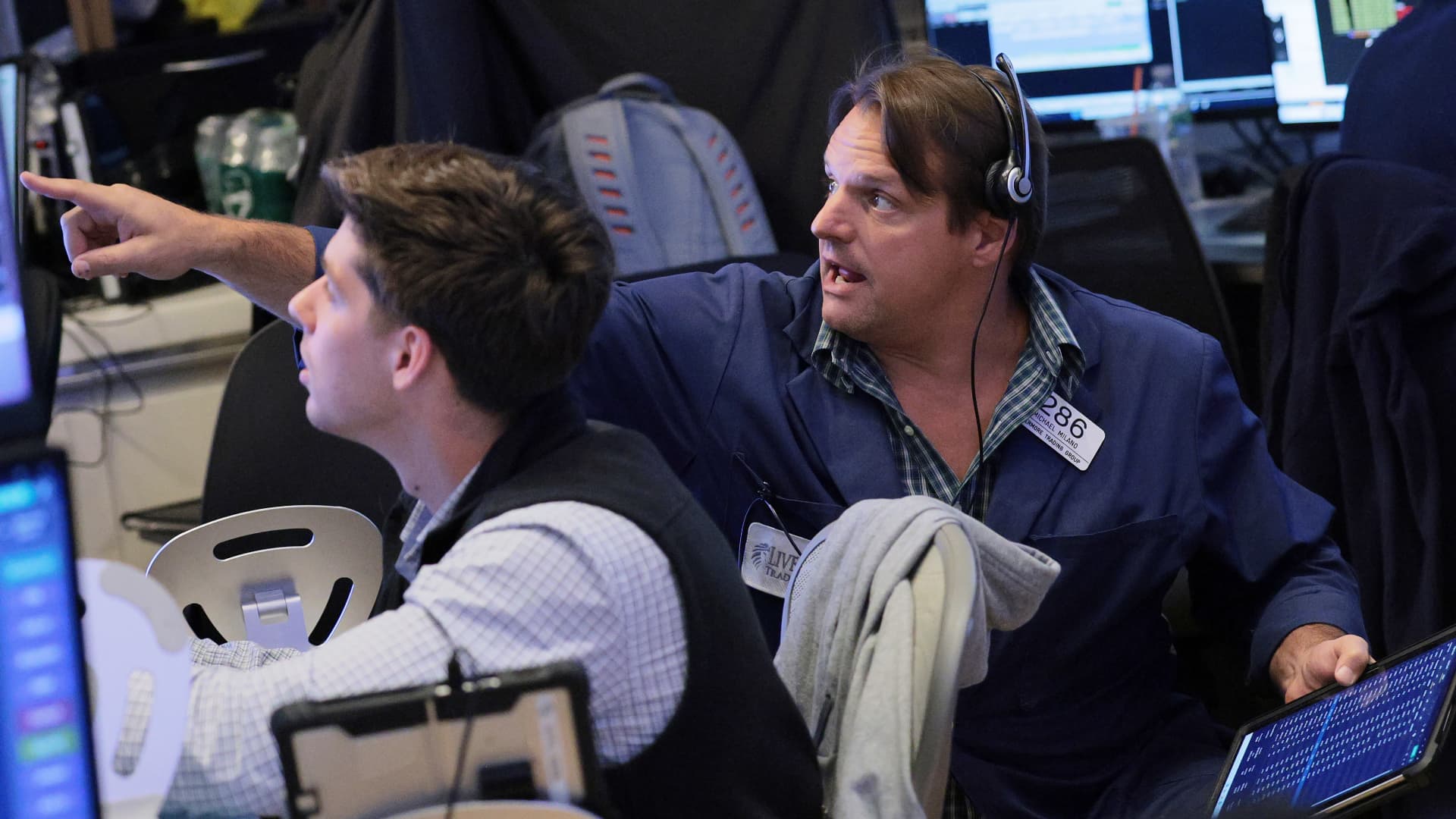
Traders work on the floor of the New York Stock Exchange during morning trading on July 08, 2026 in New York City.

Michael M. Santiago | Getty Images

Stocks were off to a blistering pace in the first half of the year. Meanwhile, the U.S. economy‘s trajectory is more tepid, somewhat divorced from that of stocks, economists said.

That disconnect may be confusing to consumers and investors who assume the stock market and economy mirror one another, moving in lockstep.

“I think there’s this widespread perception the two should be in sync,” said Joe Seydl, a senior markets economist at J.P. Morgan Private Bank.

“But, from a purely analytical perspective, they’re two very different phenomena,” Seydl said. “We’re talking about apples and oranges in many ways.”

Stock market and economy diverge

Read more CNBC personal finance coverage

Meanwhile, “real” U.S. gross domestic product — a measure of economic output, after inflation — has decelerated from about 3.3% in 2023 to roughly 1.9% so far in 2026, Seydl said.

To be sure, the state of the U.S. economy isn’t necessarily poor. The pace of growth has been “steady,” Seydl said.

Mark Zandi, chief economist at Moody’s, characterized GDP growth around 2% as “soft,” though. It’s roughly flat from last year, he said.

“We’re growing. We’re not in recession,” Zandi said. “But we’re not going anywhere quickly.”

OpenAI CEO Sam Altman on whether the company will go public this year: 'I don't know'

Federal Reserve officials in June estimated the economy would grow at a 2.2% pace in 2026. Consensus among economists is largely concentrated around a 2% growth forecast for the year, Zandi said.

Meanwhile, the labor market is showing weakness, Zandi said. Labor force participation is near its lowest level in about 50 years outside of the Covid-19 pandemic. Employers are hiring at their slowest pace in more than 10 years, excluding the pandemic. Long-term unemployment has risen steadily.

Additionally, consumer sentiment tumbled to a record low in May amid fears of higher inflation, according to the University of Michigan’s Surveys of Consumers. Sentiment rebounded somewhat in June, though remains “unfavorable,” it said.

The stock market and economy generally “travel together” but sometimes “deviate quite significantly,” Zandi said.

“And this is one of those times,” he said.

Why the divergence?

Artificial intelligence seems to be the main reason for the divergence, economists said.

The stocks of AI companies have gone “skyward” and buoyed the broader stock market, Zandi said.

Technology accounts for about 35% of the stock market, and roughly 50% when considering an expanded technology group that also includes Alphabet, Amazon, Meta and Tesla — which are classified as consumer companies but trade like Big Tech, Seydl said.

Stocks generally trade based on future expectations of company performance — and, in the current environment, investors are incredibly bullish on the earning potential of technology companies, particularly those in the AI realm.

“The rise in earnings has been concentrated in the major ‘big-tech’ firms, especially the semiconductor companies and hyperscalers” that underpin AI infrastructure, Capital Economics said in a July 1 research note.

Hyperscalers like Microsoft, Amazon and Oracle provide cloud computing infrastructure, while semiconductor companies like Intel, TSMC and Samsung manufacture AI chips, it said.

Those two sets of companies account for almost two-thirds of the growth in S&P 500 earnings since the end of 2022, shortly after OpenAI released its free version of ChatGPT to the public, it said.

We are not in an AI bubble, says Ed Yardeni

Meanwhile, technology only accounts for about 10% to 15% of the U.S. economy, Seydl said.

The U.S. economy is instead powered by consumer spending, which makes up about 70% of GDP, Seydl said.

While consumer spending remains strong — which is good for the economy — it’s increasingly propped up by high-earning households — a dynamic that threatens to sink the economy if things go sideways, economists said.

Households in the top 20% — those with incomes of about $200,000 or more — account for nearly 60% of personal outlays, up from about half in the early 1990s, according to a Moody’s analysis published in June and authored by Zandi.

We’re talking about apples and oranges in many ways.

Joe Seydl

senior markets economist at J.P. Morgan Private Bank

Spending among the top 20% grew by about 4% after inflation in Q1 2026, while that of the bottom 80% was unchanged, he wrote. This so-called K-shaped dynamic has persisted since the pandemic, he wrote.

Wealthy households hold the vast majority of stocks — and tend to spend more liberally when the market is booming, economists said. This is due to the “wealth effect”: They feel richer and spend more as a result.

If investors were to sour on the AI investment thesis and the stock market were to suffer a prolonged drawdown, it could be bad news for the economy if the wealthy pull back on spending, economists said.

There are also pressures beyond AI, such as the prospect of war resuming between the U.S. and Iran. Inflation also remains well above the Fed’s target, pressuring household budgets.

“If AI stocks hit a skid, the economy would be in big trouble because of how soft it is,” Zandi said. “It’s a very fragile, tenuous place to be.”

Choose CNBC as your preferred source on Google and never miss a moment from the most trusted name in business news.

Source: Original Article

RelatedPosts

Market Overview

UN Food Security Report Finds $540BN in Farm Subsidies Locked Into Commodities That Crowd Out Plant Foods – vegconomist

July 22, 2026
Market Overview

AEGIS Hedging to Be Acquired by Private Equity at Goldman Sachs Alternatives

July 22, 2026
Market Overview

Glencore plans large LME lead withdrawals after stocks surge, sources say

July 22, 2026
Forex Market

Gold Price Forecast: Cooling Fed Rate Hike Expectations Boost Appeal as Price May Hit $4,500?

August 9, 2026
Forex Market

Forex Today: Market Focus Shifts from Middle East to US Nonfarm Payrolls

August 7, 2026
Forex Market

Summertime job market remains muggy

August 7, 2026
Forex Market

US labor market shows signs of weakness! July nonfarm payrolls unexpectedly decrease by 23,000; May and June data revised down sharply. Fed rate hike expectations cool down.

August 7, 2026
Next Post

OKX, MetaMask, Matter Labs back dispute resolution court for AI agents

How Removal from Key Russell Growth Indices Will Impact Apollo Commercial Real Estate Finance (ARI) Investors

Should Teradyne’s Shift Into Russell Growth Indices Require Action From Teradyne (TER) Investors?

Market News Board | Market Analysis,Charts & News

MarketNewsBoard delivers trusted financial news, real-time market analysis, interactive charts, and economic insights across the global financial markets.

Covering Forex, Commodities, Stocks, Indices, Cryptocurrencies, and major economic events...

Market Overview

  • Forex Market
  • Commodities
  • Cryptocurrency News
  • Stocks
  • Indices
  • Crude Oil Prices
  • Economic Calendar

Resources

  • Central Banks News
  • Economy News
  • Interest Rate
  • Nonfarm Payroll
  • Charts

Tools

  • Currency Heat Map
  • Correlation Matrix
  • Market Sentiment
  • Currency Cross Rates
  • Crypto Rates
  • About Us
  • Contact Us
  • Disclaimer
  • Privacy Policy
  • Terms and Conditions

© 2026 MarketNewsBoard | Market Analysis, Charts & News.

AAPL
$316.85
AMZN
$259.77
BTC-USD
$78,685.11
EURUSD=X
$1.16
DX-Y.NYB
$99.52
NVDA
$220.78
TSLA
$367.95
DOW
$30.52
^N225
$66,236.05
JPY=X
$159.83
GBPUSD=X
$1.35
CAD=X
$1.39
NG=F
$2.92
BZ=F
$88.89
NFLX
$81.05
GOOG
$335.41
MSFT
$507.29
^RUT
$2,956.45
^FTSE
$10,824.26
AUDUSD=X
$0.717
CHF=X
$0.81
HG=F
$6.71
ETH=F
$2,481.00
No Result
View All Result
  • Home

© 2026 MarketNewsBoard | Market Analysis, Charts & News.