![The 87% Gold breakout setup [Video]](https://marketnewsboard.com/wp-content/uploads/2026/07/gold-march-05_Medium-360x180.jpg)

















Review
The monthly jobs report showed that the labor market softened in June. The U.S. economy added 57,000 jobs in June, versus 113,000 expected, while the unemployment rate ticked down to 4.2% in June from 4.3% in May. June’s job growth numbers snapped a three-month streak of job growth over 100,000. The numbers also eased significantly from a revised 129,000 jobs added in May.
—Emma Ockerman and Grace O’Donnell, “June Jobs Report: U.S. Labor Market Slows From a Sprint to a Jog,” Yahoo Finance, July 2, 2026.
Federal Reserve Chair Warsh seems keen to encourage more uncertainty by offering little useful policy guidance. Warsh did suggest broadening the range of data sources the Fed uses—because official data is less reliable. This is a good thing, but it does require intelligent understanding that alternative sources also lack precision. Warsh [also] reiterated a belief in the productivity pixie, suggesting artificial intelligence could be a strong automatic disinflation force. This belief is troubling (because it is not true). Any new technology is a relative shock, lowering some prices and raising others (see Apple iPad pricing for details).
— Dr. Paul Donovan, “Policy and Data Problems,” Morning Audio Comments, UBS, www.ubs.com/cio, July 2, 2026.
It was that kind of a week—the unexpected kind that you might actually expect in a shortened holiday trading week if you also understand the nature of Mercury retrograde. The “trickster,” notorious for false hopes and contradictory buy-and-sell signals, began its retrograde on Monday, June 29. This was compounded by the fact that the heliocentric position of Mercury was also in the volatile sign of Sagittarius, June 25–July 6. Thus, some financial markets made new all-time highs while others sank to multi-month and even multi-year lows. And then some of those suddenly reversed. It was also not surprising that several instances of bullish or bearish divergences were exhibited within markets of the same sector, where some made new lows or highs for their primary cycle, but not all followed the same script. Are those new highs or lows to be trusted? The trickster would argue otherwise.
In Asia and the Pacific Rim, only India’s Nifty index rallied smartly to a new 8-week high on Friday, July 3. The star of this region has been the Japanese Nikkei, but its all-time high was a week earlier on June 22. The Hang Seng of Hong Kong, on the other hand, rallied modestly after posting a new yearly low on Friday, June 26. China’s Shanghai Composite (SSE) and Australia’s ASX are doing the typical Mercury retrograde shuffle of changing directions every 1–4 trading days within a rather tight congestion zone (no new monthly highs or lows).
European equity markets were surprisingly strong with both the German Stock Market (DAX) and Swiss Market Index (SMI) soaring to new all-time highs on Friday, July 3. However, these were not accompanied by new highs in either the London FTSE or Amsterdam AEX indices.
Similar divergences were observed in the American stock markets. The Dow Jones Industrial Average (DJIA) rallied to a new all-time high of 52,903 on July 2. This is right within the middle of the range given in the Forecast 2026 book, written last November, of 49,400–57,750. But the NASDAQ failed to take out its all-time high of June 16 and the S&P’s all-time high of June 2 remains intact, for a strong case of intermarket bearish divergence amongst all three indices. As stated in the Forecast 2026 book, a new all-time high in each of the indices was anticipated within 2–5 months following the 50-week cycle low. That low has been confirmed as of March 30 in the DJIA, which means we look for the current high—and perhaps high of this year—to unfold between May–September. Our geocosmic markers for an all-time high were projected to occur within four months of the Jupiter convergence of July 15–25, and ideally within just two months of this most important of all geocosmic cycles in 2026. It would appear that we are now entering the time band when more caution than usual might be appropriate.
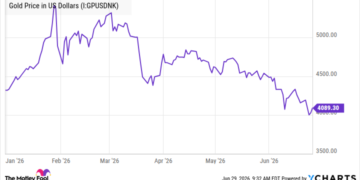
Equities were not the only interesting game in town last week, as divergences were evident across markets. Gold dropped to a low of 3955 on June 30, its lowest mark since September, during the period when heliocentric Mercury was in Sagittarius, which offsets the usual bullishness of this transit. Gold is now entering the time and price range for a longer-term cycle trough as provided in our weekly and monthly reports. Silver, however, made its multi-month low the previous week at 56.14, for a bullish divergence signal in the precious metals. But once again, can these signals be trusted with the trickster (Mercury retrograde) on the loose until July 23?
Bitcoin also plummeted to 57,775 on July 1, the lowest price since September 2024. This decline remains aligned with the cycles outlined in Forecast 2026 and updated in the recent MMA Mid-Year Market webinar. Crude Oil also dropped to a new 3-month low (67.04) on July 2 as Saturn continues to separate from Neptune and the nadir of the Aries Vortex of February 20. As pointed out before in this column and in recent webinars, the “orb of influence” of Saturn’s domination in this cosmic configuration began to lose its power as of April 7, and the themes of Neptune have begun to assert their dominance (peace over war). The control freaks of world politics are losing their grip and the pendulum is starting to swing in favor of those who protest without violence (Neptune in Aries—warriors of peace, not war, as the agents of change indicated by Neptune’s presence alone now as the midpoint of the Uranus/Pluto trine in air signs).
Short-term geocosmics
New York hit 100 degrees as a heat wave stifles the Northeast.
—The New York Times , July 2, 2026
Under Trump, you guys have two outcomes: either we win, or they cheated. That shit has to stop.”
—Bill Maher to J.D. Vance, Real Time with Bill Maher,” June 26, 2026 (YouTube clip)
The U.S. will celebrate its 250th birthday this week. And it’s not just Mercury retrograde and the trickster steering this ship into a possible party crash with Jupiter (fun) just recently entering Leo (also fun) on June 30. It’s also Mars conjunct Uranus in Gemini—the first Mars/Uranus conjunction in Gemini in about 80 years. This rare conjunction in Gemini—especially under a Mercury retrograde—deserves some attention, given that Mercury rules Gemini. So, let’s start with the Mercury and Gemini themes.
Both Mercury and Gemini pertain to matters of communication, and particularly the manner in which the mind processes and conveys information. Both Mercury and Gemini love nothing more than the giving or receiving of information, especially news and facts. But the question is: whose facts? That depends upon how the information is garnered and processed. If it is through skeptical curiosity that takes time to investigate and derive a truth, such as through research and scientific rigor, it carries more gravitas. This might be the case when Saturn or Capricorn are also involved. But that is not the case here. Instead, we find the impulsive and disruptive Mars and Uranus conjoining one another in the sign of Gemini.
Although these two planets in sync can open one up to inspired thought, invention, and unconventional thinking, it is also the case that they can be abrasive and careless with words. There can be speaking (or threatening) before thinking, thus causing animosity and combativeness rather than inspired solutions. In the hands of someone given to outbursts of anger, this aspect can be easily triggered into spewing an avalanche of hostile words. Hence, what was a period of relative calm can quickly spiral into a brawl solely based on impulsive, careless words.
In today’s world of a passive-aggressive war between the U.S. and Iran (or Russia and Ukraine, or any other countries in combat with one another), where each side accuses the others of violating the terms of an agreement, this can lead to renewed threats of bombing and destruction. However, just as quickly as the wildfire ignites, it can also suddenly burn out. The threats can be withdrawn, especially during Mercury retrograde and with Neptune on the midpoint between Uranus and Pluto. The longer-term implications signal less violence and more peace. But shorter-term, there can be flare-ups, often the result of an explosion of immature (adolescent) anger bursting out. The lesson to be learned here is to think before speaking, especially if you feel a sense of anger and resentment boiling up.
In terms of other mundane possibilities, we note the severe heat waves engulfing the world, from the Americas (North and South) to Europe. Wildfires are starting. Climate experts are predicting an El Niño pattern, which could affect the growing of crops, especially in South America. Crude Oil prices are coming down, but a flare-up in the U.S.-Iran conflict could cause a re-escalation of prices. Prolonged heat in weather patterns could also cause crop damage, leading to higher food prices. Mercury retrograde suggests the investment and trading community is looking for a reduction in inflationary pressures. The expectations of economists were off on their projections of last week’s payroll figures. They may also be off on their favorable (but price bearish) projections for future crop yields, especially given that within one year of the Saturn/Neptune conjunction (every 36 years), there are usually huge rallies in grain markets.
And related to that, we must also keep in mind that the first of five trines between Uranus and Pluto (lasting into spring 2028) will take place on July 17, followed by Jupiter in sextile to Uranus, trine to Neptune, and in opposition to Pluto, July 20-21 (the “Jupiter Convergence of 2026”). The first two aspects mentioned here are indicative of a “melt-up” in financial markets (like stocks). The last one (Jupiter/Pluto opposition) is symbolic of a financial crisis, often precipitated by a debt crisis, corporate bankruptcy, credit downgrade, or bank run. Mercury retrograde tells us markets will go up and down in quick succession. Mars conjunct Uranus in Gemini tells us that the amplitude may be greater than usual and caused by an unwise choice of words (threats, anger eruption) by a world leader.
As traders, we need to be very nimble now. As investors, try to screen out the noise and not be distracted from long-term investment goals and strategies. As conscientious human beings, make the effort to be respectful of others, control emotional outbursts, and understand that the power of your words may trigger an explosion of repressed anger in others unless expressed diplomatically. Be open to inspired thoughts that can solve problems, not create new ones. Let your mind be stimulated, not agitated. You have the choice.
Source: Original Article