



















Amman, July 18 (Petra) — Jordan’s manufacturing export base has
undergone a structural transformation, shifting from a reliance on
traditional commodities and concentrated regional markets to a
diversified portfolio of non-traditional goods, according to Jordan
Chamber of Industry (JCI) Chairman Fathi Jaghbeer.
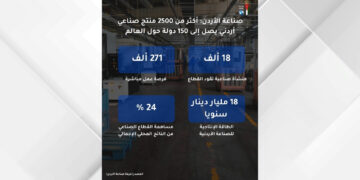
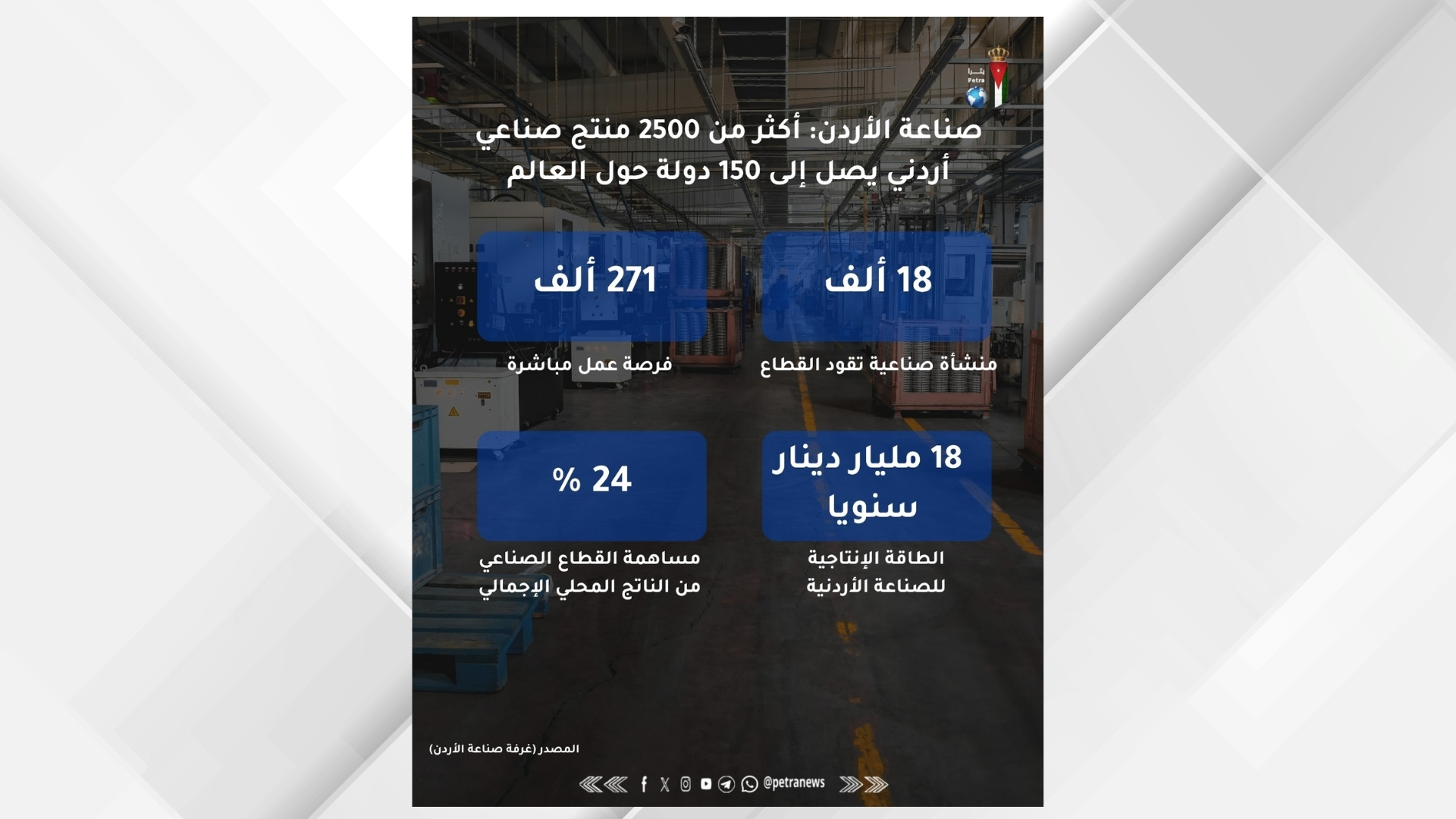
The manufacturing sector currently comprises over 18,000 operational
facilities employing 271,000 workers directly. This industrial
network manufactures approximately 2,500 products distributed across
150 international markets, generating an annual production capacity
valued at 18 billion dinars. The sector contributes 24 percent
directly to Jordan’s gross domestic product (GDP), a figure that
rises to 42 percent when calculating aggregate direct and indirect
economic impacts.
Industrial exports rose from 4.6 billion dinars in 2019 to more than
8.9 billion dinars by the end of last year, accounting for over 92
percent of total national exports. Consequently, industrial exports
covered 43 percent of total imports during this period, marking the
highest coverage ratio in the country’s economic history.
Data indicates that the number of commodities generating more than 1
million dinars in annual export value expanded to 754 goods last
year, up from 455 commodities in 2019. Within the same timeframe,
products generating over 10 million dinars in annual exports nearly
doubled, moving from 66 to 121 commodities. Higher-volume segments
also recorded growth, with goods generating over 50 million dinars
increasing from 13 to 25, and those exceeding 100 million dinars
rising from 7 to 10 commodities.
This product diversification coincided with an expansion into new
markets, supported by free trade agreements, bilateral trade
delegations, and market analysis. The number of international
destinations receiving over 100 million dinars in Jordanian
industrial exports grew from 9 markets in 2019 to 13 markets in 2025.
Destinations importing over 50 million dinars increased from 17 to 28
markets, while those exceeding 10 million dinars grew from 35 to 54.
Total export markets registering over 1 million dinars expanded from
72 to 93 countries.
The shift has been led by expansions in pharmaceuticals, chemicals,
fertilizers, value-added food processing, engineering, electrical
equipment, medical supplies, and packaging. Non-traditional
commodities-including lubricants, organic chemical products, copper
fabrications, cement, and prepared animal feeds-have increasingly
contributed to the total export volume.
JCI officials attributed this performance to coordinated
public-private sector policies, targeted international trade fairs,
and specialized programs funded through the Industry Support Fund,
which focuses on production line modernization and export readiness
aligned with the Economic Modernization Vision.
During the first four months of the current year, industrial exports
grew by 9.1 percent to reach 2.8 billion dinars, compared to 2.5
billion dinars during the same period in 2025. This growth was
distributed across all sub-sectors, offsetting declines in several
traditional regional markets.
Export data from the first four months highlighted significant
geographic shifts. Switzerland recorded the largest increase in
Jordanian industrial imports with an expansion of 118 million dinars,
followed by China at 138 million dinars, Syria at 101 million dinars,
Netherlands at 57 million dinars, Thailand at 45 million dinars, and
Belgium at 42 million dinars.
Garments and related accessories maintained the highest nominal
export volume during the first four months of the year at 517 million
dinars, followed by crude potash at 220 million dinars and
pharmaceutical preparations at 184 million dinars. Concurrently,
non-traditional sub-sectors reported rapid growth rates: lubricants
grew by 4,085 percent, organic chemicals by 938 percent, copper and
copper products by 89 percent, and cement by 84 percent.
JCI estimates indicate that Jordan’s unexploited export potential
stands at approximately 7.7 billion dollars. The chemical industries
represent the largest untapped segment at 2.9 billion dollars,
followed by the engineering sector at 1.5 billion dollars, mining at
1.1 billion dollars, leather and garments at 918 million dollars, and
therapeutics at 626 million dollars.
Additional growth capacity remains distributed across food
processing, plastics, packaging, construction materials, and
woodwork.
//Petra// AA
Source: Original Article