























Gold (XAU/USD) price advances during the North American session on Thursday, up over 1.30% as the US Dollar (USD) retreats due to falling Oil prices amid easing tensions in the Middle East. The XAU/USD pair trades at $4,132 after bouncing off weekly lows of around $4,021 hit on Wednesday.
XAU/USD rises as Middle East tensions ease, pressuring Dollar
The US-Iran conflict grabbed the headlines during the last two days as both parties exchanged attacks, threatening to derail negotiations that had been scheduled to begin in Pakistan on Saturday before the last escalation. Oil prices jumped, with West Texas Intermediate (WTI), the US Oil benchmark, reclaiming the $ 75.00-per-barrel barrier, but retreated on Thursday.
The jump in energy prices grew speculation that the Federal Reserve (Fed) could raise borrowing costs to tame already high inflation near 4.2% as reported in May. Now eyes turn to next week, with the release of inflation data on the consumer and producer sides, along with the Fed Chair Kevin Warsh’s appearance at the US Congress.
Fed expected to rise in September
Worth noting that the Fed’s last meeting minutes showed a slightly hawkish central bank, as most officials see a scenario for a rate hike, but chose to hold interest rates. As of writing, money markets are pricing in a 62% chance of a 25-basis-point rate hike at the September meeting, according to Prime Terminal data.

New York Fed President John Williams stated that inflation is still “far too high” and emphasized the importance of considering energy prices when shaping monetary policy. He reaffirmed the central bank’s goal to bring inflation down to 2%, underlining that policy decisions “must remain” guided by data.
Bullion buyers are capitalizing on falling US Treasury yields, as the 10-year T-note is down five basis points at 4.529%. This is weighing on the Greenback, which, according to the US Dollar Index (DXY), is down 0.21%.
The DXY, which tracks the performance of the buck’s value against a basket of six currencies, is at 100.85, near weekly lows of 100.78.
The drop in US yields is a consequence of the dip in Oil prices. An escalation of the Middle East conflict could trigger a recovery and weigh on Gold prices, which, despite benefiting from inflationary scenarios, tend to edge lower amid high-interest-rate environments.
Next week, the US economic docket will feature the release of the Consumer Price Index (CPI), the Producer Price Index (PPI), jobless claims and housing data.
HSBC reduces Gold price forecast
On Thursday, HSBC lowered its average Gold price forecasts for 2026 and 2027 to $4,560 and $4,925, from previous estimates of $4,864 and $5,000.
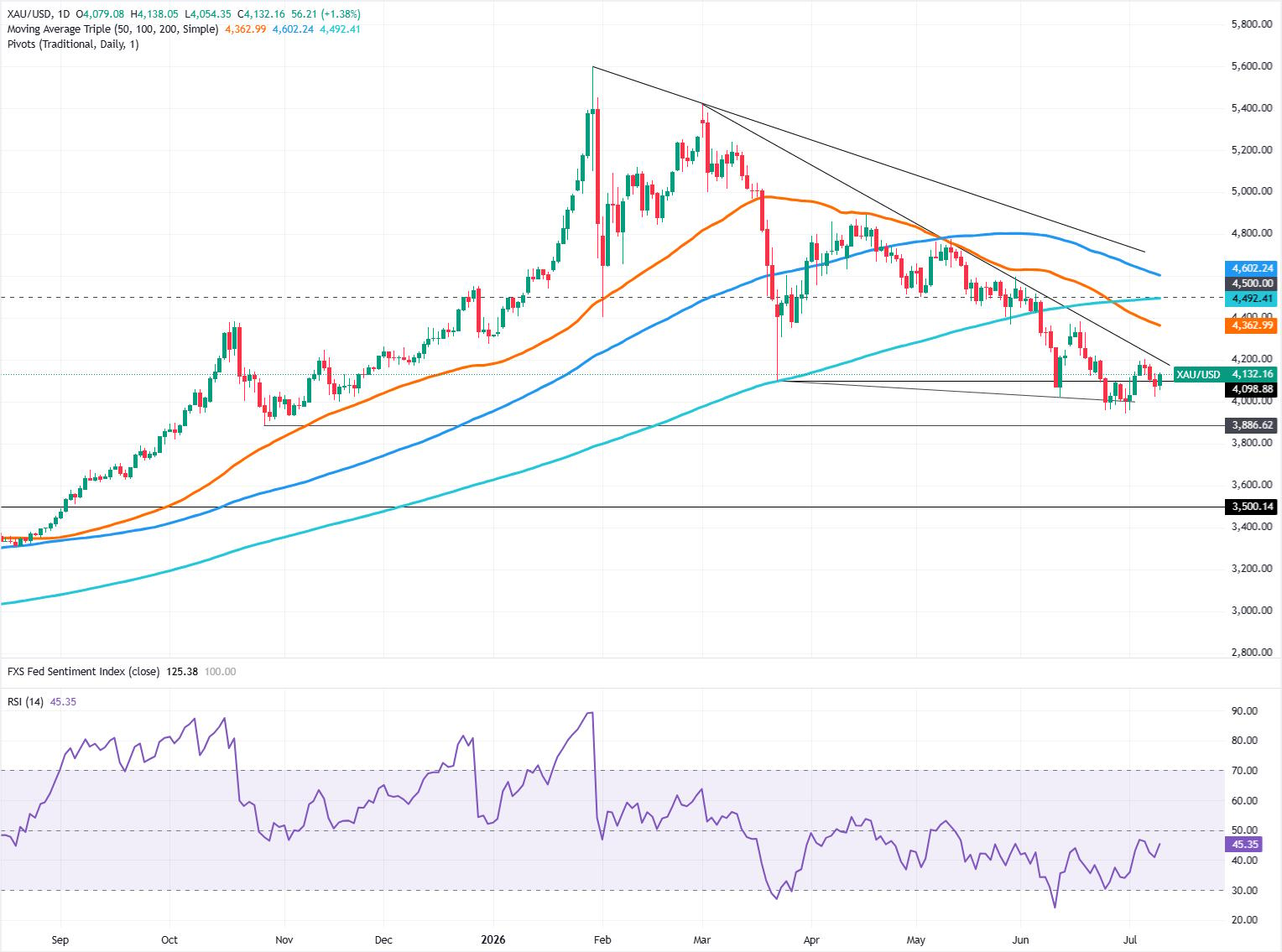
XAU/USD price forecast: Gold recovers $4,100, eyes on $4,300
Gold remains bearishly biased, despite posting a two-day peak at $4,138. In the short term, momentum has turned bullish, but if buyers want more reassurance that the downtrend has finished, they must push bullion prices past a downsloping resistance trendline at around $4,190-$4,215.
The Relative Strength Index (RSI), although bearish, is closing to the 50-neutral level, which, once pierced, would show that buyers are gaining traction.
If XAU/USD clears $4,200, the next resistance is at $ 4,300. On further strength, the next stop is the 200-day Simple Moving Average (SMA) at $4,362. Above is the 50-day SMA at $4,492 ahead of $4,500.
Downwards, Gold must drop below the July 8 swing low of $4,021. Beneath lies the June 30 swing low of $3,941, followed by the October 28, 2025, swing low of $3,886.
Gold FAQs
Gold has played a key role in human’s history as it has been widely used as a store of value and medium of exchange. Currently, apart from its shine and usage for jewelry, the precious metal is widely seen as a safe-haven asset, meaning that it is considered a good investment during turbulent times. Gold is also widely seen as a hedge against inflation and against depreciating currencies as it doesn’t rely on any specific issuer or government.
Central banks are the biggest Gold holders. In their aim to support their currencies in turbulent times, central banks tend to diversify their reserves and buy Gold to improve the perceived strength of the economy and the currency. High Gold reserves can be a source of trust for a country’s solvency. Central banks added 1,136 tonnes of Gold worth around $70 billion to their reserves in 2022, according to data from the World Gold Council. This is the highest yearly purchase since records began. Central banks from emerging economies such as China, India and Turkey are quickly increasing their Gold reserves.
Gold has an inverse correlation with the US Dollar and US Treasuries, which are both major reserve and safe-haven assets. When the Dollar depreciates, Gold tends to rise, enabling investors and central banks to diversify their assets in turbulent times. Gold is also inversely correlated with risk assets. A rally in the stock market tends to weaken Gold price, while sell-offs in riskier markets tend to favor the precious metal.
The price can move due to a wide range of factors. Geopolitical instability or fears of a deep recession can quickly make Gold price escalate due to its safe-haven status. As a yield-less asset, Gold tends to rise with lower interest rates, while higher cost of money usually weighs down on the yellow metal. Still, most moves depend on how the US Dollar (USD) behaves as the asset is priced in dollars (XAU/USD). A strong Dollar tends to keep the price of Gold controlled, whereas a weaker Dollar is likely to push Gold prices up.
Source: Original Article