
























Ethereum is trading near $1,757 as of this morning, July 5, 2026, a multi-week high that puts the token roughly 8% above the $1,620 it was stuck at in the first days of the month. The move matters because of where it came from. ETH bottomed near multi-year lows in June, clawed back $1,600 at the start of July, then punched through $1,700 on July 3 after a single session gained more than 6%. Reclaiming $1,750 is the next brick in that wall.
None of this happened in isolation. Bitcoin reclaimed $63,000 and sits around $62,646, spot Ethereum ETFs flipped back to net inflows, and the alt side of the market finally started leading instead of bleeding. The question now is no longer about the bounce being real. It comes down to how well ETH can hold the levels it just took back.
Price: ~$1,757
24h: +1.3%
7d: +8% (up from ~$1,620)
Support: $1,700, then $1,600
Resistance: $1,850 to $1,900
Here is what ETH needs to keep this recovery alive, what would send it straight back to the June lows, and the exact price map to trade it from.
What Drove Ethereum Back Above $1,750
The recovery has three drivers, and none of them is hype. The first driver is flow, and US spot Ethereum ETFs recorded roughly $29 million in net inflows on July 2, with the largest issuer product leading the tape after a stretch of thin demand, a shift you can track on the Farside Ethereum ETF flow tracker. That is small in absolute terms, but it reversed a run of outflows that had capped every prior bounce attempt since June. When you are trying to read if a move has institutional support, ETF flow data is the cleanest signal available, and it turned green at exactly the moment price broke $1,700. Traders spent all of June waiting for that flip, and it finally arrived alongside the price breakout rather than lagging it.
The second driver is supply leaving exchanges. More than 166,000 ETH in withdrawal transactions cleared in a 24-hour window, the highest count in roughly three years. Coins moving into self-custody are coins that are not sitting on an order book waiting to be sold. Thinner exchange balances mean less immediate sell pressure, and that shows up as price grinding higher on relatively light volume.
The third is rotation. For most of the second quarter, capital hid in Bitcoin while alts underperformed. That flipped this week. XRP is leading the majors near $1.14, up around 5% and touching a monthly high, while Cardano’s ADA ran more than 7% in a day and 17% on the week ahead of its July 6 testnet launch. When the alt-heavy names start outrunning BTC, it usually signals that risk appetite is rebuilding, and ETH sits at the center of that trade as the largest asset on the risk-on side.
The Bull Case for Ethereum From Here
The bullish argument starts with structure. ETH has now printed a higher low off the June bottom and a higher high above the early-July range, which is the basic definition of an uptrend forming on the daily chart. Holding $1,700 as support after using it as resistance is the kind of level flip that momentum traders wait for, and it happened this week.
Flows back the chart. If ETF inflows continue through the week and exchange balances keep falling, the path of least resistance stays up. The first real test overhead sits at $1,850 to $1,900, a zone that rejected price on the way down and now caps the upside. Clear it on strong volume and the next magnet is the psychological $2,000 handle, a level ETH has not traded at since the spring breakdown.
The rotation backdrop adds fuel. A rising appetite for altcoins tends to lift ETH harder than BTC because Ethereum is the settlement layer underneath most of the assets catching bids, from XRP to the Layer 2 networks that settle back to mainnet. When money wants beta, it buys ETH. That is the single biggest reason a reclaim of $1,750 carries more weight than a comparable Bitcoin move at this stage of the cycle.
What Sends Ethereum Back Down
The bear case is just as concrete, and ignoring it is how traders give back the gains they just made. The most immediate risk is that this is a relief bounce inside a larger downtrend, not the start of a new leg. ETH is still down roughly 50% year-to-date on the CoinGecko price chart, and a rally that only recovers a fraction of a much larger fall is exactly what a bear-market bounce looks like. Momentum readings are already stretched into overbought territory on the daily chart after a near-vertical three-day move.
The trigger for a reversal is a loss of the levels ETH just reclaimed. A daily close back below $1,700 would tell you the breakout failed and buyers could not defend their new floor. Below that, $1,600 is the line that separates a healthy pullback from a full retrace, because a break there erases the entire July recovery and reopens the June lows near $1,500.
Macro is the wild card. ETH is still a high-beta risk asset, and it does not decouple from Bitcoin for long. If BTC loses $63,000 and slides back under the range it just reclaimed, ETH will follow, and the fact that more than 50% of Bitcoin’s supply is now held at a loss shows how thin the confidence base still is across the whole market. A single risk-off session driven by macro headlines can undo a week of grind higher.
The Levels That Decide the Next Move
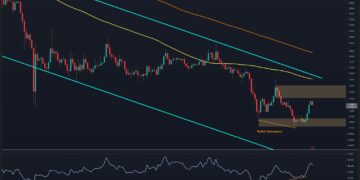
The map below is the entire trade in one view. Everything above $1,750 is confirmation, everything below $1,600 is invalidation, and the space between is where the fight gets decided.
|
Level |
Role |
What it signals |
|
$1,850 to $1,900 |
Overhead resistance |
A reclaim opens the path toward $2,000 and confirms the recovery is extending |
|
$1,750 |
Reclaimed pivot |
Now the first line of support, must hold on the first pullback to stay bullish |
|
$1,700 |
Near-term support |
The floor this bounce is built on, a daily close below it flips momentum |
|
$1,600 |
Deeper support |
Losing it erases the July recovery and signals a full retrace |
|
$1,500 |
Structural line |
A break here reopens the June multi-year lows |
The way to use this is simple. As long as ETH holds above $1,700 on closing basis, the higher-low structure is intact and dips are buyable with defined risk. Lose it and the levels below come into play fast. The reclaim of $1,750 only means something if it holds as support the next time price tests it, and that retest is usually where the market decides if it believes the move.
What Confirms the Recovery Has Legs
A reclaim is a starting gun, not a finish line, and three specific signals separate a durable recovery from a bull trap. The first is ETF flows staying positive through the week rather than a single green day. One day of inflows can be noise. A full week of them is a trend, and it is the difference between institutions nibbling and institutions committing.
The second is the retest of $1,750. Every real breakout gets retested, and the character of that retest tells you everything. If ETH pulls back to $1,750, holds, and pushes off it on rising volume, the level has flipped from resistance to support and the move is confirmed. If it slices straight back through, the breakout was liquidity being taken from late buyers.
The third is Bitcoin cooperating. ETH cannot sustain a breakout while BTC breaks down, so the recovery needs Bitcoin to defend $63,000 and keep its own structure intact. Watch ETH funding rates and open interest alongside price, because a rally driven purely by leveraged longs with no spot or ETF support is the kind that unwinds violently. The healthiest version of this move has spot buyers, positive ETF flows, and neutral-to-slightly-positive funding all pointing the same way.
Frequently Asked Questions
Will Ethereum keep rising in July 2026?
The trend stays higher as long as ETH holds above $1,700 on a closing basis and ETF inflows continue. The first real test is the $1,850 to $1,900 resistance zone, and clearing it opens the path toward $2,000. A daily close back below $1,700 would put that bullish read on hold.
What is the key support level for ETH right now?
$1,700 is the near-term floor and $1,600 is the deeper line that must hold to keep the July recovery intact. Losing $1,600 erases the bounce and reopens the June lows near $1,500. The reclaimed $1,750 pivot is the level bulls want to see hold on any pullback.
Why is Ethereum outperforming during this altcoin rotation?
ETH is the settlement layer underneath most of the assets catching bids, so when risk appetite rebuilds and capital rotates out of Bitcoin into alts, Ethereum tends to move with more force than BTC. XRP and Cardano leading the majors this week is the classic tell that the rotation is on, and ETH is the largest liquid vehicle for that trade.
Is the ETH recovery sustainable or a bull trap?
The honest answer is that the retest decides it. A clean hold of $1,750 as support on rising volume, backed by a full week of ETF inflows and Bitcoin defending $63,000, points to a durable move. A rally built only on leveraged longs with no spot or flow support is the setup that reverses hard.
Bottom Line
Ethereum reclaiming $1,750 turned a June bottom into a real July recovery, and the structure is now a series of higher lows backed by ETF inflows and falling exchange balances. If ETH holds $1,700 on a closing basis and buyers defend the $1,750 retest, the next objective is the $1,850 to $1,900 resistance and then $2,000. If $1,600 breaks, the recovery is done and the June lows near $1,500 come back into view. Trade the level flip, not the headline, keep your risk defined below the line that matters, and let the retest tell you which side is winning.
This article is for informational purposes only and does not constitute financial or investment advice. Cryptocurrency trading involves substantial risk. Always conduct your own research before making trading decisions.
Source: Original Article