















Sunday, July 5, 2026
No Result
View All Result
  • Home
  • Market Overview
    • All
    • Crude Oil Prices
    • Cryptocurrency News
    • Economy News
    • ETFs
    • Foreign Exchange News
    • Indices
    • Stock Market
    Record number of exchange-traded funds hit share market, but investors warn of ‘gambling’ risk

    Record number of exchange-traded funds hit share market, but investors warn of ‘gambling’ risk

    7 OPEC+ countries agree to expand monthly oil production modestly as prices slide

    7 OPEC+ countries agree to expand monthly oil production modestly as prices slide

    Clarity and Congress’s summer break: State of Crypto

    Clarity and Congress’s summer break: State of Crypto

    IN DETAIL: Stock market traders exchange N154bn shares

    If a Stock Market Crash Is Coming, This ETF Could Be the Smartest Buy Right Now

    If a Stock Market Crash Is Coming, This ETF Could Be the Smartest Buy Right Now

    Oil prices hover near pre-conflict levels as OPEC+ boosts output again

    Oil prices hover near pre-conflict levels as OPEC+ boosts output again

    • Crude Oil Prices
    • Cryptocurrency News
    • Economy News
    • ETFs
    • Indices
    • Stock Market
    • Foreign Exchange News
    • Commodities News
  • Forex Market
    • All
    • Central Banks News
    • Currencies
    • Interest Rate
    • Nonfarm Payroll
    CBE issues new rules governing banks’ investments in corporate, securitisation bonds

    CBE issues new rules governing banks’ investments in corporate, securitisation bonds

    Survey: Central Banks Boost Gold Reserves to Counter Inflation and Geopolitical Risks

    CBE instructs banks to increase support for national healthcare initiatives

    CBE instructs banks to increase support for national healthcare initiatives

    COMMENT: Why Iran's central bank is starving banks of liquidity

    COMMENT: Why Iran's central bank is starving banks of liquidity

    Egypt’s central bank tells banks to boost healthcare funding through CSR spending

    Egypt’s central bank tells banks to boost healthcare funding through CSR spending

    Central Banks Continue Strong Gold Purchases Despite Interest Rate Pressures

    Central Banks Continue Strong Gold Purchases Despite Interest Rate Pressures

    Analysts unanimously see CBE keeping interest rates on hold

    Analysts unanimously see CBE keeping interest rates on hold

    Gold.com (GOLD) Following Central Bank Gold Buying Is It Still A Bargain

    Gold.com (GOLD) Following Central Bank Gold Buying Is It Still A Bargain

    Radio silence: Central banks leave markets flying blind

    Radio silence: Central banks leave markets flying blind

    • Central Banks News
    • Currencies
    • Interest Rate
    • Nonfarm Payroll
  • Commodities
    • All
    • Gold
    • Oil and Gas
    • Silver
    Gold Was Volatile in the First Half of 2026. Here’s How to Invest in Gold for the Rest of the Year.

    Gold Was Volatile in the First Half of 2026. Here’s How to Invest in Gold for the Rest of the Year.

    Iraq signs Halliburton deal to boost oil and gas production

    Iraq signs Halliburton deal to boost oil and gas production

    Riverside County Gas Prices Still Falling

    Little Change to Southland Gas Prices

    JPMorgan tweaks gold price target as Fed risks return

    JPMorgan tweaks gold price target as Fed risks return

    A Sudden Glut of Oil Threatens to Weaken Iran’s Hand in Talks

    A Sudden Glut of Oil Threatens to Weaken Iran’s Hand in Talks

    Ovintiv Stock And 2 Oil And Gas Shares Retail Investors May Be Watching

    Ovintiv Stock And 2 Oil And Gas Shares Retail Investors May Be Watching

    • Gold
    • Oil and Gas
    • Silver
  • Crypto
    • All
    • Bitcoin
    • Ethereum
    • Litecoin
    • Ripple
    • Solana
    • XRP
    Ethereum Lost 22% in 1 Month. Here’s Why It Could Still Get Worse

    Ethereum Lost 22% in 1 Month. Here’s Why It Could Still Get Worse

    Ripple Price Analysis: What Are XRP’s Next Targets After 8% Weekly Surge?

    Ripple Price Analysis: What Are XRP’s Next Targets After 8% Weekly Surge?

    Alabama county hits pause on bitcoin mining after neighbors revolt over relentless noise

    Alabama county hits pause on bitcoin mining after neighbors revolt over relentless noise

    Which Crypto Can Make You a Millionaire by 2030 With $10,000? We Compared XRP, BTC, ETH, SOL, and HYPE

    Which Crypto Can Make You a Millionaire by 2030 With $10,000? We Compared XRP, BTC, ETH, SOL, and HYPE

    SA Asks: What's the outlook for bitcoin?

    SA Asks: What's the outlook for bitcoin?

    Here’s the 1 Crypto I’d Buy If I Could Pick Only 1

    Here’s the 1 Crypto I’d Buy If I Could Pick Only 1

    • Bitcoin
    • Ethereum
    • Litecoin
    • Ripple
    • Solana
    • XRP
  • Chart
  • Economic Calendar
No Result
View All Result
Home Market Overview Crude Oil Prices

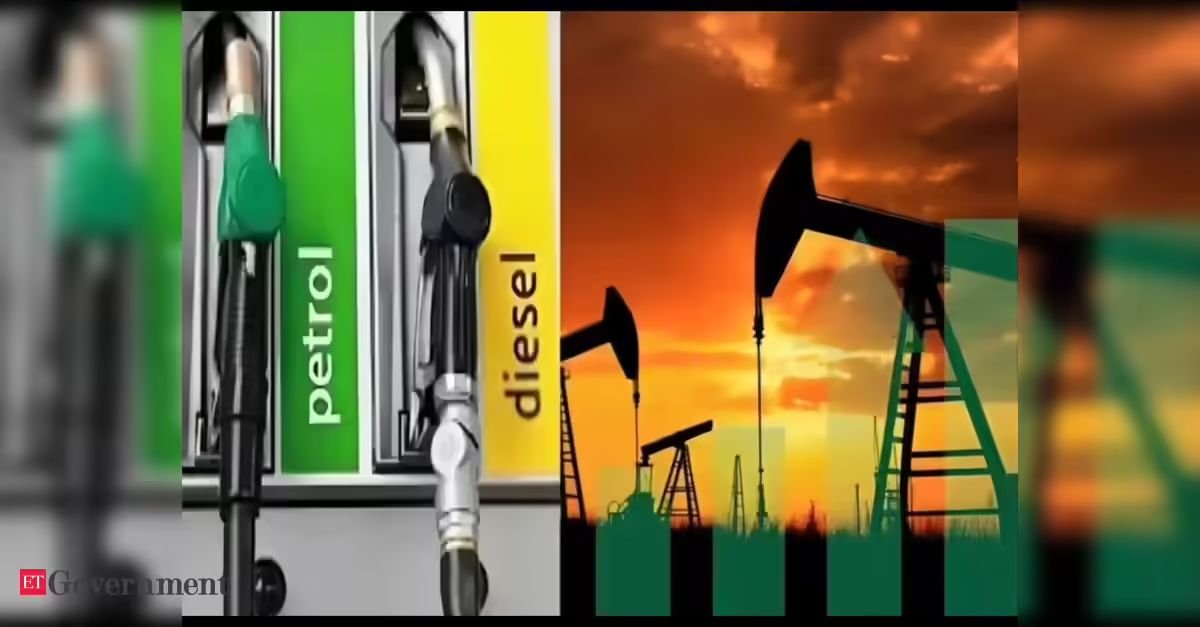
Crude Oil Prices Gulf War: Can Crude Oil Prices Drop to $50 Amid Changing Global Dynamics?, ETGovernment

Crude Oil Prices Gulf War: Can Crude Oil Prices Drop to $50 Amid Changing Global Dynamics?, ETGovernment
Share on FacebookShare on Twitter

​Whether crude actually touches $50 per barrel will depend on future geopolitical developments and global economic conditions, but the underlying market dynamics now make such a scenario considerably more plausible than many would have imagined just a few years ago.​

Following the ceasefire between the United States and Iran and the reopening of the Strait of Hormuz, international crude oil prices have fallen sharply to around $67–68 per barrel.

The decline has not surprised energy markets, which had already begun factoring in the easing of geopolitical risks. The more important question now is where oil prices will stabilise, assuming the conflict does not escalate again.

During the recent tensions in West Asia, many analysts warned that crude oil prices could soar to $150 per barrel or even higher, triggering a fresh wave of global inflation. In reality, prices never approached those levels. Even during the most intense phase of the crisis, crude generally traded between $95 and $120 per barrel, with an average close to $100 per barrel.

The exaggerated forecasts underestimated a fundamental reality of the oil market: prices are ultimately determined by the interaction of demand and supply. While geopolitical disruptions can create temporary spikes, they cannot permanently override market fundamentals.

Over the past few years, the global oil market has undergone a structural transformation. The long-held assumption that demand is largely fixed and supply is controlled by a handful of producers has become increasingly outdated. Today, oil prices are influenced by two powerful forces—demand destruction and supply expansion.

Oil Demand Is No Longer Price Inelastic
For decades, crude oil demand was considered relatively price inelastic. Even when prices rose sharply, countries continued to consume almost the same quantity of oil because viable alternatives were limited. As a result, oil-importing economies such as India, which imports nearly 88 percent of its crude oil and around 50 percent of its natural gas, had little choice but to absorb higher import bills.

That situation is changing.

When crude prices approach $100 per barrel, demand destruction begins to emerge. High fuel prices reduce consumers’ purchasing power—the classic real income effect—while simultaneously encouraging a substitution effect, with consumers and industries shifting to alternative energy sources.

The transition is already visible. Rising petrol and diesel prices accelerate the adoption of electric vehicles. Households increasingly replace LPG with electric induction cooktops. Industries facing expensive fossil fuels invest in renewable energy, electrification or more efficient technologies. Electricity generation is also steadily shifting towards solar, wind and nuclear power.

One important characteristic of demand destruction is that much of it becomes permanent. Once consumers and businesses adopt alternative technologies, they rarely return fully to previous levels of oil consumption, even if crude prices decline later. This makes repeated price spikes increasingly self-defeating for oil producers.

The Changing Dynamics of Supply
Supply-side dynamics have also evolved significantly.

The early months of the COVID-19 pandemic demonstrated how vulnerable oil producers are when demand collapses. Crude oil prices briefly turned negative because production could not be halted quickly enough while storage facilities filled up. Similar challenges have confronted producers facing sanctions or export restrictions, forcing them to sell crude at heavily discounted prices.

Many oil-exporting countries depend heavily on petroleum revenues to finance their national budgets. Consequently, they often continue exporting even when prices fall close to—or sometimes below—their production costs. Unlike manufacturing industries, shutting down oil production is technically difficult and economically expensive.

The influence of the Organization of the Petroleum Exporting Countries (OPEC) has also weakened over time. While OPEC continues to play an important role in managing global supplies, its ability to dictate prices has diminished as several countries have reduced their dependence on the cartel or exited altogether.

At the same time, non-OPEC producers—including the United States, Canada, Brazil and Guyana—have significantly expanded production, increasing competition in global markets.

Sanctions have further altered global trade patterns. Russian crude, for example, continues to reach major buyers such as India and China at discounted prices, while Venezuelan oil has also been sold below prevailing international benchmarks under varying geopolitical circumstances. These discounted supplies have added further downward pressure on global prices.

Higher oil prices have also encouraged fresh investments in production, particularly in the United States and other major producers. As new supplies enter the market, they offset a significant portion of any disruptions caused by geopolitical events.

Could Oil Fall to $50?
The combination of weakening demand growth and expanding global supply has fundamentally changed the oil market.

Demand destruction is estimated to have reduced global oil consumption by several million barrels per day, while higher prices have simultaneously stimulated additional production from multiple countries. Together, these forces have created a structural surplus that limits the ability of geopolitical events alone to sustain very high prices.

This explains why crude prices remained close to $100 per barrel even during periods of heightened military tensions and the temporary disruption of shipping through the Strait of Hormuz. Once the immediate geopolitical risk subsided and maritime traffic resumed, prices quickly fell back to around $70 per barrel.

If the current geopolitical calm persists, there is a reasonable possibility that crude prices could soften further. A trading range of $50–60 per barrel cannot be ruled out, particularly if global economic growth remains moderate and energy transition continues to reduce long-term oil demand.

Good News for India
For India, lower oil prices would provide significant macroeconomic benefits. A decline in crude prices would reduce the country’s import bill, improve the current account balance, ease inflationary pressures and create additional fiscal space for public investment. Lower energy costs would also support manufacturing competitiveness and household consumption.

While sustained low prices would undoubtedly pose challenges for many oil-exporting economies, they would be broadly favourable for large energy-importing countries such as India. More importantly, the changing economics of global energy suggests that the era of prolonged, extremely high oil prices may be giving way to a more competitive and structurally balanced market.

Whether crude actually touches $50 per barrel will depend on future geopolitical developments and global economic conditions, but the underlying market dynamics now make such a scenario considerably more plausible than many would have imagined just a few years ago.

(The author is National Co-convenor, Swadeshi Jagaran Manch and Former Professor, PGDAV College, University of Delhi)

  • Published On Jul 5, 2026 at 10:52 AM IST

Join the community of 2M+ industry professionals.

Subscribe to Newsletter to get latest insights & analysis in your inbox.

All about ETGovernment industry right on your smartphone!


Source: Original Article

Previous Post

Ethereum Reclaims $1,750 | ETH Price Levels to Watch 2026

Next Post

(CJT.DB.F) Market Performance Analysis

RelatedPosts

Record number of exchange-traded funds hit share market, but investors warn of ‘gambling’ risk

by MarketNewsBoard
1 hour ago
Record number of exchange-traded funds hit share market, but investors warn of ‘gambling’ risk

A record number of exchange-traded funds (ETFs) have been listed on the local stock market during the past financial year.The Australian Securities Exchange (ASX) added...

Read moreDetails

7 OPEC+ countries agree to expand monthly oil production modestly as prices slide

by MarketNewsBoard
2 hours ago
7 OPEC+ countries agree to expand monthly oil production modestly as prices slide

NEW YORK (AP) — A handful of countries in the OPEC+ oil-producing alliance plan to increase their outputs modestly next month, which would bring more...

Read moreDetails
Next Post
(CJT.DB.F) Market Performance Analysis

(CJT.DB.F) Market Performance Analysis

Barstool’s Portnoy plans to hold bitcoin down to $0 after timing it wrong every time

Barstool's Portnoy plans to hold bitcoin down to $0 after timing it wrong every time

Recommended.

New Fed Chief Kevin Warsh Navigates Interest Rate Decision in Tight-Lipped Outing

New Fed Chief Kevin Warsh Navigates Interest Rate Decision in Tight-Lipped Outing

July 1, 2026
Oil extends losses as easing Middle East tensions push prices toward $70

Oil extends losses as easing Middle East tensions push prices toward $70

July 2, 2026

Trending.

No Content Available
Market News Board | Market Analysis,Charts & News

MarketNewsBoard delivers trusted financial news, real-time market analysis, interactive charts, and economic insights across the global financial markets.

Covering Forex, Commodities, Stocks, Indices, Cryptocurrencies, and major economic events...

Follow Us

Market Overview

  • Forex Market
  • Commodities
  • Cryptocurrency News
  • Stocks
  • Indices
  • Crude Oil Prices
  • Economic Calendar

Resources

  • Central Banks News
  • Economy News
  • Interest Rate
  • Nonfarm Payroll
  • Charts

Tools

  • Currency Heat Map
  • Correlation Matrix
  • Market Sentiment
  • Currency Cross Rates
  • Crypto Rates
  • About Us
  • Contact Us
  • Disclaimer
  • Privacy Policy
  • Terms and Conditions

© 2026 MarketNewsBoard | Market Analysis, Charts & News.

AAPL
$308.63
AMZN
$242.67
BTC-USD
$62,761.99
EURUSD=X
$1.14
DX-Y.NYB
$100.88
NVDA
$194.83
TSLA
$393.45
DOW
$27.71
^N225
$69,744.07
JPY=X
$161.33
GBPUSD=X
$1.33
CAD=X
$1.42
NG=F
$3.25
BZ=F
$72.13
NFLX
$77.65
GOOG
$356.18
MSFT
$390.49
^RUT
$2,996.11
^FTSE
$10,679.03
AUDUSD=X
$0.695
CHF=X
$0.803
HG=F
$6.22
ETH=F
$1,757.50
No Result
View All Result
  • Home

© 2026 MarketNewsBoard | Market Analysis, Charts & News.