


























- On 27 June 2026, The Wendy’s Company was removed from several Russell 1000 and Midcap indices and added to multiple Russell 2000 benchmarks, including growth, value, and defensive sub-indices, following the annual Russell index reconstitution.
- This index reshuffle shifts Wendy’s into a smaller-cap, more defensive peer set, potentially changing how index funds and quantitative investors treat the stock.
- We’ll now examine how Wendy’s move from Russell 1000 to Russell 2000 indices might influence its existing investment narrative and risk profile.
Find 44 companies with promising cash flow potential yet trading below their fair value.
Wendy’s Investment Narrative Recap
To own Wendy’s today, you have to believe that its digital investments, menu innovation, and international build-out can offset pressure on U.S. traffic, margins, and franchisee health. The shift from the Russell 1000 to multiple Russell 2000 indices mainly affects which funds hold the stock, but does not materially change the near term story, where soft same-restaurant sales and cost inflation still look like the key swing factors and biggest risks.
The most relevant recent announcement here is the appointment of Steve Cirulis as both Chief Financial Officer and Chief Strategy Officer on 23 June 2026. With Wendy’s now grouped in a smaller cap, more defensive index cohort, many investors will be watching how this new finance and strategy leadership team executes on cost control, digital initiatives, and global expansion, given that 2026 guidance calls for approximately flat global systemwide sales growth.
Yet beneath the index reshuffle, investors should be aware of how weaker U.S. comps and franchisee margin pressure could…
Read the full narrative on Wendy’s (it’s free!)
Wendy’s narrative projects $2.3 billion revenue and $137.4 million earnings by 2029. This requires 1.7% yearly revenue growth and a $27.7 million earnings decrease from $165.1 million today.
Uncover how Wendy’s forecasts yield a $7.98 fair value, a 5% upside to its current price.
Exploring Other Perspectives
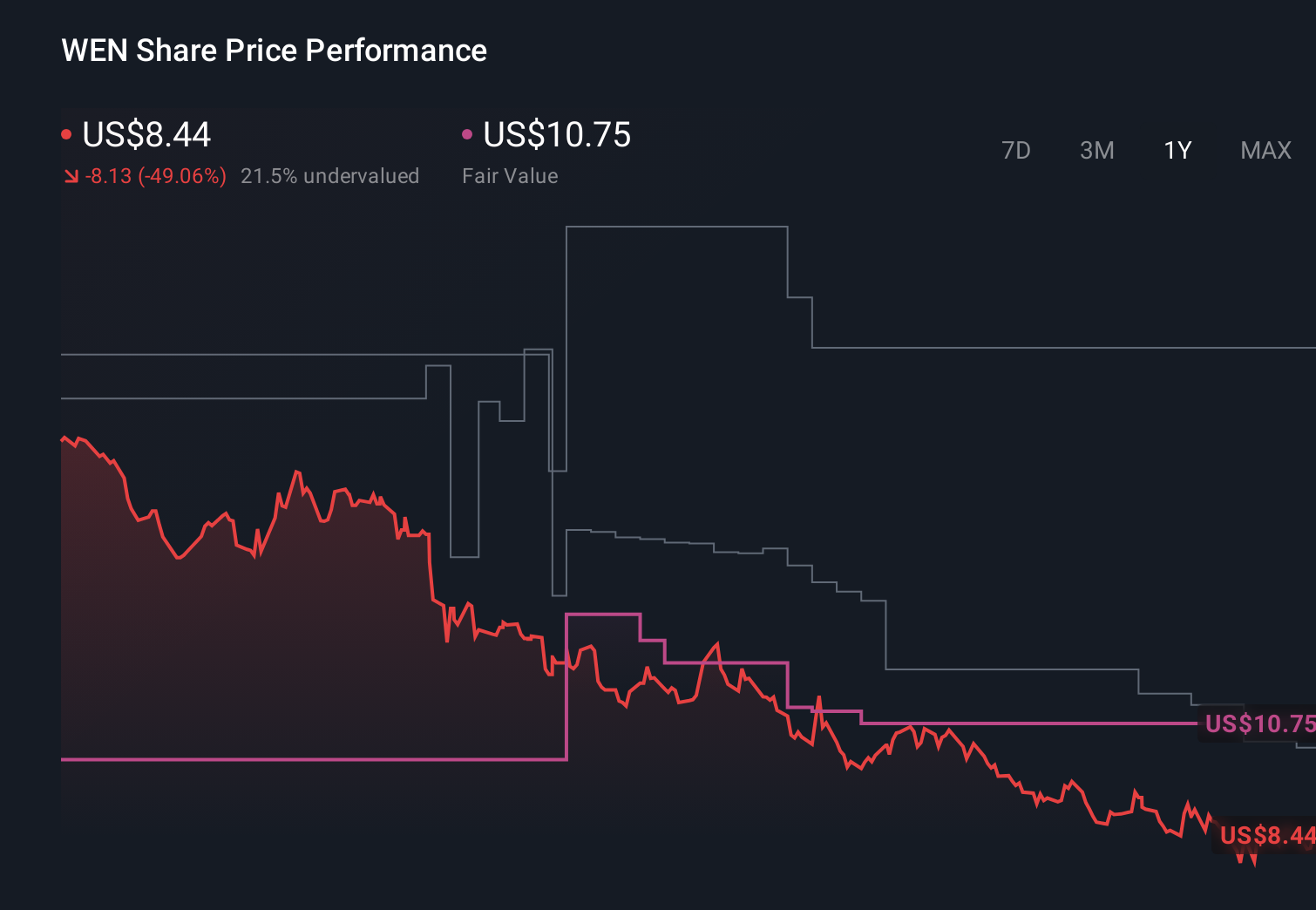
Some of the most optimistic analysts were assuming revenue around US$2.4 billion and earnings near US$149.9 million by 2029, which paints a far rosier picture than the more cautious consensus and highlights how sharply opinions can differ when you weigh this bullish outlook against concerns about Wendy’s heavy reliance on a mature U.S. market in light of its move into the Russell 2000.
Explore 7 other fair value estimates on Wendy’s – why the stock might be worth 34% less than the current price!
Form Your Own Verdict
Disagree with existing narratives? Extraordinary investment returns rarely come from following the herd, so go with your instincts.
Want Some Alternatives?
Our daily scans reveal stocks with breakout potential. Don’t miss this chance:
This article by Simply Wall St is general in nature. We provide commentary based on historical data
and analyst forecasts only using an unbiased methodology and our articles are not intended to be financial advice. It does not constitute a recommendation to buy or sell any stock, and does not take account of your objectives, or your
financial situation. We aim to bring you long-term focused analysis driven by fundamental data.
Note that our analysis may not factor in the latest price-sensitive company announcements or qualitative material.
Simply Wall St has no position in any stocks mentioned.
Valuation is complex, but we’re here to simplify it.
Discover if Wendy’s might be undervalued or overvalued with our detailed analysis, featuring fair value estimates, potential risks, dividends, insider trades, and its financial condition.
Have feedback on this article? Concerned about the content? Get in touch with us directly. Alternatively, email [email protected]
Source: Original Article