



















10h05 ▪
8
min read ▪ by
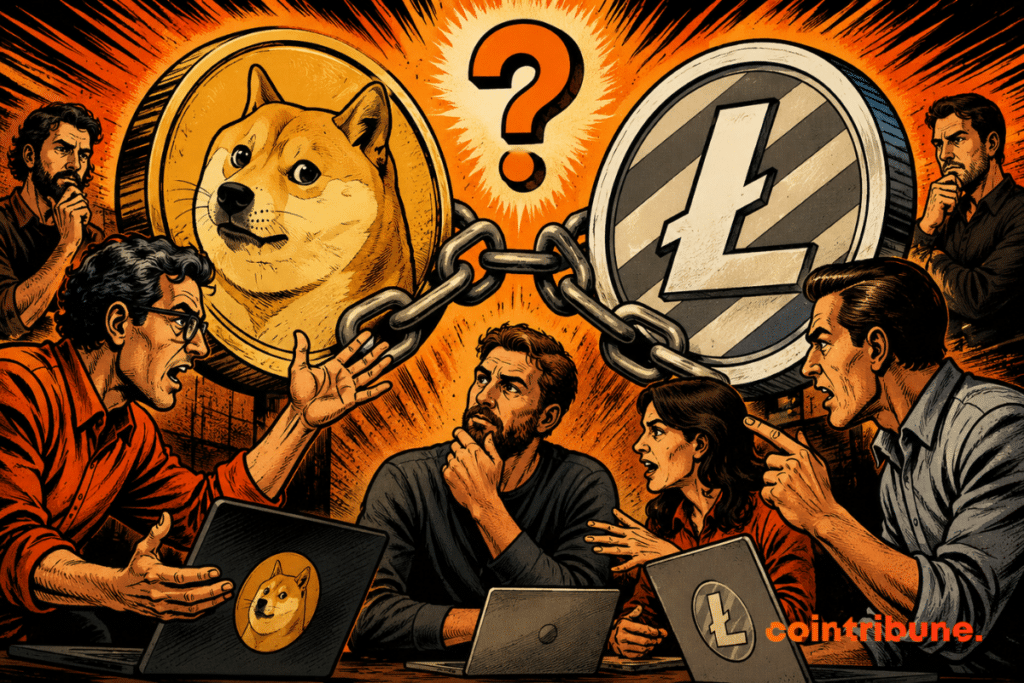
Dogecoin (DOGE) is today at the center of a new technical debate. At the heart of the controversy: the dependence of the world’s most capitalized memecoin on Litecoin. Some developers argue that the crypto project must fully control its infrastructure. Conversely, others (more pragmatic!) remind that this synergy guarantees an unparalleled level of security.
In brief
- On July 18, 2026, developer Paulo Vidal reignites the debate about Dogecoin’s dependence on Litecoin for its security.
- Crypto developer Chromatic X corrects him: Dogecoin depends on all Scrypt cryptocurrencies mined in merge, not Litecoin alone.
- Co-founder Billy Markus reminds that Dogecoin remains the most profitable Scrypt crypto to mine.
- The Dogecoin Foundation highlights an inverse dependency.
A crypto developer reignites a twelve-year-old debate
On July 18, 2026, Dogecoin Foundation developer Paulo Vidal published a question on X. Enough to awaken a technical controversy: Dogecoin does it really need to depend on Litecoin for its security or could it one day free itself?
According to Paulo Vidal, Dogecoin encourages merged mining with other networks. However, it does not have its own independent mining. He deduces that the crypto network’s security therefore remains tied to another blockchain: Litecoin (LTC). The PoW algorithm of this project created by Charlie Lee in 2011 is identical to that of Dogecoin.
Crypto analysts agree on one point: this question is by no means trivial. It indeed touches the core of what makes the robustness of a PoW-based crypto blockchain: the higher the hashrate, the more complex and costly a 51% attack becomes to carry out.
Crypto developer Chromatic X quickly nuances Vidal’s observation
In a post published on X on July 19, he strongly argues that Dogecoin does not depend on Litecoin in particular, but on all layer 1 (L1) cryptocurrencies using the Scrypt algorithm and practicing merged mining. This distinction changes the nature of the risk. In other words, Dogecoin is not hostage to a single project. It would rather be the beneficiary of a shared crypto mining ecosystem.
Chromatic X goes even further, stating:
Dogecoin should be able to secure itself alone from a purity philosophical position, rather than a technical necessity.
Explanation: strictly autonomous mining would be more of an ideological principle than a security requirement, since the current system already fulfills this function effectively.
Merged mining between Dogecoin and Litecoin is not new
Merged mining allows a crypto miner to validate blocks simultaneously on several different blockchains without additional computational power or hardware expenditure. They must nonetheless share the same proof-of-work algorithm.
Technically, it is based on a protocol called Auxiliary Proof-of-Work (AuxPoW). The principle is as follows: the block mined on Litecoin includes a cryptographic proof verifiable by the Dogecoin network. So, no need for any “social” validation by Litecoin. Dogecoin nodes only verify that the PoW meets their own rules.
Besides Dogecoin and Litecoin, other crypto projects using the Scrypt algorithm use the same mechanism. Notably, Namecoin is one example.
The merged mining between Dogecoin and Litecoin was activated in August 2014, after a proposal by Charlie Lee in the spring of the same year. Before that date, Dogecoin had too low a hashrate to withstand a 51% attack sustainably.
Adopting AuxPoW immediately changed the situation: Dogecoin’s hashrate reportedly jumped about 1,500% within a month, according to a case study published by Binance Research. Twelve years later, this mutual dependence remains structural. Market estimates indicate that over 70% of Dogecoin’s hash power today comes from merged mining with Litecoin.
What exactly do the 2026 hashrate figures for Dogecoin and Litecoin reveal?
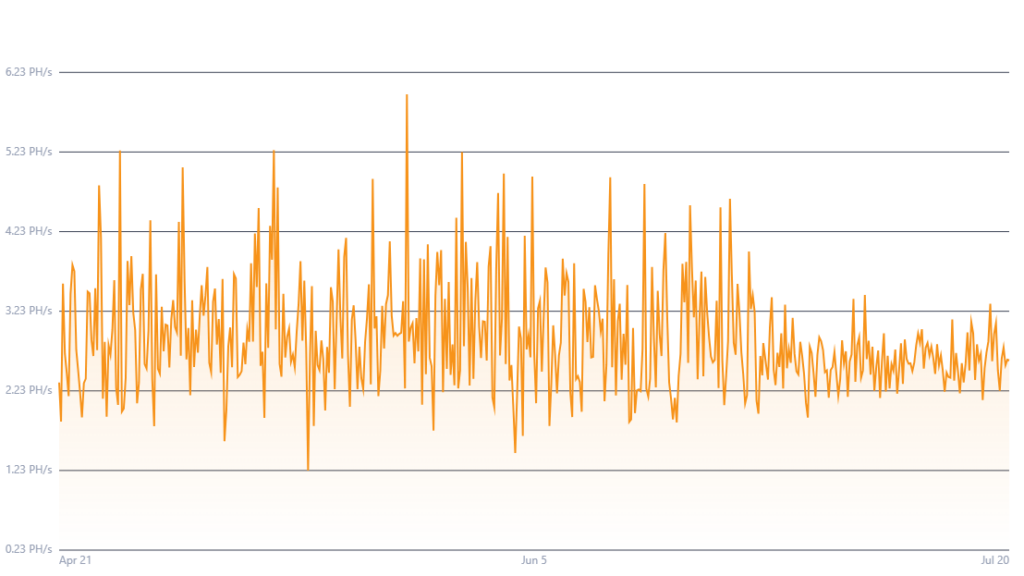
The hashrate represents the total computational power dedicated to crypto mining. Data published in June 2026 allows concretely measuring the balance of power between Dogecoin and Litecoin.
- Dogecoin’s hashrate ranged between about 2.7 and 3.4 petahashes per second (PH/s) during this period, after peaking at 8.72 PH/s in February 2026 before stabilizing.
- Meanwhile, Litecoin displayed a hashrate close to 2.7 PH/s in early June 2026.
This simply means that the two crypto networks operate on comparable scales. In other words, their combined security is based on a largely shared miner base rather than on simple submission of Dogecoin to Litecoin.
This proximity is partly explained by the deployment of new models of specialized integrated circuits (ASIC) compatible with Scrypt. These prove more powerful than previous generations. Enough to simultaneously strengthen mining activity on both crypto blockchains.
Dogecoin co-founder also gives his point of view
Known by the pseudonym “Shibetoshi Nakamoto,” Billy Markus also joined the exchange. According to him, Dogecoin remains the most profitable Scrypt cryptocurrency to mine. A remark that shifts the debate’s focus: it is not so much Dogecoin that would depend on Litecoin but vice versa. He argues that many Scrypt miners are attracted to Litecoin precisely because it lets them earn DOGE at no additional cost.
This observation is echoed by Timothy Stebbing, director of the Dogecoin Foundation. According to him, most Scrypt assets mined in merge would actually depend on Dogecoin’s monetary issuance to remain economically viable to mine. Giving up merge mining would therefore not only weaken Dogecoin but also the Scrypt miner ecosystem that has built around this interdependence since 2014.
This approach questions the idea that one blockchain is above the other. Indeed, this is not a one-way dependency. It is rather an economic balance where each crypto network brings something to the other: Litecoin provides hashing power and Dogecoin attractive mining profitability.
What would happen if Dogecoin left merged crypto mining?
Crypto analysts envisage three possible scenarios.
- Scenario 1 Dogecoin disables AuxPoW: Scrypt miners continue to mine Litecoin but lose DOGE rewards. Scrypt hashrate drops. Dogecoin must attract dedicated miners. This would cost millions in infrastructure and electricity. Probability: near zero, as no key developer supports this idea.
- Scenario 2 a hybrid transition: the “Sakura” project mentioned by the Dogecoin Foundation explores a hybrid PoW/PoS model. But developers have repeated that it is not about abolishing mining, only adding staking incentives on layer 2. PoW would remain the basic security mechanism. Probability: possible, but long-term.
- Scenario 3 merged mining continues: Scrypt hashrate grows. Dogecoin remains the most profitable Scrypt crypto. This is the most probable scenario, supported by economic and technical arguments of current crypto developers.
In any case, the debate around merged mining does not call into question Dogecoin’s current security. It rather reveals two visions of its future: preserving a proven model or aiming for total independence.
Maximize your Cointribune experience with our “Read to Earn” program! For every article you read, earn points and access exclusive rewards. Sign up now and start earning benefits.

My name is Ariela, and I am 31 years old. I have been working in the field of web writing for 7 years now. I only discovered trading and cryptocurrency a few years ago, but it is a universe that greatly interests me. The topics covered on the platform allow me to learn more. A singer in my spare time, I also cultivate a great passion for music and reading (and animals!)
DISCLAIMER
The views, thoughts, and opinions expressed in this article belong solely to the author, and should not be taken as investment advice. Do your own research before taking any investment decisions.
Source: Original Article