


















Brazilian battery suppliers are expected to invest between Real 16 billion and Real 20 billion ($3.1 billion-$3.9 billion) in the two storage system auctions scheduled for December 2026, according to the National Storage Systems Association.
With both auctions expected to attract broad participation from battery suppliers, the association, known as ABSAE, anticipates they will offer between 4 GW and 5 GW of storage capacity, it said in a July 17 statement. The contracts will have a 15-year duration, with supply expected to begin in 2028, it said.
If the investment is confirmed, it could make Brazil one of the largest storage markets in Latin America, alongside Chile.
The reserve capacity auction was considered a positive option to stimulate battery introduction, mirroring experiences in other countries, such as England and Portugal, ABSAE Executive Director Fabio Lima told Platts, part of S&P Global Energy.
The first auction, on Dec. 2, will be restricted to projects that meet national content requirements. A second auction on Dec. 4 will be open to all projects. Despite the difference, companies are expected to participate on both auctions.
“National content requirements are very flexible, and Brazil has enough production to supply a good part of battery system components,” Lima said.
It is yet unclear how the demand will be split between the two auctions, but Lima expects this to be clarified before December.
“We expect a very competitive auction, with many developers trying to offer the lowest price, and mainly attracting large suppliers rather than small companies,” according to Laura Souza, partner at Brazilian law firm TozziniFreire.
Curtailments
Moreover, incentives are planned for projects in areas with high solar and wind generation capacity, which could help mitigate growing curtailments in Brazil.
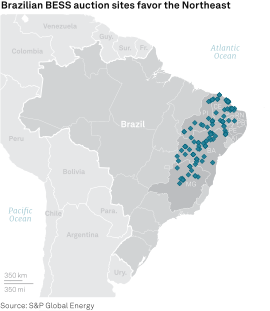
The auction includes a bonus mechanism that grants preference to projects planned for regions where the electric system lacks robustness. While the goal is to drive investment in areas where the electric system is less stable, the listed substations are mostly located in Brazil’s Northeast and north of Minas Gerais state, where there is also a concentration of solar and wind power generation.
“Many of these substations chosen for the bonus policy are heavily affected by curtailment, so it makes perfect sense to incentivize battery investments in these regions,” Laura Souza said.
Brazil’s Northeast is responsible for 44.5 GW of wind and solar capacity generation, or 77.5% of the country’s total capacity for these sources, according to the national electricity regulator, Aneel.
But further expansion is threatened by growing curtailments, as wind and solar intermittent nature create bottlenecks during peak generation hours. Renewable companies have paused investments until regulators define a clear scenario.
Until July 18, nationwide wind and solar curtailments reached 24.1% of potential generation during the month, compared with 18.3% in June, according to figures from the National System Operator.
Battery systems, however, are believed to be a part of the solution. Aneel is conducting a public consultation to define curtailment rules, including which units will be most affected, but the process is taking longer than expected.
“We lack clear rules to organize and distribute curtailments among generators, and before these rules are implemented, there is no clarity to allow companies to develop solutions,” Lima said.
Latin America
The auction could allow Brazil to catch up with its neighbors in storage systems, especially if ABSAE’s estimate of 4-5 GW is confirmed.
Some market estimates are even higher than this figure, according to sources, but there is divergence about the auction’s outcome.
“I believe 5 GW is an ambitious estimate, especially being the first auction of this type in Brazil,” Souza said.
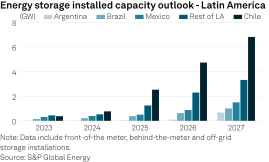
Chile has been a highlight in the region, with capacity estimated to reach 4.7 GW in 2026, according to S&P Global Energy’s Clean Power Installations Outlook, published July 8.
Chilean batteries are being installed mainly near solar power plants, which make up a relevant part of the country’s electricity capacity. In May, Chile’s solar photovoltaic capacity was 12.25 GW, or 32.3% of the country’s total generation capacity of 38 GW, according to data from the local generators association, Generadoras. Wind power capacity ranked second, at 6 GW, or 15.7% of the total.
Latin America’s total energy storage capacity is estimated to reach 13.3 GW in 2027, according to S&P Global Energy Horizon analysts.
Source: Original Article