

















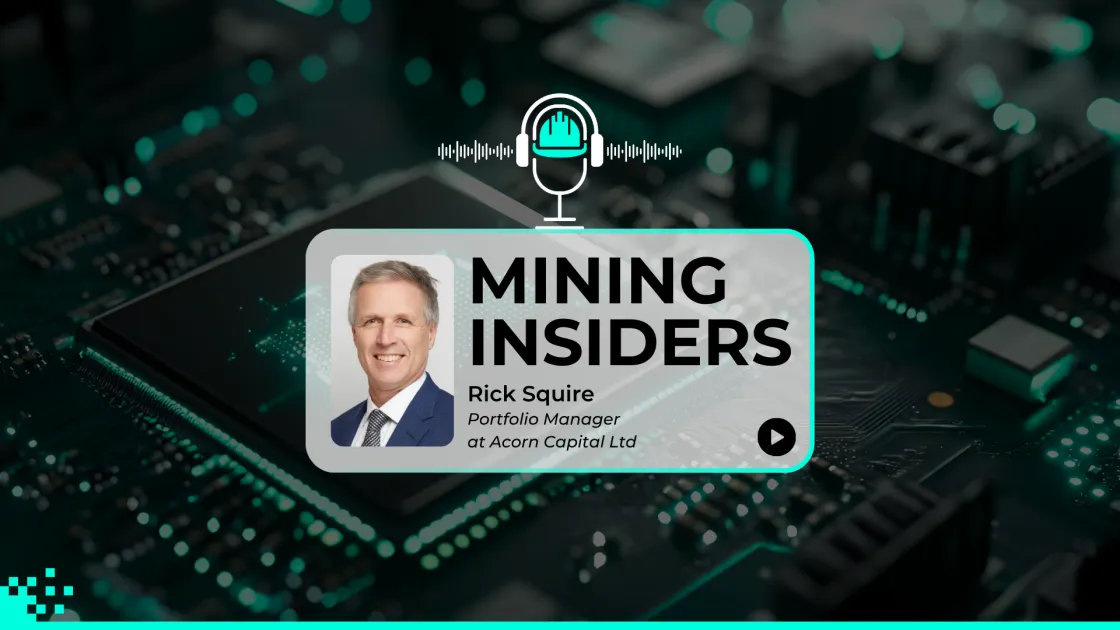
Q&A with Rick Squire, Portfolio Manager, Acorn CapitalAcorn Capital Investment Fund’s (ASX:ACQ) Rick Squire says 2026 investment decisions are being shaped by three dominant forces — the ongoing Iran conflict and related tariff shocks, the surge in artificial intelligence (AI)-driven energy demand, and the global push to reduce China-linked jurisdictional risk.Squire notes that while oil prices initially spiked, the market is underestimating how long supply disruptions through the Strait of Hormuz — including sulphuric acid and polyvinyl chloride (PVC)-related inputs — will persist.Squire sees the strongest near‑term opportunities in energy commodities such as oil, gas, coal, and uranium, with copper also poised for upside as refinery constraints tighten supply. Looking ahead, he warns that Middle East stability and unpredictable Trump‑era policy signals will continue to drive volatility, with markets likely misreading how slowly disrupted commodity flows will normalise.To listen to the interview, click here: Can you start with a quick introduction?I’m a Melbourne-based fund manager. We’ve been around since 1998 and I’ve been with Acorn for 10 years, looking after the resources and energy sectors. At Acorn, we’re really focused on companies with market caps roughly from $50 million up to $20 billion. So, we do some stocks a little bit larger and some a little bit smaller, but that’s really our sweet spot across a range of commodities in the resources and energy sectors.Are you primarily focused on the Australian sector or global?We are global, but our focus is very strong on the Australian sector, though we do have one stock on the TSX at the moment. We do look at other exchanges, but it’s more opportunistic in terms of how we invest in other exchanges. But in terms of projects, these are global, as we invest in projects in the Americas and in Africa, though predominantly in Australia. We definitely have a strong global mix of jurisdictions in terms of projects.What are some of the key themes that are really grabbing your interest today? What’s moving the needle on investment decisions?There’s probably three key drivers we’re seeing in terms of how things are influencing the market in the resources and energy sector.The first is the war in Iran and associated tariffs. Now, we’re seeing a peace agreement being signed, but you know, this is not the first announcement of a ceasefire or agreement between Iran and the US. Though we still see ongoing disruption being caused from that.The second is AI and how that’s really affecting the market.The third one is just the strategic metals and the work to remove that jurisdictional risk that stems from China’s control of key commodities.The war in the Middle East has definitely been a major topic and the impact that it’s had on certain strategic supply chains, such as the fertiliser industry. How do these broader geopolitical issues impact opportunities?Some of them have an immediate impact, some are near-term, and others are long-term.So we need to distill out where the impacts are. Obviously when the war first broke out, there was a strong rise in the oil price — that was an obvious one where we responded very quickly to build up our oil position, which did quite well.Then as the war went on, we saw the likelihood of the ceasefire happening, and so we reduced that exposure.But if you look at the next three, six, 12 months, we actually see that there will be ongoing disruption in the supply of oil and the operation of those refineries that need to have products that pass through the Strait of Hormuz. So, while the market is pricing in a fall in the oil price, I actually see that disruption to likely continue for another three to six months.So we think that the oil producers will actually continue to do well. But what most people have realised is that it’s not just oil that comes out of the Strait of Hormuz, it’s a variety of other products. Sulphuric acid is a really important one now that’s used in nickel refineries, it’s used in a lot of uranium operations, and so that supply is really being impacted, not just the availability of those products, but also the cost.Another one, particularly that we’re seeing in Australia, is the resins that are used in PVC piping. The resin that plumbers use for the PVC piping — that price has gone up enormously.The availability has become really challenging and so even if they turn the refineries on tomorrow, it’s going to take quite some time to normalise those supply chains to actually see that cost base coming down.And so because of that, we still see quite a good opportunity in that sector, and think that the market is probably misreading the speed at which a rebound in supply will take place. Looking at the impacts, with the growth in AI and related technologies, where is that creating the biggest supply gaps? How can we address that with renewed exploration and investment?So there’s a bit of a spread there, but what we particularly like is energy. We think that the rise in demand in energy use is real, and that’s sort of coupled with what’s happening in the Middle East and the security of supply around energy, oil, and gas, in particular, but also in coal and uranium.So we see a really good opportunity in the energy space just in terms of that. But it’s really important for Australian investors when they’re thinking about gas, there’s the gas exporters, but then there’s the domestic gas market and the pricing and demand are very different between the two.The big oil and gas companies like Woodside Energy (ASX:WDS) and Santos (ASX:STO), they have strong exposure to the global gas market, but in the smaller cap end of the market, a lot of them are actually getting their exposure to the domestic gas market in Australia, and that’s not experiencing the same pressures.They do have pressures of their own, those related to policy coming out of the Australian government, the gas reservation policy, and other factors. So, you need to be very careful that you don’t bucket these commodities to say that all gas will behave this way or that because there are nuances.Putting that aside and looking back to your question, we really see the opportunity now in energy. There are also commodities like copper — a lot of people are talking about copper, but a lot of what I actually see in the near-term over the next three to 12 months is probably more copper supply, which goes back to our discussion on sulphuric acid.Sulphuric acid is not used in all copper refineries, but in some of them, the processing is heavily reliant on sulphuric acid, and if the price of that is going up, if availability is more challenging, that’s going to disrupt supply, which will actually result in positive pressure on the copper price.So there’s some interesting dynamics going on, and definitely a mix of factors driving the prices for those commodities.Looking domestically in Australia, what are some of the biggest opportunities at the moment? While prices have calmed down somewhat, it does still seem to be a positive time for the junior mining industry.I think it is. The way I think about it as an investor in the space is that we can break it into different commodities and think about how those individual commodities are performing.I’ll give you a simple example. If you compare lithium with gold, gold’s been on a bull run for two and a half years. Yes, it’s had a little bit of a pullback this year, but now that things are starting to normalise in the Middle East, it’s running back up again. But that’s been on an incredible run for two and a half years. If you have a look at where performance has been, broadly speaking, what you saw was 2024 was the year of the producers — they were the ones that really benefited from that rising gold price. Then in 2025 and early 2026, there was actually a switch, and it was the developers that were making the good money.So we haven’t seen that cycle down yet to where it goes right down into those explorers. We haven’t seen that in this bull run — that bull run in 2021 came to a short and sharp end, but then it took off on a much longer and stronger cycle.If you compare that with what we saw in lithium, lithium was in the doldrums for several years, then in mid-2025, it really started to take off. If you have a look at companies like Liontown (ASX:LTR), they’ve had a good run but just in the last six months, you’ve seen a few developers like Li-FT Power (ASX:LFT) and Wildcat Resources (ASX:WC8) start to lift from about November or December 2025, so it’s part of that natural cycle.You can see that the cycle in lithium is very different from gold; it’s been more rapid. That transition from producer to developer has been far more rapid than what we saw in gold, and the timing of the uplift is totally different. It only started to kick in in mid-2025, but the gold bull run started in early 2024. It’s important to understand which commodity is on a run, but also which part of its phase it’s in. The gold producers are probably not the best place to be — you’re probably better off being in the gold developers if you really want to leverage the upside. But it’s probably too early to go into those gold explorers, and so the same thing applies with lithium.Just to wrap up, what are your thoughts on the remainder of 2026? Will we see more price spikes or will things continue to level off?I think it’s heavily dependent on the comments coming out of Donald Trump. What he says and also what happens in the Middle East, and the global response, is a key driver.We saw the ceasefire announced more than a month ago, but there were still quite a few serious issues with the Kuwait Airport, for example, so these serious disruptions continued. Let’s hope that the ceasefire can last and that it’s real. But that sort of thing will be a big disruption.The market might be misreading how quickly the flow of commodities will resume. I think there could be a bit of a delay, and the flow might not be as quick or as easy as people think. That’s where the opportunity and the risk is for investors. Write to Amy Rotman at Mining.com.auImages: Mining.com.auAdd to Watch List:Wildcat ResourcesWoodside EnergySantosLi-FT PowerLiontown ResourcesLithiumGoldCopperUranium

Deep information. Source link
Read moreDetails