




















The strategic and economic importance for the US of US oil & gas production cannot be overemphasized. Canada is #4.
By Wolf Richter for WOLF STREET.
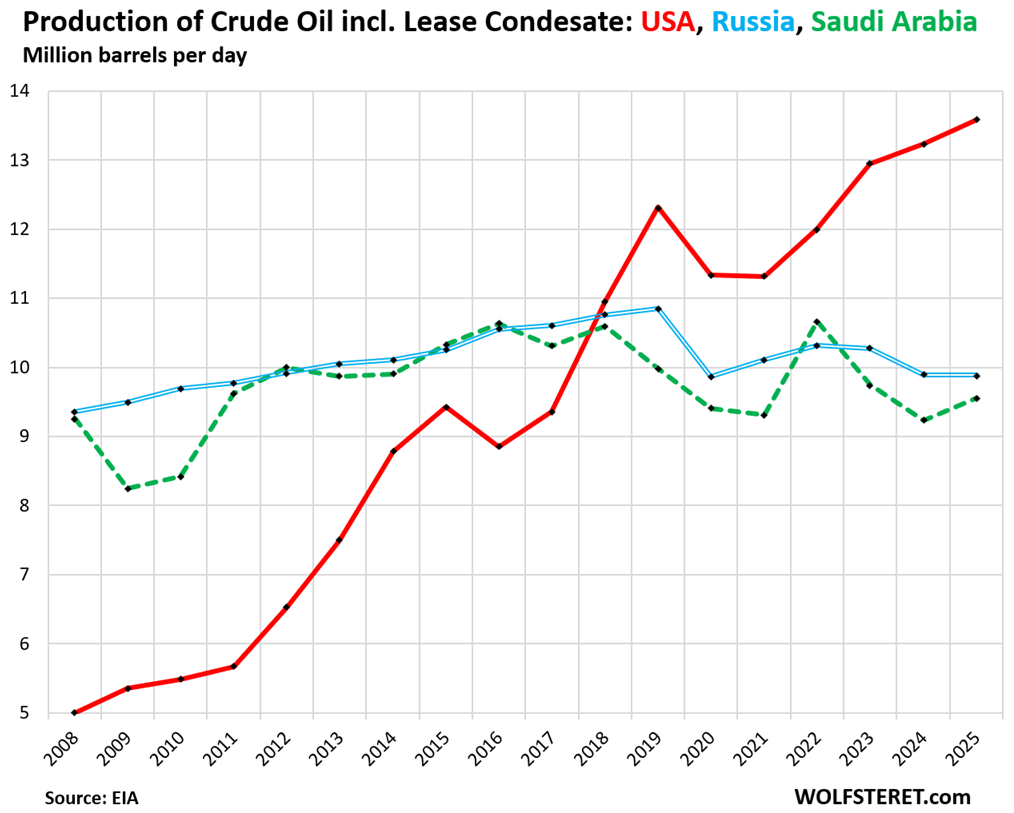
In 2018, the US became the largest crude oil producer in the world, surpassing Russia and Saudi Arabia. The gap has widened since then, with production declining in Russia and Saudi Arabia over those years, and soaring in the US. In 2025, US production of crude oil, including lease condensate, rose to a record 13.59 million barrels per day (MM b/d), up by 172% since 2008, according to EIA data. We discussed this on March 3, along with imports and exports — that the US is a net exporter of crude oil and petroleum products, including a huge exporter of diesel, gasoline, jet fuel, and other value-added products (with charts and all).
What is new today is the EIA’s update of the production data for other countries: #2 Russia produced 9.89 MM b/d of crude oil, including lease condensate, in 2025, down by a hair from a year earlier; and #3 Saudi Arabia produced 9.56 MM b/d of crude oil, including lease condensate, up by 3.5%.
And so in 2025, the US produced 37% more than Russia and 42% more than Saudi Arabia. In terms of quantity, the US produced a record 3.70 MM b/d more than Russia and a record 4.03 MM b/d day more than Saudi Arabia.
Lease condensate is a light, high-API gravity (45° to 75°) crude oil that typically enters the crude oil stream for refining or processing. It can also be blended with heavier more viscous crude oils to facilitate pipeline transportation. Or it can be used as refinery feedstock for the production of kerosene, jet fuel, diesel, gasoline, liquefied petroleum gas (LPG), light naphtha, and other products.
Further down on the world scale, to round off the top 10 producers of crude oil, including lease condensate, in 2025:
4. Canada: 5.0 MM b/d
5. Iraq: 4.4 MM b/d
6. China: 4.3 MM b/d
7. Iran: 4.1 MM b/d
8. UAE: 3.8 MM b/d
9. Brazil: 3.8 MM b/d
10. Kuwait: 2.6 MM b/d
“U.S. crude oil production has been buoyed by continued gains in drilling productivity and operational efficiency across key shale basins, which allow operators to extract more oil per well,” the EIA said in the report today.
Production in the Permian Basin of Texas and New Mexico rose by 4% in 2025, to 6.6 MM b/d, accounting for 48% of US production, according to the EIA. If the Permian Basin were a country, it would be the #4 producer in the world, ahead of Canada.
The strategic and economic importance of soaring US oil production – and the associated natural gas production that has made the US the largest natural gas producer in the world and the largest LNG exporter in the world – cannot be overemphasized:
It has created the strategic and economic advantages in the US of relatively cheap and reliable energy for transportation and commercial uses, as feedstock for the vast US petrochemical industry, for power generation, heating, fertilizers, and other purposes.
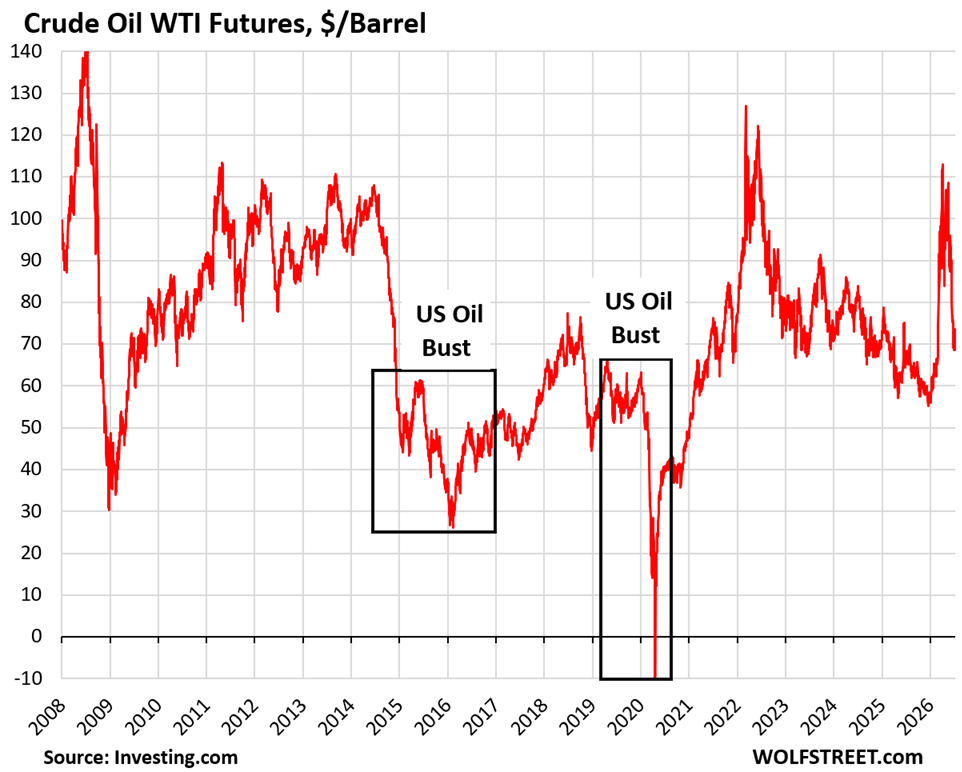
And it has reshuffled the global energy dynamics, which is why the closure of the Strait of Hormuz had little impact on supply in the US – though prices spiked initially due to massive speculation and due to the US market’s ties to the rest of the world via exports.
Meanwhile, the price of US benchmark grade West Texas Intermediate (WTI) has settled back down into the sweet spot for frackers at around $72 a barrel, after the brief speculative spike:
Enjoy reading WOLF STREET and want to support it? You can donate. I appreciate it immensely. Click on the mug to find out how:


Source: Original Article