


















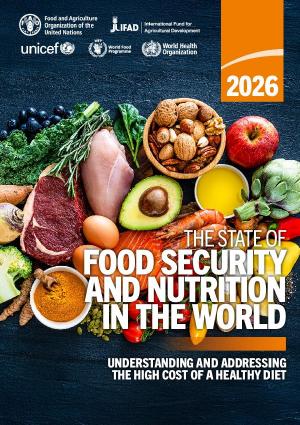
The 2026 edition of The State of Food Security and Nutrition in the World, published jointly by FAO, IFAD, UNICEF, WFP and WHO, identifies agricultural subsidy design as a structural reason healthy diets remain unaffordable for around 2.7 billion people. Global support to agricultural producers runs to roughly $540 billion annually, and about 70% of it is tied to a narrow band of commodities: grains, sugar, dairy, beef, and oil crops grown for livestock feed.
The report’s finding goes further than pricing. That concentration of support has made those commodities cheaper than unsubsidised alternatives while also incentivising processing, logistics and market infrastructure built around them. The authors describe the result as self-reinforcing pathways that make it harder for fruits, vegetables and legumes to compete.
Legume research left underfunded by design
The report is direct about what this has meant for plant proteins. Legumes, nuts and seeds are named as critical components of a healthy diet whose value chains suffer chronic research underfunding and processing bottlenecks. Yield improvements for leguminous crops appear limited, the authors argue, precisely because the sector has been neglected by historical agricultural policy rather than because the agronomy is intractable. Correcting that imbalance is described as an urgent priority.
Where funding has been directed at these groups, results followed. Targeted investment in grain legumes across sub-Saharan Africa and South Asia produced improved varieties now planted by millions of smallholders, with high estimated rates of return. Asian seed-sector reforms from the late 1980s opened the door to private investment in vegetable breeding and distribution, followed by rapid increases in production and consumption.
Reallocation without new spending
Redistributing existing producer support across food groups, with no increase in total expenditure, could raise fruit and vegetable consumption by around 10% in OECD countries. The report recommends shifting support away from starchy staples, whose prices are already structurally low after decades of policy backing, and towards underfunded nutrient-dense groups.
It also warns that repurposing carries trade-offs. Moving support away from staple cereals could raise staple prices before lower-cost alternatives reach markets, which would fall hardest on low-income consumers who depend on them.
Europe told not to intensify animal production further
On animal source foods, the report draws a regional distinction. In Europe, it states there is no reason to accelerate intensification of the meat and dairy sector, since prices there are already structurally low following decades of concentrated policy support and capital-intensive production systems. The affordability case for intensification, in the report’s framing, applies to Africa rather than to markets where animal products are already cheap.
Running alongside this is a warning against pursuing lower retail prices in isolation. The report puts the hidden costs of diet-related disease at USD 8.1 trillion annually and cautions that reducing what consumers pay must not shift costs onto society through environmental degradation, compromised food safety or precarious rural livelihoods.
Animal source foods, fruits and vegetables together account for close to 70% of the cost of a healthy diet globally, while starchy staples supply half the calories in the benchmark basket and one-sixth of the cost. The full report is available through FAO’s Open Knowledge repository.
Source: Original Article