Consumer staples and utilities benefit from inelastic demand: Households may cut discretionary spending during recessions, but they still need essentials like electricity, groceries, and household products, helping these sectors generate steadier earnings.
XLP and XLU offer a simple, low-cost defensive tilt: Both ETFs invest exclusively in large, liquid, profitable S&P 500 based companies while providing above-market dividend yields and historically lower volatility.
Defensive does not mean risk-free: Both sectors have historically experienced smaller drawdowns than the broader market during major bear markets, although they can still post substantial losses.
Don’t wait: the analyst who called NVIDIA in 2010 just revealed his top 10 AI stocks. See the full list FREE now.
mayu85 / Shutterstock.com
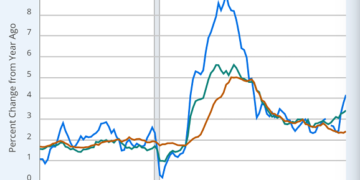
The U.S. economy has proven remarkably resilient over the past two decades. Sure, COVID briefly punished the economy, but the downturn was short-lived after the Federal Reserve slashed interest rates to near zero and launched another round of quantitative easing, purchasing large quantities of government and mortgage-backed debt to stabilize financial markets and support lending.
Even during the inflation shock and 2022 bear market, economic activity held up better than many expected. GDP continued expanding, productivity remained strong by historical standards, and the labor market stayed resilient. While hiring cooled across parts of the technology sector, healthcare employment continued to grow steadily.
One consequence of this resilience has been a stock market sitting near record highs. That is great for capital appreciation, but less so for income investors.When stock prices rise much faster than dividend payments, yields naturally compress. Today, the S&P 500 yields only about 1%, leaving many retirees and income-focused investors searching for alternatives.
If the goal is boosting portfolio income without venturing into covered calls, one straightforward approach is tilting toward sectors that have historically paid higher dividends. Many investors naturally gravitate toward real estate or energy, but both tend to be economically sensitive and can experience sharp earnings declines during recessions. Instead, there is a stronger case for emphasizing sectors whose products and services people continue buying regardless of the economic backdrop.
Don’t wait: the analyst who called NVIDIA in 2010 just revealed his top 10 AI stocks. See the full list FREE now.
Two stand out in particular: consumer staples and utilies. Both have historically demonstrated relatively defensive earnings characteristics while offering dividend yields comfortably above the broader market. In the sections ahead, we’ll examine why these sectors have traditionally held up better during downturns, and highlight an ETF representing each.
Why Consumer Staples and Utilities Tend to Hold Up Better
The common thread between consumer staples and utilities is a concept economists call inelastic demand. In simple terms, it means consumers continue buying a product or service even when prices rise or the economy weakens because it is considered a necessity rather than a discretionary purchase.
Electricity, natural gas, and water are obvious examples. Households may lower the thermostat a few degrees, but very few simply stop paying their utility bill. The same applies to consumer staples such as groceries, toothpaste, laundry detergent, diapers, and household cleaning products. People might switch to cheaper brands or buy fewer premium items, but they still need these products regardless of the economic cycle.
When households tighten their budgets during a recession , discretionary spending is usually the first thing to go. Vacations get postponed, restaurant meals become less frequent, and purchases of cars, electronics, and luxury goods are delayed. Essentials remain much further down the list of potential cuts. As a result, companies selling necessities often experience more stable revenue, which can help protect profit margins, earnings, and ultimately share prices.
It is not a perfectly causal relationship. Company-specific issues, regulation, valuation, and broader market sentiment still matter. But ceteris paribus, or all else being equal, sectors with more inelastic demand have historically held up better during economic downturns than more cyclical parts of the market.
How to Invest In Defensive Sectors Via ETFs
Investors can access these sectors through the State Street Consumer Staples Select Sector SPDR ETF (XLP) and the State Street Utilities Select Sector SPDR ETF (XLU). Both funds draw exclusively from the S&P 500, meaning every holding has already met the index’s size, liquidity, and profitability requirements before entering the portfolio.
Historically, both have also been less sensitive to market movements than the broader index. According to Yahoo Finance, XLP carries a five-year monthly beta of 0.54, while XLU’s is even lower at 0.49. Both also offer more income than the S&P 500, with 30-day SEC yields of 2.63% for XLP and 2.67% for XLU, that are largely qualified dividends. XLP and XLU are also highly affordable thanks to a 0.08% expense ratio, or around $8 a year in fee drag assuming a $10,000 investment.
These factors are why they form part of my Cockroach ETF Portfolio alongside healthcare stocks, gold, and Treasurys. This is an all-weather allocation designed for lower-risk investors or retirees who prioritize downside resilience alongside long-term equity exposure. Remember, sector ETFs can be useful as a long-term hold, not just as trading tools!
Don’t wait: the analyst who called NVIDIA in 2010 just revealed his top 10 AI stocks. See the full list FREE now.
Watts Water Technologies (WTS) is back in focus after a broad reclassification in the Russell index family, moving into larger cap, value, and defensive indices...