























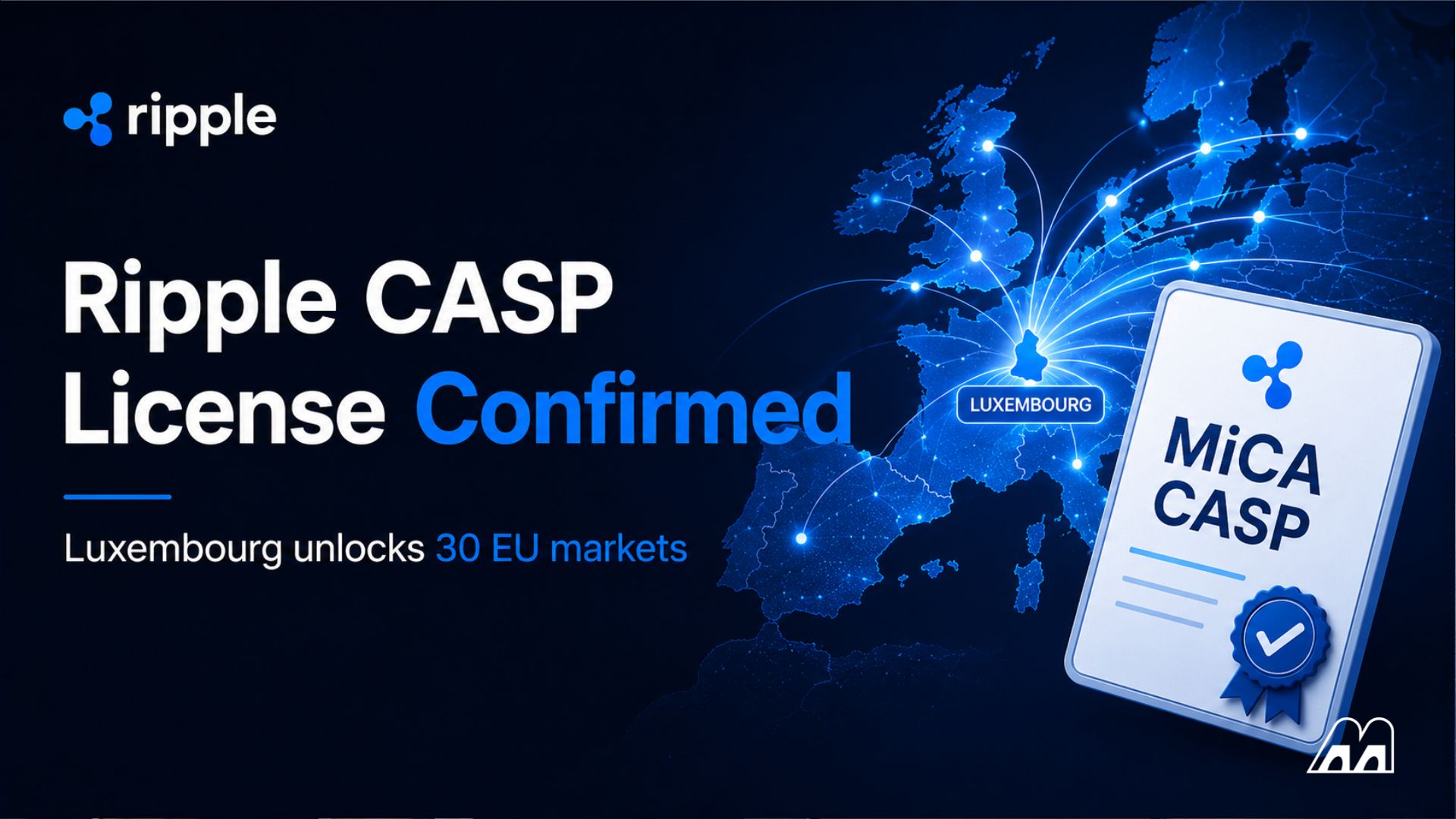
Ripple announced on July 6 that Luxembourg’s Commission de Surveillance du Secteur Financier (CSSF) has granted it full Crypto Asset Service Provider (CASP) authorization under the EU’s Markets in Crypto-Assets Regulation (MiCA). The Ripple CASP license follows a preliminary “Green Light Letter” issued on June 23 and makes Ripple fully MiCA-compliant, allowing it to offer regulated crypto payment services to financial institutions and businesses across all 30 European Economic Area countries.
Combined with the EU Electronic Money Institution (EMI) license Ripple already holds in Luxembourg, the authorization creates what the company describes as a single integration point for European banks and fintechs to access its full crypto and stablecoin payments infrastructure. Ripple now holds more than 75 regulatory licenses globally.
What the Ripple CASP License Covers
A CASP license under MiCA authorizes a firm to provide specific categories of crypto-asset services, including custody, exchange for fiat currency, exchange for other crypto assets, and transfer services. Once authorized in one EEA member state, the license “passports” across the entire bloc, eliminating the need for separate national approvals in each jurisdiction.
Ripple chose Luxembourg as its regulatory home, joining a group of institutional-focused crypto firms that have clustered in the country alongside Malta, Ireland, and the Netherlands. The CSSF used a two-step process, issuing the preliminary Green Light Letter in June before granting full authorization in early July, the same approach it used when approving Ripple’s EMI license earlier in 2026.
“This CASP authorisation means Ripple enters the post-transitional MiCA era fully compliant and ready to scale,” said Cassie Craddock, Managing Director for UK and Europe at Ripple.

Why the Timing Matters
The approval landed five days after MiCA’s transitional grace period expired on July 1, 2026. From that date, any entity providing crypto-asset services to EU clients without authorization is operating in breach of EU law. ESMA has been explicit that there are no extensions and no partial-compliance exceptions.
The conversion numbers illustrate the scale of the regulatory shakeout. Of more than 1,200 firms that previously held national Virtual Asset Service Provider registrations across the EU, only approximately 210 converted to full CASP status, a rate of roughly 17%. The remaining 83% either missed the window, abandoned their applications, or quietly exited the market.
Germany leads with 53 authorized entities. France, Luxembourg, Ireland, and the Netherlands processed the bulk of remaining approvals. Ten EU member states have yet to issue a single CASP license.
The most prominent casualty of the deadline is Binance. The world’s largest crypto exchange withdrew its MiCA application in Greece on June 24 after reports that the Hellenic Capital Market Commission was preparing to reject it, citing concerns around the exchange’s anti-money laundering history and the fit-and-proper test applied to majority owner Changpeng Zhao. Binance has since suspended new registrations and restricted services for EU users, though it says it plans to reapply through France.
How Ripple Compares to Other Licensed Firms
Ripple’s dual-license structure (EMI plus CASP) is relatively uncommon. Most crypto firms that cleared MiCA hold only a CASP license, which covers crypto-asset services but does not extend to electronic money functions. Ripple’s combination lets European clients move fiat into crypto, settle cross-border payments, and pay out in local currency through a single regulated pipeline.
Other major exchanges that have secured MiCA authorization include Coinbase (Central Bank of Ireland), Kraken (Ireland and Luxembourg), OKX (Malta), Crypto.com (Malta), Bitstamp (Luxembourg), and Bitpanda (Austria). Each of these can now passport services across the EEA and compete for the roughly 60% of European crypto transaction volume that was still flowing through unlicensed platforms at the deadline, according to industry estimates.
The competitive dynamic this creates is significant. Licensed firms are positioned to absorb a large wave of migrating users and institutional clients as unlicensed platforms wind down. Ripple’s pitch is specifically aimed at the institutional segment, where banks and fintechs require a regulated counterparty before integrating crypto payment rails into their operations.
The RLUSD Question Most Reports Are Missing
Ripple’s announcement highlights its stablecoin payments infrastructure alongside the CASP license. RLUSD, Ripple’s dollar-pegged stablecoin, has grown to approximately $1.7 billion in market capitalization and partners with institutions including BlackRock, Deutsche Bank, and LMAX.
However, a CASP license and an EMI license do not, by themselves, authorize Ripple to publicly offer RLUSD as a regulated stablecoin in the EU. Under MiCA, dollar-pegged stablecoins classify as e-money tokens (EMTs) and require a separate authorization process that includes publishing a MiCA-compliant white paper, meeting reserve requirements (including holding at least 30% in segregated EU bank deposits), and receiving approval from the home regulator.
As of early July 2026, RLUSD has not received EMT authorization in the EU. Circle’s USDC and EURC remain the only top-ten stablecoins by market cap that are fully MiCA-compliant. Tether’s USDT was effectively pushed out of EU-regulated exchanges after Tether chose not to pursue authorization, citing MiCA’s reserve requirements as incompatible with its model.
Ripple’s EMI license gives it the regulatory foundation to pursue EMT authorization for RLUSD, but that step has not yet been completed. Until it is, RLUSD cannot be offered to EU retail users through regulated exchanges, which limits one of the key revenue channels Ripple has been building around. This gap between the CASP authorization and RLUSD’s EU availability is the variable most likely to determine how quickly Ripple’s European payments volume can scale.

What It Means for XRP
The market’s response to Ripple’s licensing milestones has been consistently muted. When the preliminary CASP approval was announced on June 23, XRP dropped approximately 3% rather than rallying, dragged down by broader market weakness. XRP is currently trading near $1.05 to $1.12, down more than 70% from its $3.65 all-time high set in July 2025.
The pattern reflects a structural disconnect. MiCA licenses are granted to service providers, not to tokens. Ripple’s own announcement mentioned XRP only once, in the standard company description at the bottom of the press release. The commercial engine of the CASP approval runs through Ripple Payments and RLUSD infrastructure, with XRP functioning as one component of the broader ecosystem rather than the primary beneficiary.
XRP would benefit if European payment volume grows substantially and routes through the XRP Ledger, where each transaction burns a small amount of XRP in fees. But most of Ripple’s institutional payment flows currently settle in RLUSD or fiat. The fees generated from XRP-based settlements are fractions of a cent per transaction, too small to meaningfully affect token supply dynamics at current volumes.
For XRP holders tracking ETF inflows and the CLARITY Act’s progress through Congress, the CASP license adds to Ripple’s institutional credibility without creating a direct demand mechanism for the token.
What Comes Next
Ripple’s immediate priority in Europe is converting the CASP authorization into institutional client relationships. The company says its Ripple Payments platform has processed more than $100 billion in cumulative volume across 60-plus markets, and the dual-license structure in Luxembourg positions it to expand that volume into European corridors.
The European Commission opened a consultation in May 2026 on whether to revise MiCA, with responses due by August 31 and a full legislative report expected by June 2027. The review may extend MiCA’s scope to cover DeFi, staking, and NFTs, and could change the stablecoin reserve rules. Separately, a proposal to centralize CASP supervision under ESMA rather than national regulators would alter the dynamics that currently make Luxembourg, Malta, and Ireland preferred licensing hubs.
Roughly 80% of the EU’s previously registered crypto market has been removed from legal operation. The firms that remain are competing for a concentrated pool of institutional and retail demand with fewer rivals and a clearer regulatory framework than Europe’s crypto market has ever had. Whether Ripple captures a meaningful share of that opportunity depends on how quickly it can secure RLUSD’s EMT authorization and convert its regulatory advantage into actual payment volume flowing through its European infrastructure.
FAQs
What is a CASP license under MiCA?
A CASP (Crypto Asset Service Provider) license is the authorization required under EU MiCA regulation for any firm to legally offer crypto-asset services such as custody, exchange, and transfer to clients across the European Economic Area. Without it, firms cannot operate after July 1, 2026.
Does Ripple’s CASP license affect XRP directly?
The CASP license is a company-level authorization for Ripple’s payment services, not a token approval. XRP would only benefit indirectly if European payment volume grows and routes through the XRP Ledger, generating transaction fees. The token did not rally on either the preliminary or full approval announcements.
Can Ripple offer RLUSD in the EU with its CASP license?
Not yet. RLUSD classifies as an e-money token under MiCA and requires separate EMT authorization. Ripple’s EMI license provides the regulatory basis to pursue approval, but that process has not been completed. Until then, RLUSD cannot be publicly offered through EU-regulated exchanges.
How many crypto firms secured MiCA licenses before the July 1 deadline?
Approximately 210 out of more than 1,200 previously registered crypto firms converted to full CASP authorization by the July 1, 2026 deadline, a conversion rate of roughly 17%. Major licensed exchanges include Coinbase, Kraken, OKX, and Crypto.com. Binance withdrew its application and suspended EU services.
Source: Original Article