












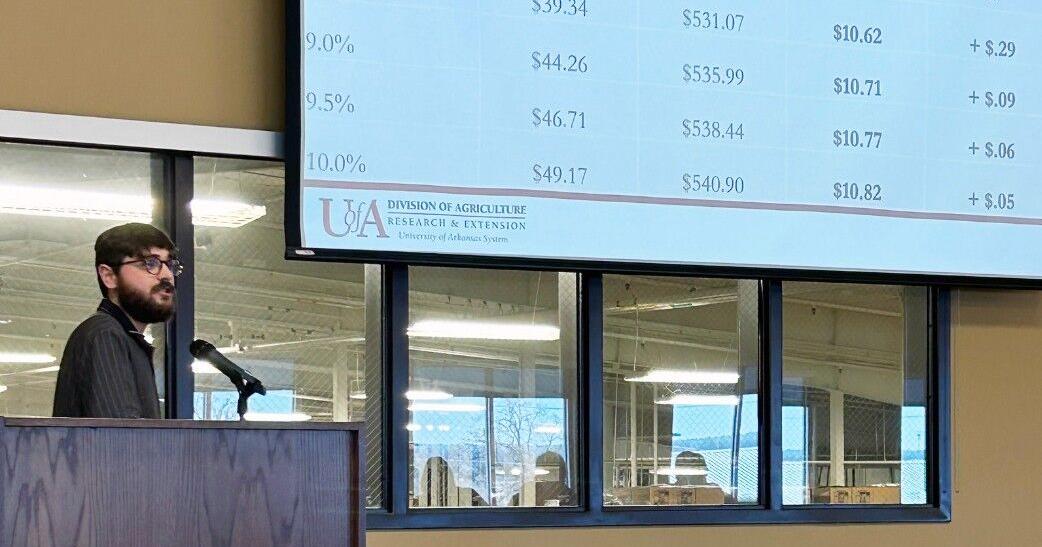

Extension economist Ryan Loy discusses Fed decision-making. (UADA image)
The Federal Reserve Open Committee’s decision to maintain current interest rates may be a temporary respite for farmers with loans before an anticipated rise later this year, said Ryan Loy, extension economist for the University of Arkansas Division of Agriculture.
At its June meeting, the committee voted to maintain the current rate of 3.5-3.75 percent, which is unchanged since a 0.25 percent cut in December 2025. The rate is not what consumers get but is the rate banks charge each other on loan transactions.
“Keeping the same pattern of the last two years, the Fed may wait until the end of 2026 to move the current benchmark rate,” Loy said.
The committee’s next move will be closely watched. The committee has four more meetings this year: July 28-29, Sept. 15-16, Oct. 27-28, and Dec. 8-9.
The rate is likely to be maintained at the July meeting, “given no other major geopolitical or trade disruptions,” Loy said.
“September is more difficult to forecast as industry analyst and market operator, the CME Group forecast a 49.5 percent of a rate hike,” he said. “As it stands now, this rate hike is increasingly likely as we move to the end of 2026.”
Uncertainty over the Strait of Hormuz, which channels some 20 percent of the globe’s oil consumption, and shifts in the movement of Venezuelan oil and sanctions against Russia and other exporters, energy loomed in the background as the committee made its decision.
“The main issue is determining whether energy-driven inflation will remain contained in the energy sector or spread throughout the economy,” Loy said.
That spread would be documented through core inflation measures such as the personal consumption expenditures price index, known as PCE, and the federal Bureau of Labor Statistics’ Consumer Price Index Report. The current core PCE is 3.4 percent, up from 3 percent in February, and up from 2.8 percent in May 2025. The federal Bureau of Economic Analysis noted that consumer spending on gasoline and other energy “goods” rose by $21.1 billion in the last year.
For farmers, “a rate reduction would provide some relief on interest expenses, but rising input costs next year may offset any relief from declining interest expenses,” Loy said. “A farmer may have to borrow more at a lower interest rate, which potentially could offset the relief.”
Kevin Warsh, who was appointed chairman of the Fed’s board of governors in May, said the committee was still committed to its previously stated goal of 2 percent inflation.
To learn about extension programs in Arkansas, contact your local Cooperative Extension Service agent or visit uaex.uada.edu.
Source: Original Article