










Image © Adobe Images
It’s a big week for the euro and dollar, with a central bank decision apiece.
The Euro to Dollar exchange rate has worked off the oversold conditions that marked its early-October lows, and with that relief now spent, we see the risk of the broader downtrend resuming.
The picture is complicated by decisions from the Federal Reserve on Wednesday and the European Central Bank on Thursday, but the medium-term signals favour the next move being lower.
From a technical perspective, the momentum picture has reset: the RSI, shown beneath the price chart, is back at a more comfortable 38 after a spell below 30, though it has turned lower again:
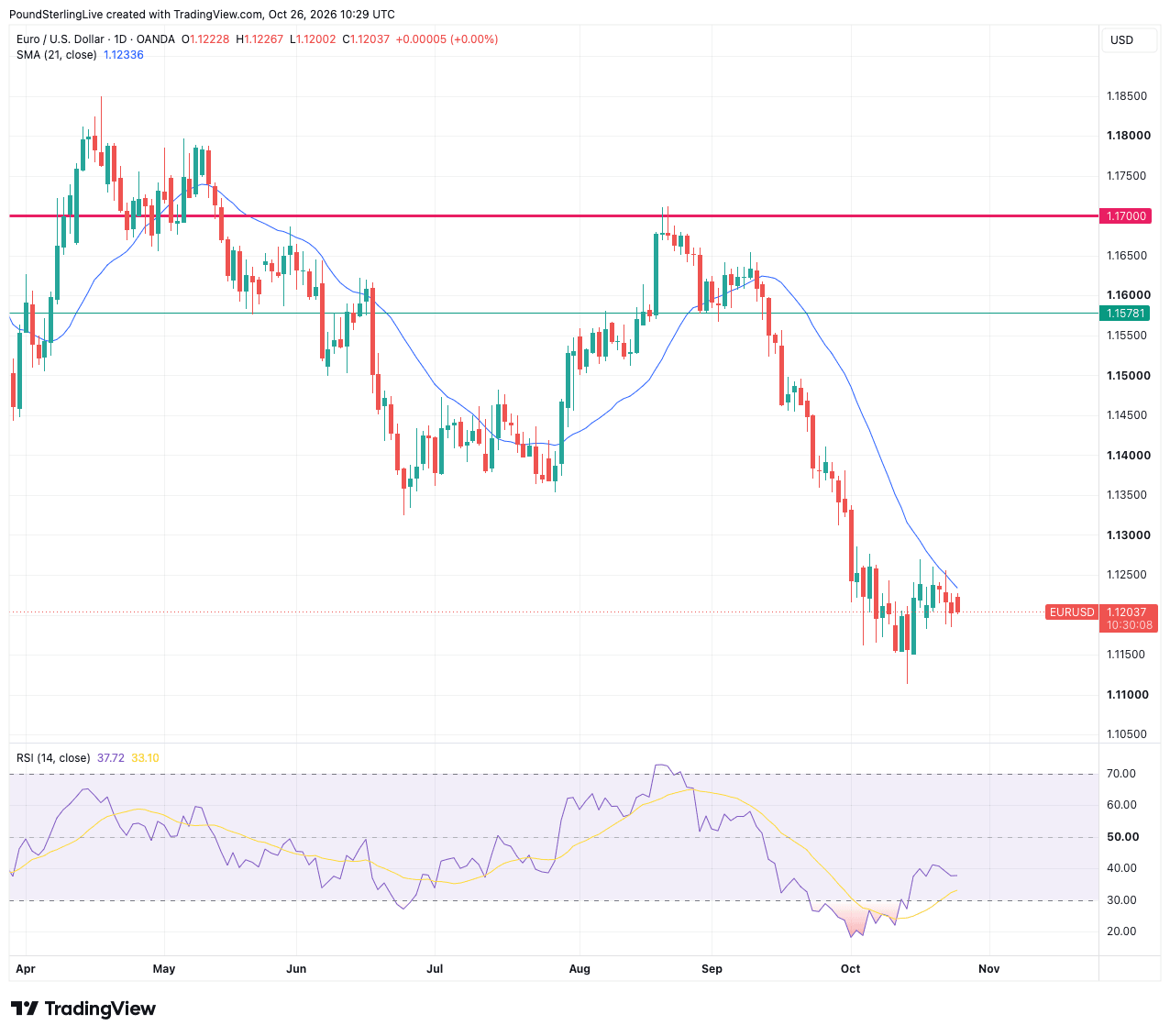
EUR/USD daily chart. Image © Pound Sterling Live, chart created with TradingView.
EUR/USD trades at 1.1204 at the start of the week.
The RSI fell below 20 in early October, a deeply oversold reading, and the rebound that followed has since unwound it. With momentum reset and the gauge pointing down again, the pair has room to fall without becoming stretched.
The pair has also re-established contact with its 21-day moving average, drawn in blue, after trading well beneath it for most of September and early October. The average sits at 1.1234 and is still falling, and pushes towards it last week faded, the latest at 1.1256 on Thursday.
That leaves the 21-day acting as a lid, and below it the 14 October low at 1.1113 is the next level of note.
We favour a move back towards 1.1150 this week and, beyond that, a retest of 1.1113. A daily close above Thursday’s 1.1256 high would change our near-term Euro to Dollar forecast.
Last week we called for a hold above 1.1150 and a modest rebound. The floor held, with no session trading below 1.1185, but the rebound stalled at the falling 21-day.
The Dollar Index Looks Ominous
The U.S. Dollar Index’s rally has paused, but the setup looks ominous and we prefer the upside.
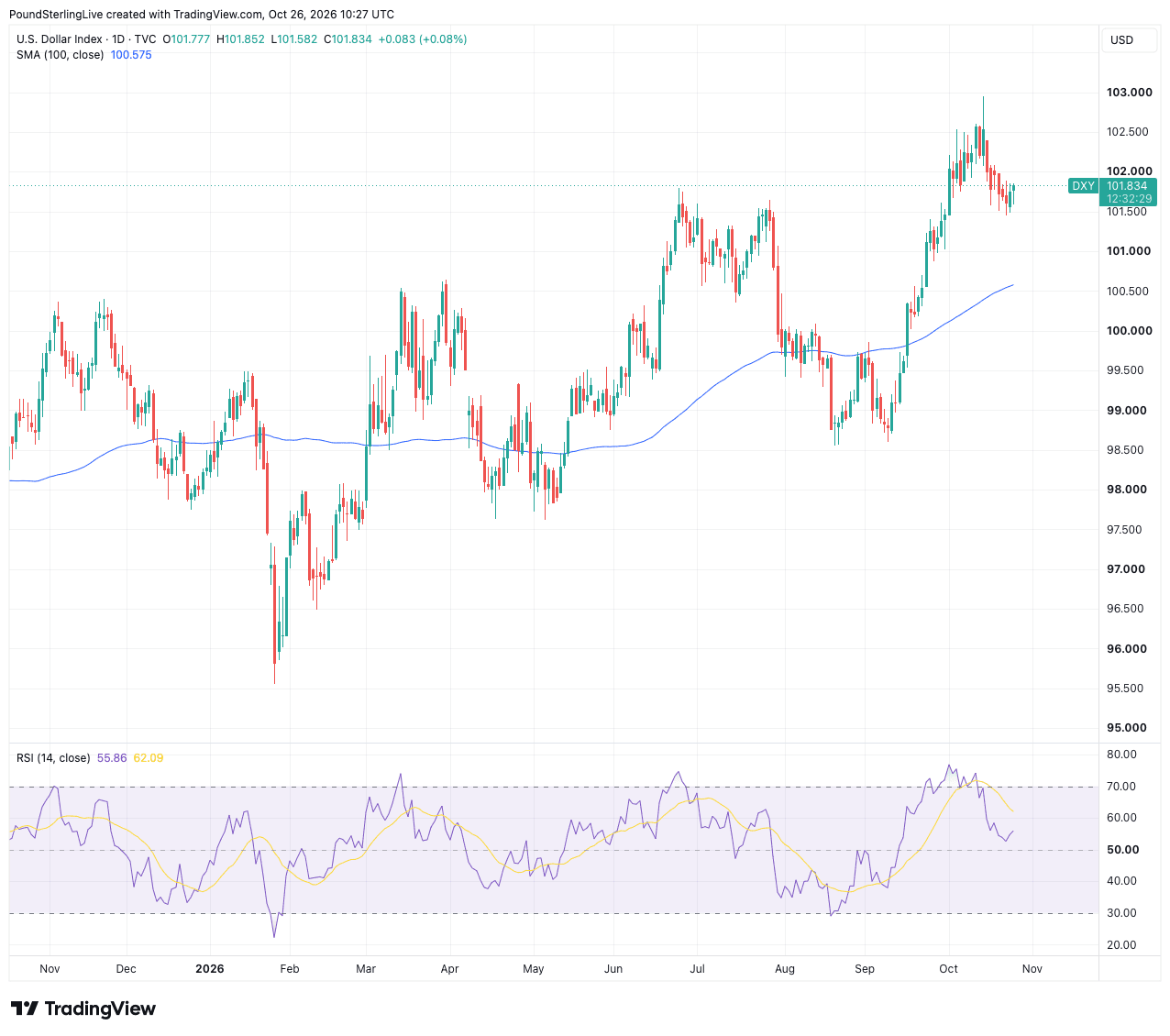
U.S. Dollar Index daily chart. Image © Pound Sterling Live, chart created with TradingView.
The index peaked near 103 in mid-October and has pulled back to 101.83, but it remains well above a rising 100-day moving average at 100.58, and its RSI has turned back up from the 50 midline.
A pause well above a rising 100-day reads as a correction within an uptrend. Buyers have stepped in long before the average was tested, and the trend that carried the index up from near 98.60 in early September remains in force.
Commonwealth Bank of Australia expects the dollar to recover some of last week’s losses but sees 103 as a ceiling for now.
The Case For and Against the Euro
Our base case is for weakness, but the research we track is split, and the opposing case deserves a hearing.
On the bearish side, Jeremy Stretch at CIBC Capital Markets argues that extended euro short positions could build further: “Such a scenario advocates for a EUR/USD retreat towards 1.111, which marks the mid-point of the trading range witnessed since the start of 2025 (1.0141–1.20810.) Only should the cross retake the 2 October high at 1.1285, we peaked at 1.1269 last Friday, would test the view,” he writes in a note of 23 October.
Bank of America’s technical strategists put it more briefly in their weekly note of 23 October: “sell corrective rally in EUR/USD.”
The bull case for the euro rests on those same short positions and on the AI-related stress in credit markets. Speculators hold their largest short euro position since October 2021, according to MUFG, which leaves room for a sharp squeeze, and the bank finds that the dollar has fallen against the euro in comparable episodes of tech credit stress.
“Following IG technology-credit widening regimes accompanied by falling Treasury yields, USD weakness has historically been concentrated against CHF and EUR. Over the subsequent six weeks, USD declined by an average 2.07% against CHF and 1.50% against EUR, while DXY fell 1.23%,” says MUFG in its FX Weekly of 23 October.
French risks seem to have faded somewhat, but it is hard to see any tailwind emerging from that quarter. The French parliament debates the government’s budget savings this week, and Budget Minister David Amiel has said amendments already approved would widen the deficit by €10bn, according to CBA.
ECB Decision Is Key for the Euro
The ECB announces its decision at 13:15 on Thursday, with consensus at an unchanged 2.50% deposit rate and a December hike around 75% priced, according to Brown Brothers Harriman.
A press conference that keeps December in play would support the euro, and anything that softens it would weigh. “We believe that the outcome of the ECB policy meeting could thus largely corroborate market rate hike expectations, in a boost to the EUR’s relative rate appeal,” writes Crédit Agricole CIB in a note dated 23 October.
Bank of America leans the other way, expecting the ECB on hold “leaning dovish as tighter financial conditions offset renewed energy-price risks,” with some form of verbal intervention likely on French bond markets.
Eurozone GDP for the third quarter, where consensus is 0.2% growth on the quarter, and German October inflation, forecast at 3.1%, close the week on Friday. Above-consensus prints would support the euro.
The Fed’s Hawkish Bias Underpins the Dollar
The Fed decides at 18:00 on Wednesday, with consensus looking for no change at 3.75% to 4.00%. A message that firms up a December hike would extend the dollar’s advance, while any hint of patience would hand the euro some relief.
“The bar for pricing out a December Fed hike appears fairly high, which should prevent larger USD corrections for the moment,” says ING in an FX note of 23 October.
Thursday’s U.S. GDP and core PCE figures follow, with consensus at 3.0% and 0.3% month-on-month respectively, and prints above consensus would back the dollar.
With the dollar’s uptrend intact, the 21-day capping the pair and few tailwinds for the euro, we favour the next move being lower, and our Euro to Dollar forecast looks for a drift towards 1.1150 this week.
Source:
Original Article