








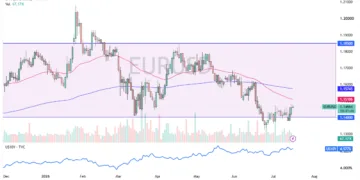



















The Euro (EUR) trades marginally lower to near 1.1460 against the US Dollar (USD) during the European trading session on Thursday after giving back its early gains. The EUR/USD pair turns upside down as the US Dollar bounces back amid fears that elevated energy prices due to Middle East tensions will keep global inflation projections de-anchored.
At press time, the US Dollar Index (DXY), which gauges the Greenback’s value against six major currencies, trades slightly higher to near 100.57.
Crude oil prices are likely to stay higher as the global energy supply is expected to remain disrupted amid fears that the military aggression between the United States (US) and Iran would widen. During the day, an Iranian army spokesperson said that the US continues to attack several areas, while warning that the war will spread to new arenas, the Islamic Republic News Agency (IRNA) reported.
On Wednesday, US President Donald Trump also warned, in an interview with Fox News, that he will authorize bombing Iranian bridges and power plants if Tehran doesn’t return to the table for negotiations.
In the last two trading days, the US Dollar faced selling pressure as traders scaled back Federal Reserve (Fed) interest rate hike expectations due to cooling US inflationary pressures in June.
Going forward, investors will focus on the US Retail Sales data for June, which will be published at 12:30 GMT. The US Retail Sales are estimated to have risen at a moderate pace of 0.2% Month-on-Month (MoM) against 0.9% in May.
Economic Indicator
Retail Sales (MoM)
The Retail Sales data, released by the US Census Bureau on a monthly basis, measures the value in total receipts of retail and food stores in the United States. Monthly percent changes reflect the rate of changes in such sales. A stratified random sampling method is used to select approximately 4,800 retail and food services firms whose sales are then weighted and benchmarked to represent the complete universe of over three million retail and food services firms across the country. The data is adjusted for seasonal variations as well as holiday and trading-day differences, but not for price changes. Retail Sales data is widely followed as an indicator of consumer spending, which is a major driver of the US economy. Generally, a high reading is seen as bullish for the US Dollar (USD), while a low reading is seen as bearish.
Next release:
Thu Jul 16, 2026 12:30
Frequency:
Monthly
Consensus:
0.2%
Previous:
0.9%
Source:
US Census Bureau
Source:
Original Article


