










- On June 27, 2026, Duolingo, Inc. was reclassified across the Russell family of indices, being added to several value benchmarks and removed from multiple growth benchmarks.
- This pivot from growth to value index inclusion signals a meaningful shift in how quantitative index providers currently categorize Duolingo’s profile.
- We’ll now examine how Duolingo’s move into value-focused Russell indices may reshape its existing investment narrative and risk balance.
Outshine the giants: these 16 early-stage AI stocks could fund your retirement.
Duolingo Investment Narrative Recap
To own Duolingo, you need to believe its mobile learning platform can keep converting a large, engaged user base into profitable, recurring subscription and exam revenue, even as AI tools proliferate. The shift from Russell growth to value indices mainly affects which passive funds hold the stock; it does not directly change product adoption, which still looks like the key near term catalyst, or competition from AI driven language tools, which remains the central risk.
The most relevant recent announcement is Duolingo’s plan to report Q2 2026 results on August 5. With the index reclassification now in play, that update becomes an important checkpoint on how revenue, profitability and user trends are tracking against both the growth heavy history implied by its former benchmarks and the more valuation driven profile suggested by its new Russell value index inclusion.
Yet, while this index shift may appear positive on the surface, investors should still pay close attention to the risk that…
Read the full narrative on Duolingo (it’s free!)
Duolingo’s narrative projects $1.5 billion revenue and $198.2 million earnings by 2029.
Uncover how Duolingo’s forecasts yield a $104.97 fair value, a 18% downside to its current price.
Exploring Other Perspectives
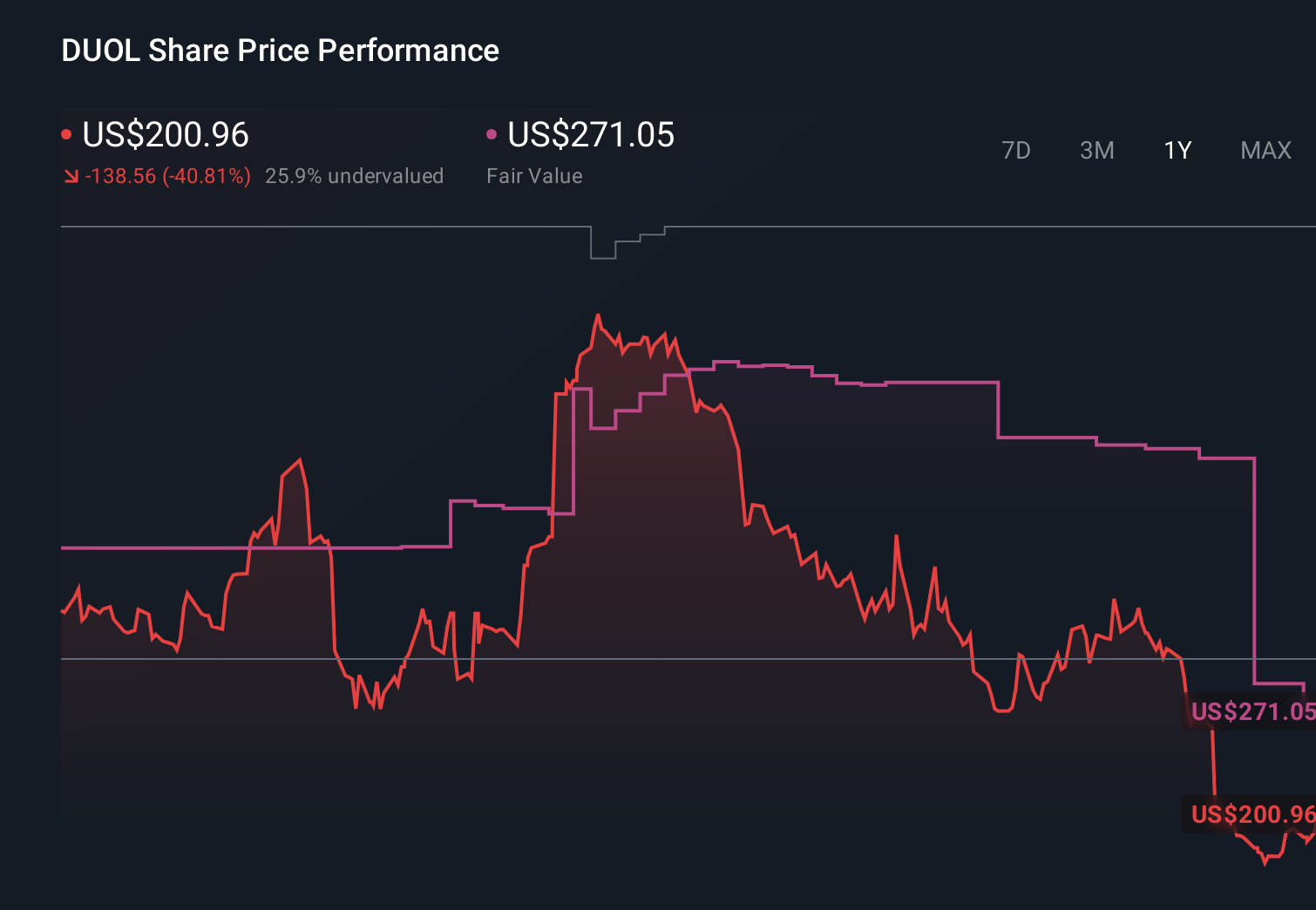
While the consensus narrative focuses on growth in users and new subjects, the lowest analysts pair this index move with concern about slower user growth and earnings potentially falling toward about US$100.8 million by 2029, reminding you that expectations differ sharply and both stories could evolve as Duolingo’s value classification and future results interact.
Explore 24 other fair value estimates on Duolingo – why the stock might be worth 37% less than the current price!
The Verdict Is Yours
Disagree with existing narratives? Extraordinary investment returns rarely come from following the herd, so go with your instincts.
Interested In Other Possibilities?
Every day counts. These free picks are already gaining attention. See them before the crowd does:
This article by Simply Wall St is general in nature. We provide commentary based on historical data
and analyst forecasts only using an unbiased methodology and our articles are not intended to be financial advice. It does not constitute a recommendation to buy or sell any stock, and does not take account of your objectives, or your
financial situation. We aim to bring you long-term focused analysis driven by fundamental data.
Note that our analysis may not factor in the latest price-sensitive company announcements or qualitative material.
Simply Wall St has no position in any stocks mentioned.
New: Manage All Your Stock Portfolios in One Place
We’ve created the ultimate portfolio companion for stock investors, and it’s free.
• Connect an unlimited number of Portfolios and see your total in one currency
• Be alerted to new Warning Signs or Risks via email or mobile
• Track the Fair Value of your stocks
Have feedback on this article? Concerned about the content? Get in touch with us directly. Alternatively, email editorial-team@simplywallst.com
Source: Original Article