














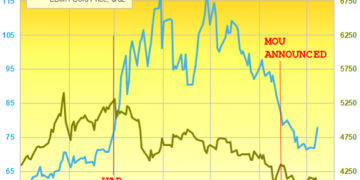









Oil prices rose on Wednesday after President Trump said the US-Iran memorandum of understanding is “over” and the US launched a renewed wave of attacks on Iran.
Futures on Brent crude (BZ=F), the international benchmark, jumped more than 5% to cross $78 per barrel after a similar climb on Tuesday. Contracts on US WTI crude (CL=F) advanced by a similar margin to trade above $74, as both products hit two-week highs.
Prompted by Iranian attacks on three vessels in and near the Strait of Hormuz on Tuesday, the US military on Tuesday night began a series of air strikes inside Iran that struck more than 80 targets — including both military installations and vessels used by Iran’s Revolutionary Guard Corps — overnight according to US Central Command.
Only hours later, President Trump said in the Turkish capital of Ankara — where he is participating in a major NATO summit — that the deal signed by the US and Iran, intended to allow the two sides to find a path to lasting peace, was likely ended.
“For me, I think it’s over,” Trump said early Wednesday morning in Ankara at the annual NATO summit. “As far as I’m concerned, it’s just a waste of time.”
The waves of attacks by both sides and President Trump’s comments threaten to derail what was already a tenuous situation in the Middle East. Such a tit-for-tat exchange of military action had already occurred once since the memorandum was signed, though leaders in Washington and Tehran quickly agreed to return to a ceasefire.
Read more: How oil price shocks ripple through your wallet, from gas to groceries

‘Elevated’ uncertainty in the near-term
On Tuesday, the US Treasury Department’s Office of Foreign Asset Control (OFAC) rescinded a sanctions waiver it had granted Iran, allowing the nation to sell its crude oil on the global market, likely to deal a major economic blow to Tehran. Experts have estimated that the regime derives more than 80% of its funding from oil sales, and Tehran had made the removal of sanctions a key red line in negotiations with the US.
The developments leave the oil market in a fragile position. While 15 million barrels of oil crossed through the Strait of Hormuz on Monday, those levels dropped to roughly 6 million barrels on Tuesday before falling even further to near zero on Wednesday — putting immediate pressure on an already tight oil market.
In terms of vessel crossings, those have fallen from around 20 on Monday to just 11 on Tuesday before completely halting on Wednesday, per Rystad data. Data from the intelligence firm Kpler showed somewhat higher numbers, noting 41 verified crossings on Tuesday.

Source: Original Article