

























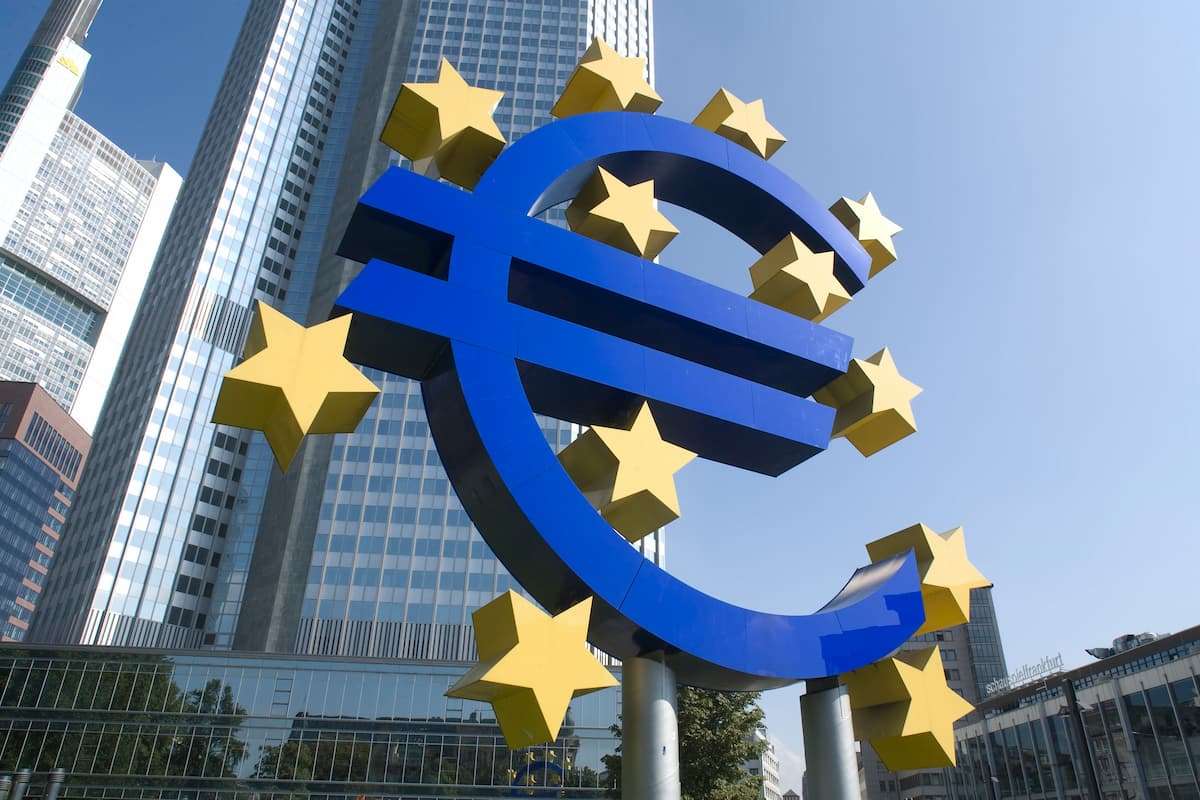

© ECB
The launch of the European Central Bank’s climate factor is a significant moment for green monetary policy. The move recognises that carbon intensive assets can be exposed to risks from atransition to a decarbonised economy and that these are not currently captured by traditional risk assessment methods.
The climate factor attempts to price in those risks (for example, the risk of an asset becoming stranded), with each asset given an “uncertainty score”, based on how exposed the relevant sector and company are to climate risks. This score is then converted, according to a formula set by the ECB, into a “climate factor” – with high uncertainty generating a low climate factor, and vice versa. Assets with a low climate factor are ultimately penalised – their value as collateral is (slightly) discounted – whereas assets with a high factor are barely impacted (if at all).
The ECB sees this as a way of protecting itself from potential losses due to transition risks. Butin reality, the climate factor can have far-reaching consequences. Because assets with high transition risks are worth less than before, banks are less likely to pledge them as collateral. This makes it more costly for the corporations that own high risk assets.
Strengthening the climate factor
The climate factor could be a powerful tool to tackle the carbon bias in the collateral framework, potentially restricting indirect support for the worst polluters. But to achieve this, the ECB needs to address some apparent weaknesses in the way the scheme is implemented.
- Increase transparency. The ECB does not intend to publish the climate factor for each asset, nor will it publish key parameters such as the minimum value of the factor. This will make it difficult for external stakeholders to evaluate the measure. The ECB should increase transparency regarding the climate factor and its underlying components.
- Make the calculations automatic. Currently, climate factors will only be calculated for assets on an annual basis, and not when the asset becomes eligible. Assets that become eligible between annual updates are assigned a median climate factor, which will not reflect the asset’s actual transition risks. Given that some assets are short-term, there is a risk that high carbon assets could slip through the scoring system. But this need not be the case. The scores for most sectors and most companies will already have been calculated.It will generally be possible to calculate the climate factor for each asset automatically, as soon as the asset becomes eligible. This would result in a more meaningful climate factor than adopting a median factor for everything.
- Address the carbon bias. Historically, the collateral scheme has advantaged high carbon activities by granting eligibility and assigning relatively low haircuts (the percentage reduction given to the value when pledged as collateral). Some have argued that to remedy that advantage, the most polluting activities should be excluded from the collateral scheme. With the climate factor, all carbon intensive assets remain eligible as collateral, albeit at a lower value. What is not clear is whether the decrease will be enough to make them less attractive compared to other assets. If it is not, it will not deliver the disincentive needed to drive a change in how high carbon assets are treated and therefore must be strengthened. The exclusion of some assets (asthe Bank of England did recently by excluding coal mining) could enhance its impact even more.
Extending the factor
The ECB accepts a variety of asset types as collateral, each with its own specificities, and decided to focus on just one of them to begin with. However, this means that the climate factor, as designed, only applies to a small portion of the assets pledged as collateral in the Eurosystem – less than 5%.
Due to the differences between the types of assets, replicating the climate factor across the collateral framework would be difficult, if not impossible. Instead, the ECB needs to investigate how to extend the principle of the climate factor whilst adjusting the methodology to each asset type.
One obvious way of doing this would be to start with credit claims, which are among the most common asset classes pledged as collateral. A climate factor for credit claims could be primarily constructed on data about the company’s sector, to avoid data availability issues.
By implementing the climate factor, the ECB is taking an important step forward in integrating climate change into its monetary policy. As this is the ECB’s first attempt to incorporate climate considerations into its collateral framework, there is clearly a need for a watching brief to evaluate the impact and refine the measure where necessary.
As the financial sector becomes increasingly alert to the risks posed by climate change, it can only be hoped that the ECB’s appetite and ambition to integrate climate change throughout its activities continues to increase.
This page was last updated July 6, 2026
Written by

Clarisse Murphy is a central banks campaigner at Reclaim Finance and works on promoting monetary policy that is aligned with current environmental and social challenges. Before joining Reclaim Finance, Clarisse contributed to the work of various organisations specialising in human rights.
Source: Original Article