
















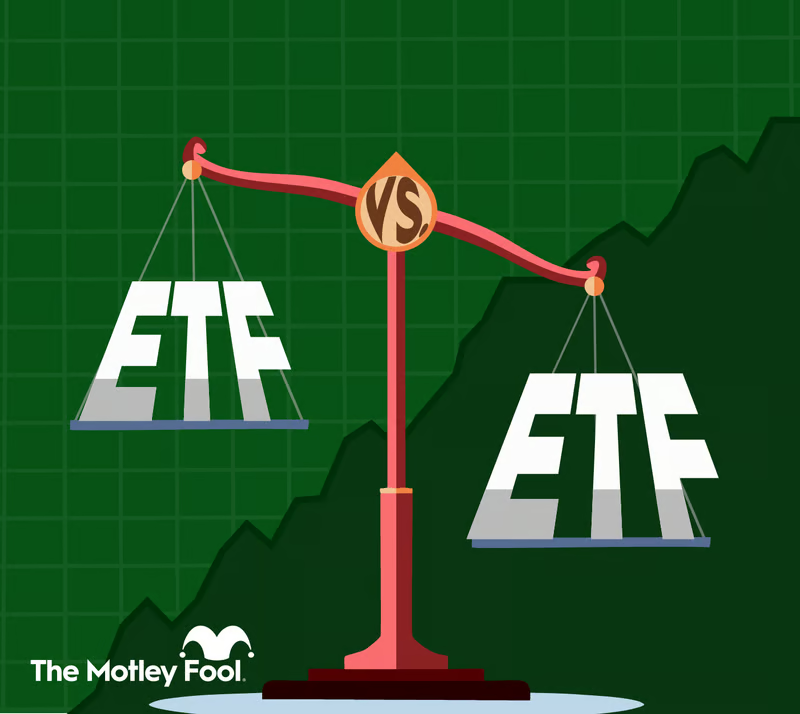
The iShares 10+ Year Investment Grade Corporate Bond ETF (IGLB +0.32%) and the Vanguard Long-Term Corporate Bond ETF (VCLT +0.31%) offer nearly identical long-term corporate bond exposure, differing primarily in yield and cost.Both funds target the long end of the corporate credit curve, providing income through investment-grade debt. Investors often look to these ETFs for higher yields than government bonds, though they may accept greater sensitivity to interest rate shifts and corporate credit risk in exchange.Snapshot (cost & size)MetricVCLTIGLBIssuerVanguardiSharesExpense ratio0.03%0.04%1-yr return (as of June 17, 2026)6.60%6.80%Dividend yield5.53%5.22%Beta0.620.61AUM$9.2 billion$2.6 billionBeta measures price volatility relative to the S&P 500; beta is calculated from five-year monthly returns. The 1-yr return represents total return over the trailing 12 months. Dividend yield is the trailing-12-month distribution yield.The Vanguard fund is slightly more affordable with an expense ratio of 0.03%, compared to 0.04% for the iShares fund. Additionally, the Vanguard fund provided a higher payout with a 5.50% trailing-12-month dividend yield.Performance & risk comparisonMetricVCLTIGLBMax drawdown (5 yr)(34.30%)(34.10%)Growth of $1,000 over 5 years (total return)$887$896What’s insideThe iShares 10+ Year Investment Grade Corporate Bond ETF (IGLB +0.32%) is a fixed income fund consisting of roughly 3,800 holdings, primarily high-quality corporate debt with maturities over 10 years. Its largest positions include various investment-grade issues, though the portfolio is highly diversified and no single position exceeds 0.29% of the portfolio. Launched in 2009, this iShares fund has paid $2.62 per share over the trailing 12 months.The Vanguard Long-Term Corporate Bond ETF (VCLT +0.31%) manages a portfolio across thousands of investment-grade corporate debt with maturities between 10 and 25 years. Like its peer, the fund is highly diversified and no single position exceeds 0.38% of the total assets under management (AUM). Also launched in 2009, the Vanguard fund has a trailing-12-month dividend of $4.15 per share.For more guidance on ETF investing, check out the full guide at this link.What this means for investors Long-term corporate bond ETFs can look appealing when yields are high. However, they are some of the most sensitive options in the investment-grade bond market when it comes to interest rates. Both IGLB and VCLT invest in long-maturity corporate debt, which means investors face considerable risks from changes in interest rates and credit spreads.The iShares 10+ Year Investment Grade Corporate Bond ETF and the Vanguard Long-Term Corporate Bond ETF share very similar exposures. Both own diversified portfolios of investment-grade corporate bonds with maturities beyond 10 years, so their broad performance should usually be driven by the same forces: long-term Treasury yields, corporate spreads, and investor demand for credit. VCLT has a slight cost advantage, while IGLB may differ in benchmark construction and holdings mix but those differences are secondary to the shared long-duration credit exposure.Investors are choosing how to allocate within the high-duration corporate bond category, rather than between fundamentally different funds. VCLT may suit investors prioritizing low cost, while IGLB may appeal to investors who prefer its structure or benchmark. Neither fund is a substitute for cash, short-term bonds, or low-volatility fixed income, as they are intended for investors comfortable with rate sensitivity and corporate credit risk.
Source link


The notable upward performance of ASE Technology Holding was primarily driven by the ongoing artificial intelligence boom and robust company fundamentals, particularly the surging demand...
Read moreDetails