























The key event at the annual central-bank gathering in Sintra is due at 3pm CET on Wednesday, when Christine Lagarde, Kevin Warsh, Andrew Bailey and Tiff Macklem appear on the same panel.
Markets are coming into the session after Lagarde, Warsh and Bailey all delivered restrictive signals in mid-June, highlighting concern over inflation persistence.
Since then, oil has continued to correct towards levels seen before the Middle East conflict, falling more than 45% from its May peak. That move has softened expectations for further monetary tightening.
Fed funds now imply only one further 25 basis points of tightening, taking rates to 4.00%, while Euribor futures suggest the ECB may deliver one final move of the same size to 2.50% after the summer rather than in July. SONIA pricing also implies that if the Bank of England does raise by 25 basis points, it may not come until late in the year.
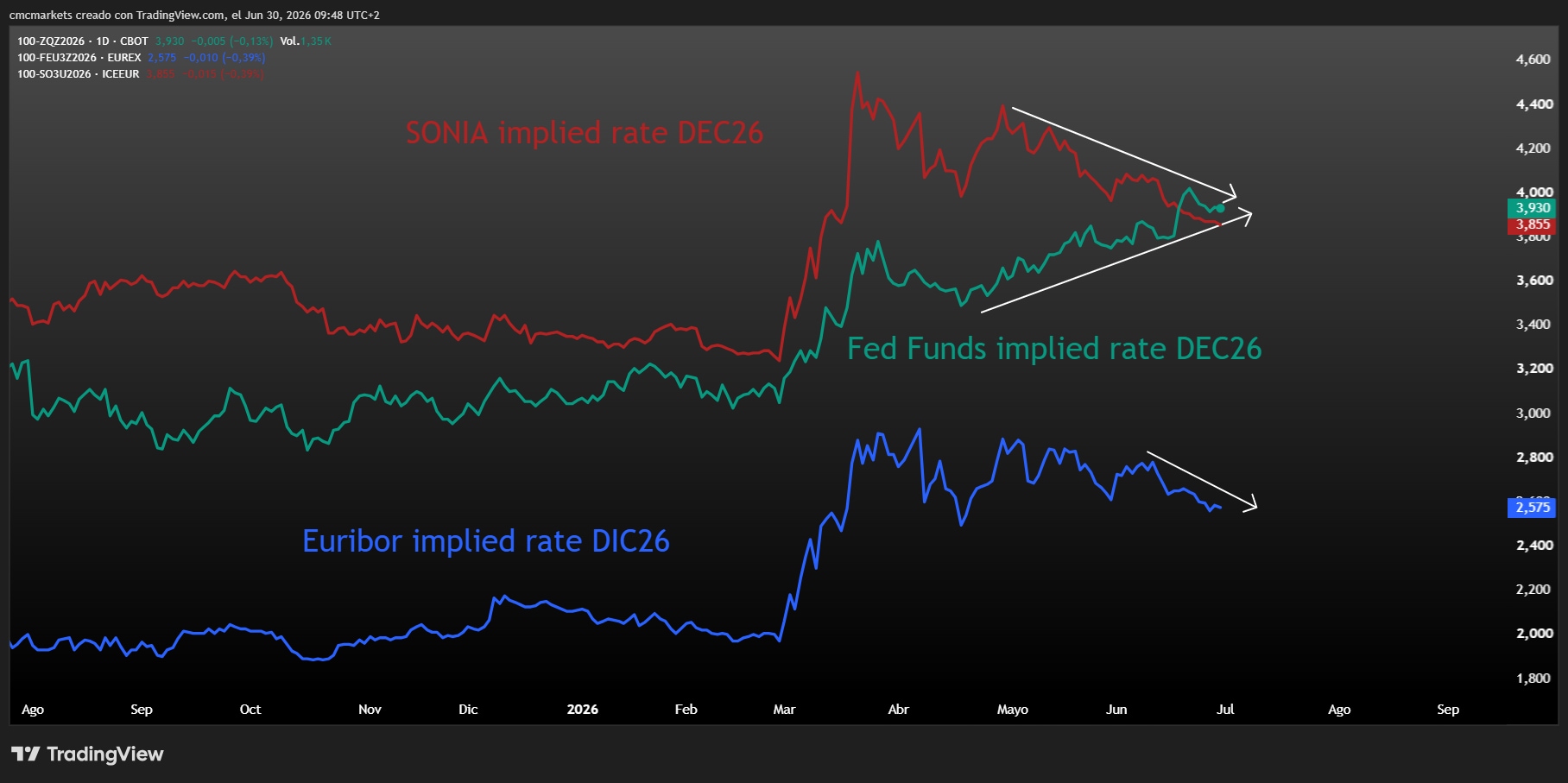
Implied rates in Fed funds, Euribor and SONIA (Dec 2026), built with TradingView as of 30 June 2026
That backdrop could reinforce a clearer policy split between the major central banks.
Lagarde and Bailey oversee economies that are more exposed to energy shocks and closer to stagnation, making the ECB and the Bank of England more sensitive to the recent fall in oil and less willing to tighten unnecessarily.
By contrast, Warsh’s Fed debut was explicitly hawkish, with the main risk framed as persistent inflation. In the US, that pressure is no longer coming only from traditional commodities, but also from more expensive memory chips, storage and artificial-intelligence infrastructure, which may keep core inflation sticky.
That divergence is starting to feed through into foreign exchange, with the US dollar regaining traction while both the euro and sterling test important technical zones.
EUR/USD looks more fragile because of the unfavourable rate differential and is testing support at 1.1410-1.1389, the base of the broad sideways range that has held for months.
GBP/USD is showing a similar pattern and is approaching support at 1.3160-1.3010, the lower boundary of an eight-figure range that has held for more than a year.
If Warsh remains clearly hawkish while Lagarde and Bailey adopt a more neutral tone, the policy gap may widen further and increase the pressure on both sets of support. Sintra could become the first major test of whether monetary divergence between the US and Europe is finally feeding through decisively into FX.
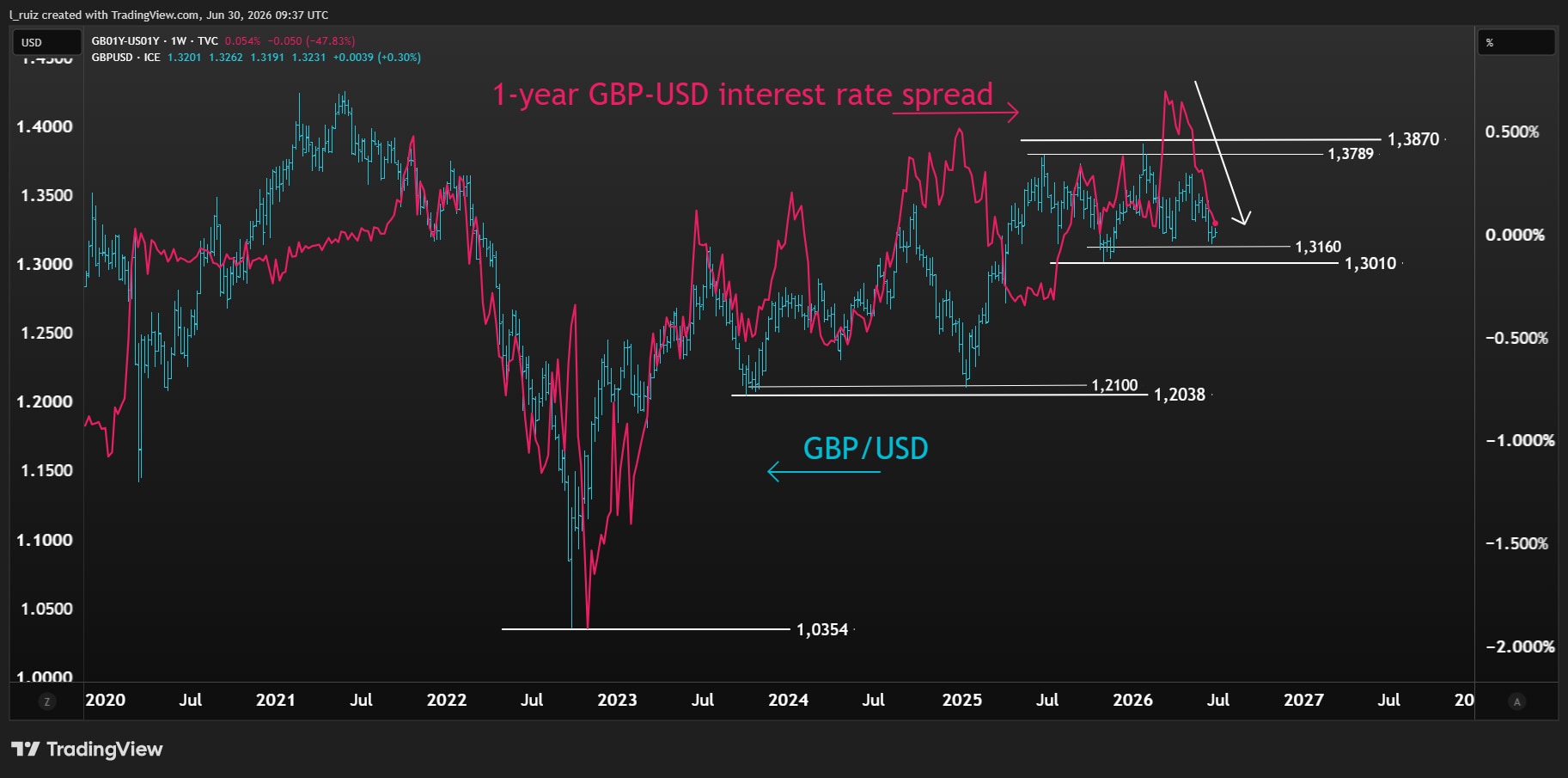
GBP/USD weekly chart and one-year UK-US yield spread, built with TradingView as of 30 June 2026
Source: Original Article