










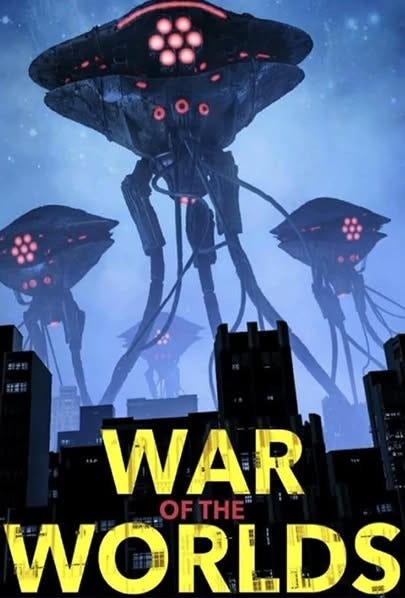
On October 30, 1938 a very young Orson Welles pulled a clever stunt. He masterminded a live radio dramatization of H.G. Wells’s War of the Worlds, presented as if CBS was actually reporting on a Martian invasion. Although the program occasionally notified listeners that it was a dramatic presentation, not news, thousands of Americans panicked, packing churches, fleeing their homes, and jamming switchboards.
Last weekend Citrini Research released a report — on Substack! — titled The 2028 Global Intelligence Crisis. The report, which rapidly went viral, laid out a scenario for economic and financial chaos caused by AI, written as if it were a retrospective published after the dire developments it projected. Although it’s always hard to know why financial markets move on any given day, the report may have played a role in Monday’s 800-point decline in the Dow. Science fiction moving markets? Why not?
There are two distinct questions about the huge reaction to a report that didn’t actually contain any news. It was just opinion, albeit cleverly presented. The first is whether the economic scenario the report laid out makes sense, to which the answer is no. The second is why investors are so on edge that such a report could elicit such an extreme reaction.
Citrini Research argued that AI will rapidly disrupt many businesses – a statement that could be true but is hardly news. Interestingly, the authors didn’t stress the ways AI could replace human workers. Instead, they argued that AI agents can replace many businesses that act as middlemen.
Their motivating example was DoorDash, America’s largest online food delivery company. When you go to DoorDash’s website to order a meal, the company’s algorithm both passes that order on to the restaurant and arranges for delivery by a gig-worker driver. All this, the authors argued, will become unnecessary. Writing as if describing past events, they say
Coding agents had collapsed the barrier to entry for launching a delivery app. A competent developer could deploy a functional competitor in weeks, and dozens did, enticing drivers away from DoorDash and Uber Eats by passing 90-95% of the delivery fee through to the driver. Multi-app dashboards let gig workers track incoming jobs from twenty or thirty platforms at once, eliminating the lock-in that the incumbents depended on. The market fragmented overnight and margins compressed to nearly nothing.
Could this happen? Maybe. The ludicrousness of much AI hype shouldn’t blind us to the growing evidence that it is significantly changing some kinds of work. When someone like Mike Konczal explains how AI has transformed some parts of his work, I sit up, take notice, and resolve to try it out myself (eventually).
Examples of industries that have been quickly wiped out by technological change — not as quickly as the Citrini post predicts, but quick nonetheless — are easy to find. Consider the case of video rental stores, still ubiquitous in 2005, obliterated by streaming a few years later:
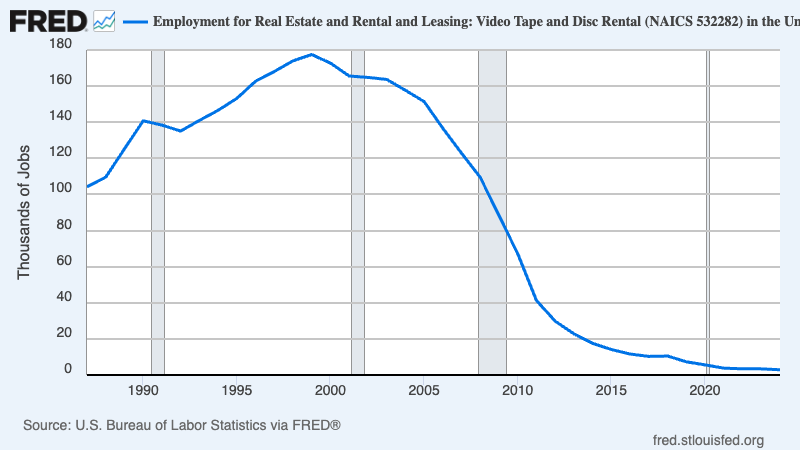
When an industry suddenly collapses, people get hurt: Investors lose their money, workers lose their jobs and in some cases their whole careers. But does technology-driven industrial disruption cause financial and economic crises, the way Citrini Research predicts? I can’t come up with any examples. The tech boom of the 1990s caused a recession when it ended, not while it was underway.
The Citrini post argued that investors and workers hurt by AI will cut their spending, which they will. But if AI delivers big productivity gains, it will reduce prices and raise real income in sectors that aren’t displaced, causing other Americans to spend more. There’s no reason to believe that disrupting part of the economy will reduce overall demand.
The only way I can see that AI could be a recessionary force would be if the firms and/or workers who lose from the technology were highly leveraged — that is, were carrying a lot of debt — and so were forced to cut their spending much more than those gaining from AI increased their spending. But there’s no evidence for that.
So while Citrini may be right about how disruptive AI will be — I think they’re overhyping it but I could be persuaded otherwise — I’m quite sure that they’re wrong about the macroeconomic effects.
Which still leaves the question of how a basically literary endeavor — a speculative essay about the economics of AI that brought no new facts to the table — could rattle financial markets.
Let’s go back to Orson Welles and the Martians.
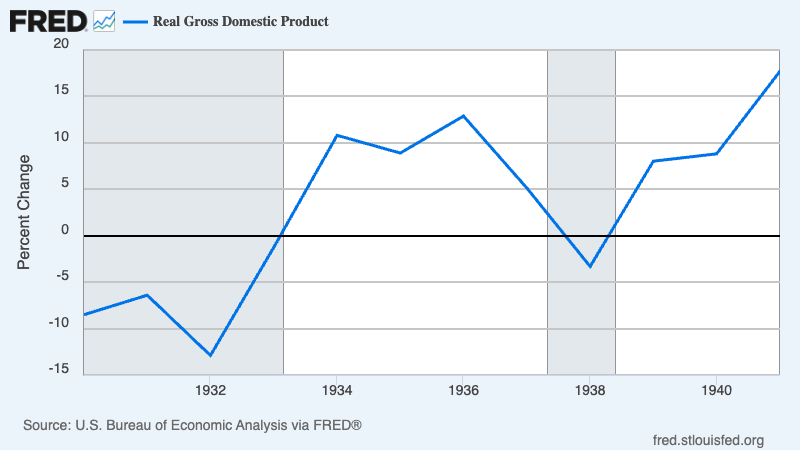
Welles was a genius and his adaptation of H.G. Wells was brilliant, but it the fact that it aired in 1938 surely contributed to its impact. For Americans were primed for panic. The Great Depression wasn’t over — in fact, the economy had just suffered a nasty relapse:
Overseas, fascism was on the rise, and the storm clouds of war were obviously gathering. Americans were, understandably, ill at ease. No wonder, then, that some were ready to panic over what sounded like dire news on the radio.
Fast forward to this week. We’re living amidst political turmoil that is spilling over into economic uncertainty. Donald Trump has just seen most of his signature economic policy, his tariffs, declared illegal by the Supreme Court, and has responded by imposing steep new tariffs, also clearly illegal. The European Union has suspended consideration of its trade deal with the United States.
Everyone is also worried that Trump will seek political and psychological compensation by attacking Iran. According to news reports, military officers have been warning Trump that such an attack would be high-risk. The real news here is that someone is leaking this information, an indication that insiders are worried that Trump might do it anyway.
So these are uneasy times — the kind of times in which investors can be rattled by an alarmist financial analysis that goes viral.
And the truth is that I’m uneasy too. But I’m less worried about either Martians or artificial intelligences than I am by some of the human beings currently in positions of power.
MUSICAL CODA
Something calming: