







UK energy and union bosses have called on the country’s ruling Labour party to prioritize indigenous oil and gas production over imports, for the sake of energy security, jobs and climate goals, days before Andy Burnham is set to take over as prime minister.
In an open letter to the Parliamentary Labour Party, dated July 14, more than a dozen industry bodies, including Offshore Energies UK, Fuels Industry UK, the Chemical Industries Association and the GMB and RMT unions, argued that a “credible energy transition” cannot be achieved by replacing UK energy supplies with more carbon-intensive imports.
“The truth is our country will continue to need oil and gas for decades to come. The question is not whether we use these resources, but whether we produce as much of them as possible ourselves or become increasingly dependent on imports from overseas,” the signatories wrote. “Today, our policies leave us importing more than 40% of our energy, including oil and gas and derivative fuel products from volatile regions, while refusing to prioritize our domestic production.”
“That is why – for our jobs and communities, economy and security, and for our climate obligations – we are asking you to back North Sea oil and gas. Not imports,” the letter concluded.
UK oil and gas production has fallen precipitously this century, with oil output down from some 2.5 million barrels per day in 2001 to around 657,580 b/d in April, according to the latest data from the Department of Energy Security and Net Zero.
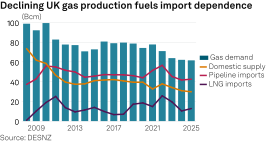
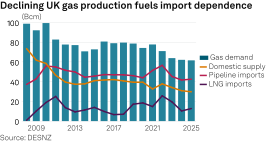
Meanwhile, gas production was just 29.7 Bcm in 2025, compared to demand of over 60 Bcm, according to DESNZ, leaving the UK reliant on imported pipeline gas from Norway and LNG from international markets.
In recent years, industry leaders have complained about the challenging fiscal, tax and regulatory environment, as well as a ban on new exploration under the current Labour government. Those factors have helped drive a wave of consolidation and IOC exits in the mature North Sea basin.
Burnham, who is running uncontested to replace Keir Starmer as Labour leader and prime minister after winning the Makerfield by-election last month, has not yet unveiled a North Sea strategy, but has promised to foster growth in all regions of the UK. He is expected to assume office on July 20 following Starmer’s resignation.
Industry eyes will be trained on his government’s decisions around two key oil and gas projects – Adura’s 70,000 b/d Rosebank oil field and Shell’s Jackdaw gas project – which have been left in limbo under current energy minister Ed Miliband. They could both be online by next year if approved, according to their operators.
British crude grades help underpin Platts Dated Brent, the world’s foremost crude benchmark, which was last assessed at $77.32/b on July 13. Platts is part of S&P Global Energy.
However, loadings of one of those grades, the Brent Blend, are on course to fall to zero in August, down from 22,581 b/d in July, Platts has reported.
Source: Original Article