












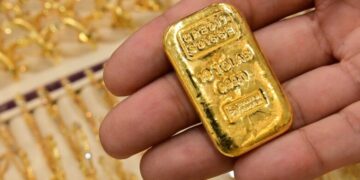

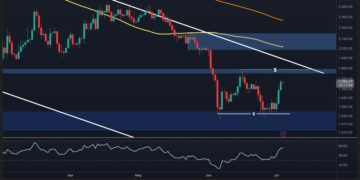





Gold prices remain under pressure after spot bullion briefly fell below 4,000 dollars per troy ounce last week, marking the lowest level in seven months since early November, as investors reassess the outlook for US interest rates and the dollar.
Yuichi Ikemizu, representative director of the Japan Precious Metals Market Association, said the decline reflects both the sharp rise in gold from last year through the start of this year and a change in market sentiment after the Federal Open Market Committee meeting in June. With investors increasingly viewing the Fed as hawkish, short-term traders have moved away from gold on expectations that US interest rates could rise further.
Gold, which offers no interest income, tends to come under selling pressure when rates rise. Ikemizu said the dollar index has climbed to a one-year high, moving in the opposite direction to gold, as funds have shifted into the dollar. He said the move represents a short-term unwinding of the so-called debasement trade, in which investors sell currencies and government bonds on concerns over declining confidence and buy gold instead.
After the outbreak of the US-Iran conflict, oil prices initially rose, creating expectations that higher energy costs could fuel inflation and lead the United States to raise interest rates. Under that scenario, higher crude oil prices worked against gold. But even after crude prices retreated close to levels seen before the conflict, gold continued to fall.
Ikemizu said the war triggered selling across assets immediately after it began, including bonds, anti-dollar assets and stocks, as money moved into cash and the US dollar. Stocks later recovered quickly, but gold investors remained cautious and have not returned in force. He said market attention has shifted from crude oil to the dollar and the possibility of US rate hikes.
As of June 29, markets were still pricing in a high probability that the Fed will raise interest rates this year. Ikemizu said gold prices have already fallen partly because of that expectation, making it difficult for short-term traders to return while rate-hike expectations remain high.
Still, he said the size of the current fall suggests the market may have already dropped close to its lower limit. From the spot-price peak around January 29, gold has fallen by about 30%. Ikemizu compared the decline with major sell-offs during the 2008 financial crisis and the COVID-19 pandemic in 2020, when gold fell roughly 27% to 28% before recovering. The recent drop below 4,000 dollars represented a decline of about 30%, close to the scale of those earlier corrections.
Ikemizu said he does not believe the long-term upward trend in gold has changed. He noted that after the major declines in 2008 and 2020, gold resumed rising over the longer term.
Central banks remain an important source of support. Ikemizu said they bought more than 1,000 tons of gold annually for three consecutive years from 2022, and about 840 tons last year. Although the volume was lower, last year’s purchases were made at much higher prices, meaning central banks bought a record amount in dollar terms.
This year, central bank buying has remained strong, with purchases of nearly 250 tons in the first quarter. Ikemizu said emerging-market central banks have been especially active, citing Poland, Uzbekistan, China and Kazakhstan. Poland bought 18 tons in May alone.
Some countries have also sold gold, including Azerbaijan, Turkey and Russia. Ikemizu said Russia appears to be selling to fund war-related procurement, while Turkey has used gold in connection with currency defense. However, he said not all reported sales were outright disposals, as a significant portion appears to have involved swaps in which gold was exchanged for dollars under agreements to buy it back later. He said such transactions should be viewed as an effective use of gold reserves rather than a negative factor.
China has also increased its purchases as prices have fallen. Ikemizu said China bought only about 1 ton a month while gold was rising sharply, but its purchases increased to 5 tons, then 8 tons, and 10 tons last month as prices declined. He said China appeared to be buying strategically on price weakness.
A World Gold Council survey of central banks showed that a record 45% of respondents said they plan to increase their gold holdings this year. When asked whether the central bank sector as a whole would buy gold, about 80% to 90% said they expected purchases to continue, reflecting a broader trend of rising participation among monetary authorities.
Ikemizu said the key condition for a rebound in gold would be a shift in expectations for Fed policy. If inflation calms and the Fed no longer needs to raise interest rates, gold could quickly turn higher. He said the US-Iran conflict is also likely to move toward stabilization, and if crude oil prices settle further, inflation expectations could ease.
Ikemizu had previously projected in early March that gold could reach 6,000 dollars this year, but he said that target now appears unrealistic after the recent decline below 4,000 dollars. He now expects gold to recover to around 4,800 to 4,900 dollars by the end of the year, a rise of about 20% from current levels. He said other financial institutions have similarly lowered their forecasts, but none are predicting a further major fall.
Over the longer term, Ikemizu said the conditions supporting gold purchases remain intact. Government debt continues to rise worldwide, and concerns over the long-term decline in the value of the dollar and US Treasurys remain at the core of the debasement argument. He cited a forecast by a well-known Swiss gold investment fund that gold could rise to nearly 9,000 dollars by 2030 under an inflationary scenario, saying he agrees with that view.
Although the dollar is currently attracting funds as a temporary safe haven, Ikemizu said the longer-term shift toward gold over the dollar and US Treasurys is unlikely to change.
Source: 日経CNBC 公式チャンネル
Source: Original Article