























London, 3 July 2026 (EBM Newsdesk Analysis) —
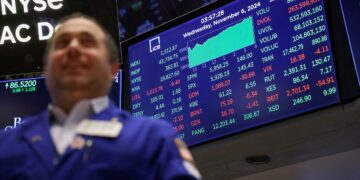
Two stories collided in markets overnight and the result was unexpectedly constructive for European equities. A weak US payrolls report took a 25-basis-point Fed rate hike largely off the table for September, collapsed the dollar index from a thirteen-month high, and sent gold back above $4,100. Asia bounced hard on the relief — South Korea’s Kospi soared 5.8%, recovering most of Thursday’s 7.9% collapse, with Samsung and SK Hynix jumping 9.2% and 10.9% respectively. And in Europe, both the Euro Stoxx 50 and the German DAX opened at fresh all-time highs.
Why Europe Is Outperforming Again
Join The European Business Briefing
New subscribers this quarter are entered into a draw to win a Rolex Submariner. Join 40,000+ founders, investors and executives who read EBM every day.
I think the European rally is worth examining carefully, because it is not simply a sympathy move with US futures. It is the same rotation dynamic we have been tracking for months playing out again at scale.
European indices are tech-lite by construction. When the AI and semiconductor trade unwinds — as it has done sharply over the past two sessions on Wall Street, with Marvell losing 10.2%, Micron 5.5% and AMD 5% on Thursday alone — European indices are structurally insulated. Add to that the fact that European equities trade at materially lower price-to-earnings multiples than their US counterparts, and you have a relative value argument that becomes increasingly compelling as US tech multiples compress.
This dynamic is the European mirror of what is happening on the Dow, which hit its own all-time high on Thursday even as the NASDAQ 100 fell 1.6%. Investors are not leaving equities — they are rotating within them. And on a global basis, some of that rotation is landing in European stocks for the same structural reasons we saw Europe outperform the US for several months earlier this year. We examined this divergence closely when the ECB’s rate hike created the conditions for Europe’s rare monetary inversion — and the relative-value argument that was forming then has only strengthened since.
The Payrolls Number and What It Actually Means
June Non-Farm Payrolls came in at 57,000 — against expectations of 110,000 — with May’s figure revised down sharply to 129,000 from 172,000. The unemployment rate fell to 4.2%, but this appears to reflect a drop in the participation rate rather than genuine labour market strength, which raises its own set of questions about the underlying health of the US economy.
The immediate market reaction was a sharp dollar selloff. The Dollar Index dropped from its thirteen-month high above 101.50 to 100.25 — a meaningful move in a single session. The probability of no rate change before year-end on the CME’s FedWatch Tool rose to 25% from 17%, and the probability of a September hike fell from 50% to 43%.
My view is that this should not be over-read. Fed Chair Kevin Warsh has been explicit that getting inflation back to the 2% target takes priority over employment data, and a single month’s payroll reading — however weak — will not shift the Fed’s strategic posture. The more significant signal is whether this presages a genuine softening in US economic momentum. If Q2 earnings, which begin in just over a week, deliver weak guidance alongside strong headline numbers, the market will have a more complete picture. For now, this looks like volatility around a rate path that has not fundamentally changed — the Fed is more likely to hold than hike this year, but it is not yet cutting.
The ECB: Lagarde’s Balanced Risks Signal
The European dimension of the rates story received its own catalyst at the ECB’s Sintra forum, where President Christine Lagarde stated that inflation and growth risks across the eurozone are becoming “more broadly balanced.” This is the kind of language the ECB uses when it wants to signal a pause rather than commitment to further action — and coming immediately after the ECB’s June rate hike to 2.25%, which was the first increase since 2023, it is reassuring for rate-sensitive European sectors. The euro’s recent slide to a one-year low against the dollar has done some of the tightening work for the ECB, complicating the case for further hikes even as the currency’s weakness partially offsets the relief that lower oil prices were supposed to deliver.
Oil: Cautious Optimism Holds
Crude prices were little changed overnight as markets assessed ongoing US-Iran diplomatic progress. The structural picture has improved materially: Saudi shipments have more than doubled over the past fortnight versus the first quarter, Kuwait’s output rose sharply in June, and the market structure has shifted from backwardation to modest contango — a technical signal that supply availability expectations have improved. Neither WTI nor Brent has yet broken decisively above pre-conflict levels, but the direction of travel is clear enough that risk premiums are compressing. The Hormuz situation remains the wildcard for European energy costs, and as we have consistently flagged, the impact of that risk premium on European inflation has been the defining factor in the ECB’s policy decisions this year.
Gold: A Better Week, Cautiously
Gold built on Thursday’s gains to approach $4,200 overnight — its highest level since early last week — after the payrolls data shifted rate expectations and weakened the dollar. The daily MACD has turned upward, which is technically encouraging. I am not reading this as a renewed bull run. As we examined in detail in our analysis of why gold has stopped behaving as a safe haven, elevated real yields under Warsh’s Fed create a structurally adverse environment for non-yielding assets. A sustained break above $4,200 would be a more meaningful signal. Until then, I think European institutional allocators should continue to treat the recent recovery as consolidation rather than a trend reversal.
The Bottom Line
This is a constructive Friday for European markets, driven by three converging factors: US rate pressure easing, dollar weakness improving the relative attractiveness of European assets, and the structural advantage of tech-lite indices in a rotation environment. I would not call this the start of a sustained European outperformance cycle — but the conditions that drove Europe’s earlier period of relative strength this year are reassembling, and the Q2 earnings season starting next week is the next real test of whether they hold.
Related reads:
The ECB hiked to 2.25% — here’s what it means for European borrowing costs and the rate path ahead
The euro hit a one-year low as collapsing oil prices reshaped the ECB’s inflation calculus
Why gold has stopped being a safe haven for European institutional investors
Source: Original Article