











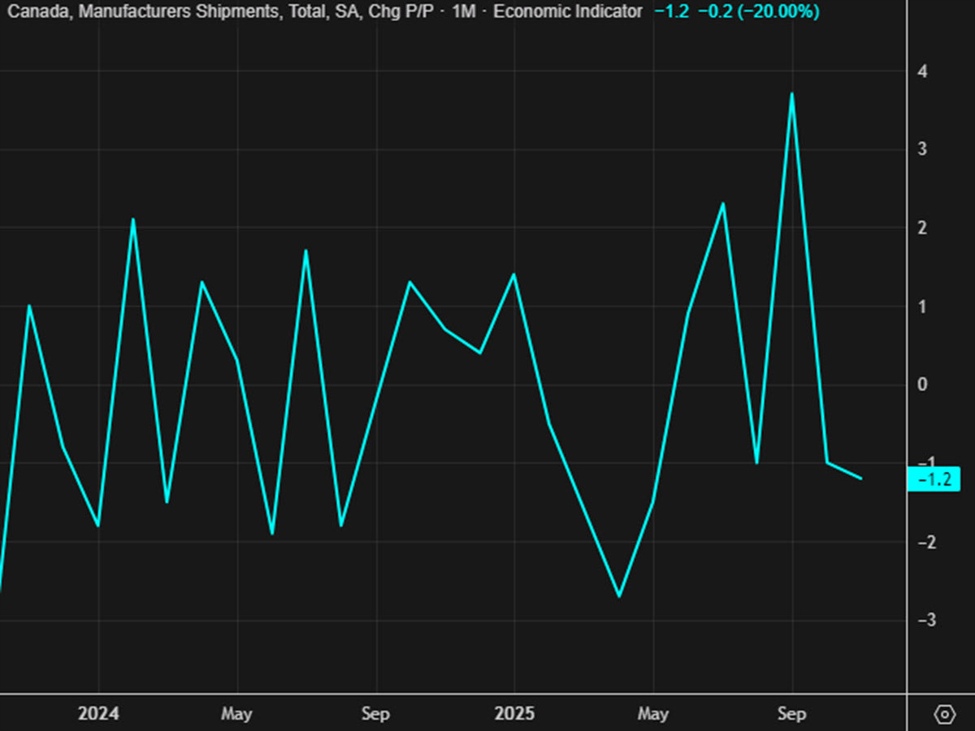
- Prior was -1.2%
- Sales of C$71.0 billion
- Gains in 12 of 21 subsectors led by motor vehicles +12.0%
- Sales down 1.1% y/y
- Sales up 0.2% q/q
- Inventories -1.2%
- Unfilled orders +0.4%
The drop in inventories is going to be a drag on Q4 GDP and the sales numbers in the quarter aren’t particularly inspiring either. The Canadian economy finished the year on soft footing. The Canadian consumer was a surprising source of strength in 2026 but it will be hard to keep that momentum going through 2026 if there isn’t help from manufacturing, commodity markets or housing.
Canadian manufacturing had a turbulent 2025, shaped heavily by US tariffs, supply chain disruptions, and shifting commodity prices. After a solid first quarter where sales totalled $217.9 billion (up 1.6% quarter-over-quarter), the sector hit a wall in Q2. Sales plunged 4.8% to $206.0 billion — the steepest quarterly drop since the pandemic-era decline in Q2 2020 — as tariffs on Canadian goods took a significant toll on petroleum and coal products, motor vehicles, and primary metals. April saw the sharpest monthly decline at 2.8% to $69.6 billion, with roughly half of manufacturers reporting direct tariff impacts. May dipped further to $68.7 billion, the lowest level since January 2022.
The third quarter brought a meaningful recovery. Sales rebounded 2.8% to $212.3 billion, the strongest quarterly gain since Q2 2022, capped by a 3.3% surge in September to $72.1 billion — the highest since February. Transportation equipment and petroleum and coal products led the rebound.
That momentum stalled in Q4. October saw sales fall 1.0% to $71.5 billion as chemical products dropped 6.0%, wood products plunged 9.0% to their lowest since July 2020 (hit hard by U.S. tariffs triggering sawmill closures), and transportation equipment slipped 2.3%. Sales declined in six provinces, led by Ontario and Quebec.
November brought a steeper 1.2% decline to $70.8 billion, with 15 of 21 subsectors posting losses. Motor vehicle sales fell 15.9% to $3.8 billion — the lowest since October 2022 — after global semiconductor shortages disrupted a major assembly plant and rippled through the parts supply chain. Motor vehicle parts dropped 6.3% and machinery fell 3.2%. Petroleum and coal products bucked the trend, rising 6.8% to $8.2 billion on higher prices and the end of a refinery maintenance shutdown. Ontario and British Columbia led provincial declines. The inventory-to-sales ratio rose to 1.72, reflecting weakening demand relative to supply. An advance estimate for December pointed to a modest 0.5% rebound, led by the food subsector and motor vehicles.