










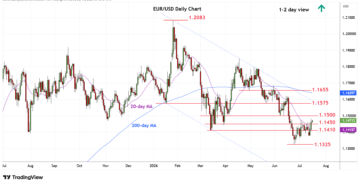















Kevin Warsh’s rookie meeting as Fed Chair was initially billed as the arrival of a rate-cutting Trump loyalist — instead he blindsided markets. The June FOMC gutted forward guidance, split the dot plot 9-9 toward hikes, and pushed the 2026 median rate projection to 3.8% from 3.4%, all while Warsh pointedly refused to submit his own dot. EURUSD buckled on the shock, breaking out of a year-long 1.15-1.1825 range and sliding to its lowest level since May 2025 (1.1325), as the hawkish surprise crushed the euro’s relative appeal. His congressional testimony this week doubled down on the message: “there’s still plenty of work to do,” he told lawmakers, explicitly rejecting any “mission accomplished” framing on inflation — keeping the pair pinned near multi-month lows around 1.14 as traders waited to see if he’d blink. He didn’t.
Then came the twin gut punches. Tuesday’s CPI fell 0.4% MoM — the first outright decline in inflation since 2020 — smashing forecasts and instantly slashing July hike odds from 42% to under 17%. The 2-year Treasury yield plunged by as much as 14 basis points in its steepest one-day drop in months, as traders violently unwound the hawkish repricing they had built around Warsh’s June meeting. Wednesday’s PPI added to the pressure: producer prices fell 0.3% versus expectations for an unchanged reading, while core PPI also missed forecasts across the board, and the resulting fresh collapse at the short end of the Treasury curve sparked renewed buying interest in EUR/USD, as if the market had once again partially repriced the certainty of its hawkish trade.
Yet the real drama is that even after two stunning downside surprises, September hike odds are still hovering near 50-60% — meaning euro bulls celebrating the “disinflation is back” narrative may be getting ahead of themselves. With Warsh’s committee still split by nine hawkish dots and refusing to rule anything out, EURUSD’s next major move hinges entirely on whether this marks the beginning of a genuine turning point — or merely a two-day reprieve before the next inflation surprise sends the pair lower once again.
Technical analysis
In the previous section, we defined the one-year trading range for EURUSD as 1.15–1.1825, but in reality—although the vast majority of the time the pair traded within those boundaries—there have been some excursions beyond that range. On the downside, the key level has been the psychological 1.14 mark, which already acted as the last line of defense in both August 2025 and March 2026.
This level has now been pierced during several trading sessions, but for the time being the area is broadly holding, with EURUSD currently trading at 1.1468.
Technical indicators have recovered slightly, but it is important to bear in mind that 1.15 has now become resistance, made even stronger by the fact that the very clear descending trendline that has guided the pair throughout 2026 is located not far above that level. Furthermore, it appears that the uptrend which began the pair’s rally in December 2024 was broken in March. In our view, while this does not necessarily signal a full-fledged trend reversal, it does indicate a transition into a “different market regime”.
Overall, we remain cautious on EURUSD. In particular, if energy prices resume a clearly bullish trend, we see further—although perhaps not substantial—room for additional U.S. dollar appreciation. Our primary downside target is 1.12, with an intermediate support area around 1.1290 and the possibility of an extension as low as 1.1065.
Source:
Original Article

