






















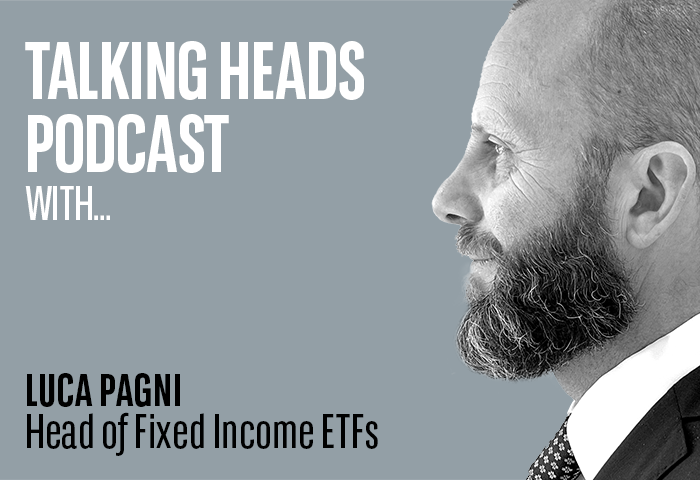
Talking Heads with Luca Pagni
Daniel Morris: Hello, and welcome to the BNP Paribas Asset Management Talking Heads podcast. Every week, Talking Heads will bring you in-depth insights and analysis on the topics that really matter to investors. In this episode, we’ll be discussing fixed income ETFs (exchange-traded funds). I’m Daniel Morris, Chief Market Strategist, and I’m joined by Luca Pagni, Head of Fixed Income ETFs.
Welcome, Luca. Thanks for joining me.
Luca Pagni: Thank you, Daniel, for inviting me.
DM: I think we’re well aware how important ETFs have become for investors over the years, though I think a lot of that focus is still on equity ETFs and probably there is less appreciation for the growth in the fixed income market.
But maybe let’s start by you telling us how you’ve seen the industry develop over the years, and in particular, what role do you see for ETFs in portfolio construction?
LP: As you know, I joined the ETF team in 2020, and since then, I’ve seen this market grow very quickly. In Europe, fixed income ETF assets have tripled since 2020, from around €250 billion to €750 billion now. At BNP Paribas, the growth has been even stronger, with our asset[s] increasing almost 10-fold over the same period. But honestly, despite that progress, I still think bond ETFs are underused.
They represent just over 10% of the mutual fund market in Europe, while in the US, they account for around 30%. This gives you a clear indication of the growth potential we still have in Europe. I believe bond ETF[s] can play several different roles. They can be used as building blocks in asset allocation. That’s probably the first and most important role they have. But they can also be used to express tactical views, so in a more short-term horizon.
In practice, what they do is provide pure beta at low cost, and they usually simplify the implementation of investment decision[s]. We discussed this point with one of our insurance clients at the beginning of the year. They used to trade single line directly because they have [a] team of fixed income experts, but they are now increasingly shifting away from direct bond portfolios and making greater use of ETFs.
They explained that the added value of their investment process lies in the asset allocation decision. While the execution itself is not a major driver of performance, if you want to implement an investment decision by trading a portfolio of selected bonds, execution can take days.
Just think about the sheer number of security[ies] in any bond index – thousands of bonds, each with different characteristics, performance potential, each with [a] different liquidity profile. So, identify[ing] the right portfolio and executing it in the market can take a long time and does not necessarily add much value for the investor.
Let’s take an example. If you want to invest in long-dated European corporate bonds, you need to select security[ies] from an investment universe of more than 1,000 bonds. Then you have to ensure the right duration of the basket, and then carefully diversify issuer risk. This is very time-consuming.
On the other hand, if you use ETF[s], the execution of this investment decision is almost instantaneous. You get exposure to the selected market with just one intraday trade. One trade gives you broad diversification and the precise beta exposure you need. And today, investor[s] can access almost any fixed income market through ETF[s].
The offering has improved substantially in recent year[s], and is now segmented by asset class and maturity bucket. So, for example, our European government bond range now includes eight ETFs, each with a different maturity profile. This makes asset allocation much easier to fine-tune for the investor.
They can really choose the maturity band, the market the kind of exposure they want. It allows investor[s] to focus their time on the decision that truly add[s] value, namely asset allocation, rather than spending time on the operational complexity of implementing those decisions
DM: Luca, you seem to be suggesting that ETFs are mostly an alternative to direct bond investment.
LP: I think this is a key point. We used to think about ETFs as an alternative to active funds, but I really believe this frames the issue the wrong way. The real debate is not ETFs versus active fund[s], but rather ETF[s] versus single line portfolios. In fact, if the active fund is really providing reliable alpha, then it surely makes sense to use it to improve performance on the portfolio.
But if what you want is pure market exposure, pure beta, then you’ll be better off with ETFs. They are way more efficient than direct line portfolios and give you full diversification and attractive liquidity.
DM: Talking about liquidity, how did ETFs change liquidity in the fixed income market?
LP: ETFs have created a real liquidity revolution in fixed income. You know, I started managing bond funds in the late ’90s, and back then, price discovery was a real adventure. It could easily take 15 minutes just to find the price of a corporate bond. And by the time you had found which counterparty was ready to take the other side of your trade, [the] interest rate might have moved, and you had to start the process all over again.
ETFs changed that for good. They transformed a rather opaque over-the-counter market into a more regulated, transparent and liquid one. And today you can get reliable around-the-clock pricing on almost every segment of the bond market. Just think about what that means in terms of execution capacity and even price discovery.
ETFs remain tradable even during market crises, when the underlying market is pretty much closed for business. And we [have] witnessed this several times in recent years, for example, during the Covid crisis and the war in Ukraine.
In the worst moment of those crises, corporate bonds or emerging market bonds were virtually untradable. You could not get a price on them. No trader wanted to deal with single line idiosyncratic risk. But traders could still make markets on ETFs thanks to their diversified profile. The diversified profile means that they can hedge any open interest they have in ETFs quite efficiently because they do not have to deal with idiosyncratic risk. They can use futures, [a] CDS index, or total return swap to eliminate market risk coming from the ETF position.
That makes [it] extremely eas[y] for them to price ETFs rather than single bonds. For that same reason, you now have ETFs that trade with [a] smaller bid-offer spread than the average bid-offer spread of the underlying market.
For example, take the Euro yield market. The average bid-offer spread in that market is 50 basis points, but you now have the most liquid ETF in Euro yield that trades at less than 25 basis points of bid-offer spread. This is another considerable advantage of ETFs versus single line portfolios. In some cases, investor[s] can more than offset the ETF management fees simply thanks to the more favourable bid-offer spread.
DM: The key messages I’m hearing from you, Luca, are: fixed income ETFs have grown rapidly and, in your view, nonetheless remain underused in Europe. They improve portfolio construction by offering low-cost beta exposure, diversification, faster execution and better liquidity than direct bond portfolios.
Well, Luca, thank you very much for joining me.
LP: Thanks again for having me, Daniel.
DM: That’s it for this week’s episode of Talking Heads. If you’d like more information about our capabilities in fixed income ETFs, please reach out to your asset management contact or check out Viewpoint, our website for investment insights at viewpoint.bnpparibas-am.com.
Viewpoint brings commentary and analysis in a variety of formats, from investment outlooks to asset allocation videos and podcasts, to help investors make better informed decisions.
You’ve been listening to the BNP Paribas Asset Management Talking Heads podcast with me, Daniel Morris, and Luca Pagni, Head of Fixed Income ETFs.
Please do join me next week. Until then, take care.
Source: Original Article