

























Strategy founder Michael Saylor has said that bitcoin’s four-year halving cycle is gradually losing its significance. The main growth driver is now institutional capital flows.
In an essay titled “Bitcoin Evolves Without Changing,” Michael Saylor argued that the network’s base layer should remain unchanged and conservative, with all innovation built on additional layers. Over the next decade, he said, bitcoin will see fewer protocol-level changes–but its role in the global financial system will grow substantially. The network’s job, in Saylor’s words, is to “move slowly and not break.“
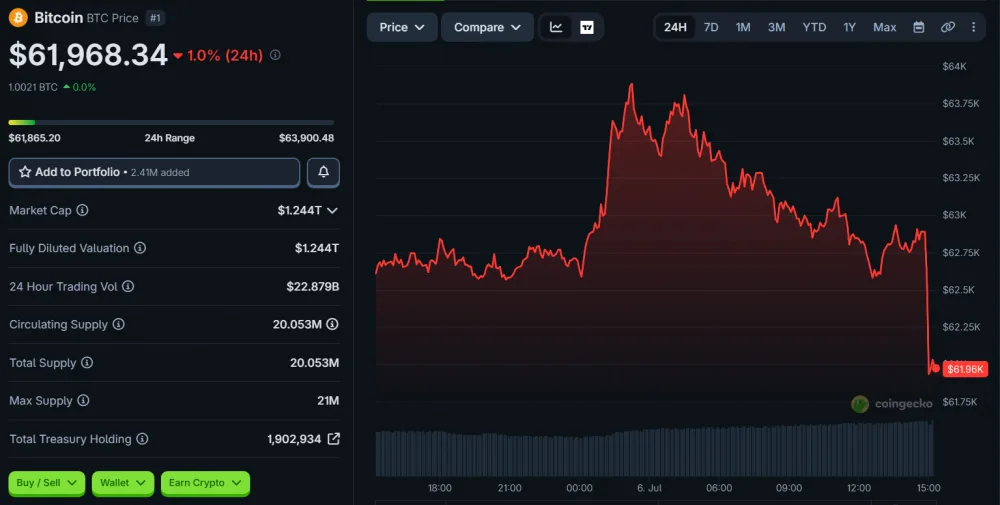
At the time of publication, bitcoin (BTC) trades at roughly $62K, up 4.6% on the week.
Contents
Why the Four-Year Bitcoin Cycle Is Fading — Saylor’s View
Saylor believes the traditional Bitcoin (BTC) four-year halving cycle that has driven market dynamics in past years is gradually losing its relevance. If the halving was once the key driver, capital flows now take center stage:
- The U.S. spot bitcoin ETFs
- Corporate treasuries
- Sovereign reserves
- Bank lending
- Derivatives
- Insurance products
- Collateral instruments
- Global savings
“The halving squeezes supply. Capital flows set the growth trajectory,” Saylor said.
In his view, the next decade will be bitcoin’s institutional adoption phase. Bitcoin will become the foundation for capital, credit, and financial infrastructure. Its main role is not competing with payment systems but serving as a global scarce asset.
Read more: Bitcoin Four Year Cycle Isn’t Dead, Analyst Says
Bitcoin Will Remain Unchanged, Innovation Moves to Other Layers
Saylor emphasized that bitcoin’s base protocol will become even more conservative over time. Any changes will require near-total consensus. Most innovation will move to crypto wallets, custody services, Lightning Network, sidechains, multi-layer protocols, digital credit, and digital money.
Bitcoin, he said, is designed for final settlement, treasury reserves, collateral operations, and ownership transfer. Consumer payments, lending, banking services, and other financial products will be built on top of bitcoin or through institutional interfaces.
Not all users will interact with bitcoin the same way. Some will choose self-custody, others ETFs, banks, corporate products, or bitcoin-backed loans. Transparency, reserve proof, risk management, and counterparty risk control will become key.
Read more: Bitcoin and Ethereum in Crisis — Can Solana Become the Main Global Payments Network in 2026?
Saylor’s Forecast: BTC Price and Role by 2036 and Key Risks
Saylor predicts that by 2036, bitcoin will be more widespread and deeply integrated into the global financial system. It will serve as a reserve asset for retail investors, corporations, banks, funds, and sovereign states. Bitcoin will become the dominant collateral asset for digital credit markets, the foundation for high-value settlements, and the base for new forms of digital money.
Among the key risks, Saylor listed possible protocol compromise, excessive “paper bitcoin” issuance by intermediaries, custodial centralization, regulatory pressure on infrastructure, and uncertainty around the future fee market as mining rewards diminish.
“Bitcoin’s job is not to become everything. Bitcoin’s job is to remain what stays unchanged,” Saylor concluded.
Learn more: What Is Bitcoin DeFi (BTCFi)? Complete Guide
Source: Original Article