




















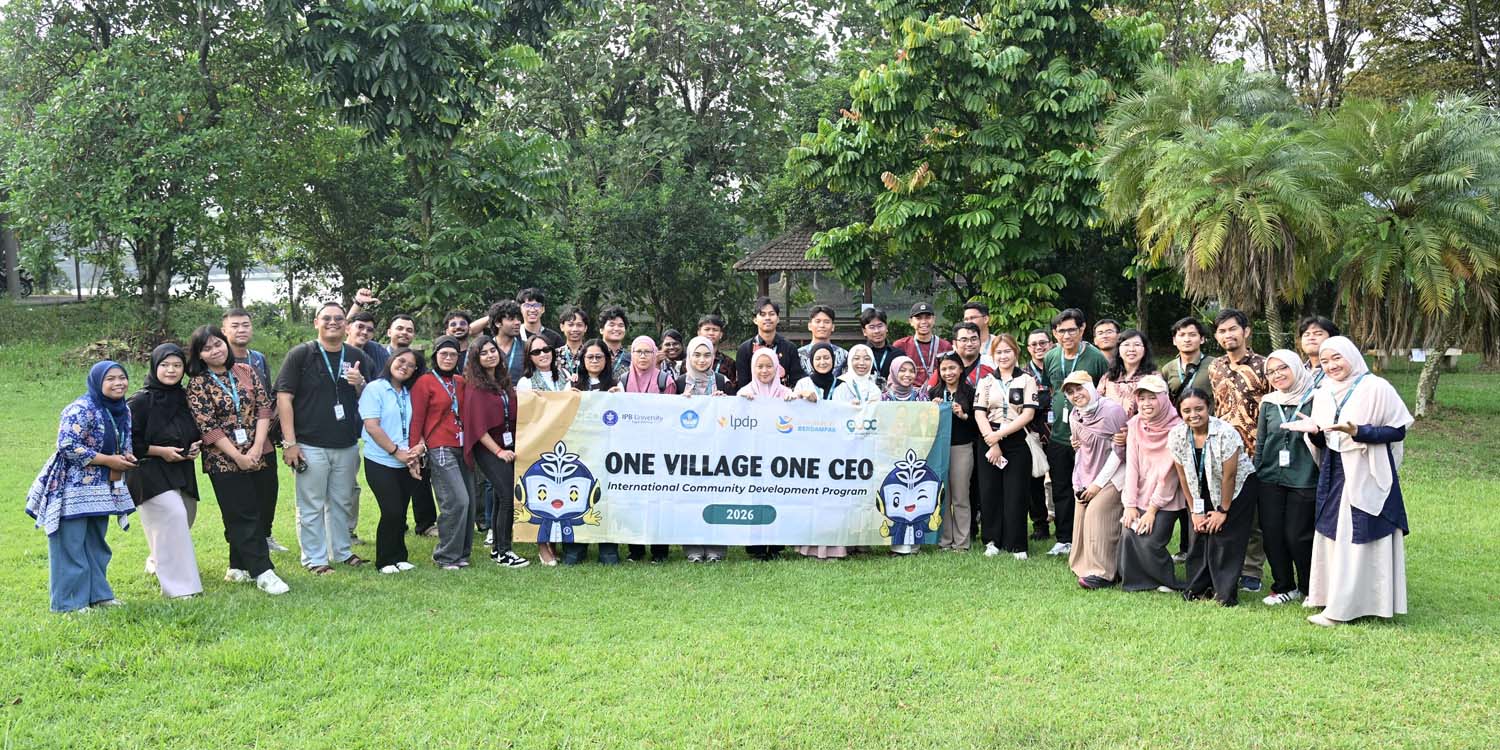
IPB University continues to expand its international network for community empowerment based on local commodities through the One Village One CEO (OVOC) International event held at the Agribusiness and Technology Park (ATP) in Bogor (6/26).
The event, attended by participants from South Korea, China, Malaysia, the Philippines, Thailand, and Indonesia, served as an opportunity to strengthen global collaboration while promoting flagship products from villages mentored by IPB University to international markets.
Dr Roza Yusfiandayani, Vice Chairperson of the Institute for Agromaritime Development and Innopreneurship Acceleration (LPA2I) in charge of Innovation, Technology Transfer, and Community Empowerment, explained that OVOC is a business ecosystem development model based on local potential that was first launched in 2018.
Now in its eighth year, the program has evolved into an international event that brings together academics, students, and communities from various countries.
“Through OVOC International, we aim to build a business ecosystem from upstream to downstream based on each region’s flagship commodities. Over the course of OVOC’s eight year journey, we have expanded our network to various countries so that products from villages mentored by IPB University can gain access to global markets,” said Dr Roza.
She added that IPB University has currently identified several flagship commodities such as coffee, areca nuts, taro, sweet potatoes, and edamame to be promoted in eight countries, which are Malaysia, the Philippines, Japan, South Korea, Belgium, the Netherlands, Poland, and other partner nations.
In addition to bringing local products to international markets, this initiative also brings international students to learn firsthand in the villages supported by IPB University. Over the course of six days, participants will take part in community based learning programs in Bogor, Cianjur, Garut, Ciamis, and West Lampung.
“They will study cultivation practices, agricultural product processing, and the development of community based business models before bringing that experience back to their respective countries,” she said.
During the field practice sharing sessions, Dr Roza continued, OVOC partner farmers demonstrated the success of downstream processing for various commodities.
“The sweet potato farmers’ group in Bojong Jengkol Village, for example, has developed premium sweet potatoes into a variety of value added processed products and implemented a sorting system to meet the needs of export markets and modern retail outlets,” she said.
Meanwhile, the taro farmers’ group mentored by IPB University has successfully expanded market access through industry partnerships while also developing a mini-laboratory as an educational facility for visitors.
In the horticulture sector, the development of edamame also shows promising prospects. Through technical assistance in cultivation, OVOC’s social innovations, and marketing partnerships, this commodity has been able to meet the demand of modern markets while increasing the capacity of the farmers under the program.
Dr Roza hopes that OVOC International will serve as a strategic step in supporting IPB University’s 2026 theme, Global Engagement.
According to her, the more than 1.072 partner villages that have joined the OVOC ecosystem hold great potential to strengthen the competitiveness of Indonesia’s local commodities in the global market, while expanding the impact of community empowerment through international collaboration. (dr) (IAAS/WSG)


The report shows that Kazakhstan accounted for 9.6% of the EU's petroleum oil imports during the January to March period, placing it behind only the...
Read moreDetails