



















The global push for a transition to green energy has sparked demand for critical minerals such as lithium, vanadium, copper and cobalt. These are needed for electric vehicles, wind turbines and solar panels. Sub-Saharan Africa hosts about 30% of the world’s mineral reserves, including huge quantities of critical minerals: 92% of all platinum, 36% of all chromium, 54% of all manganese and 56% of all cobalt.
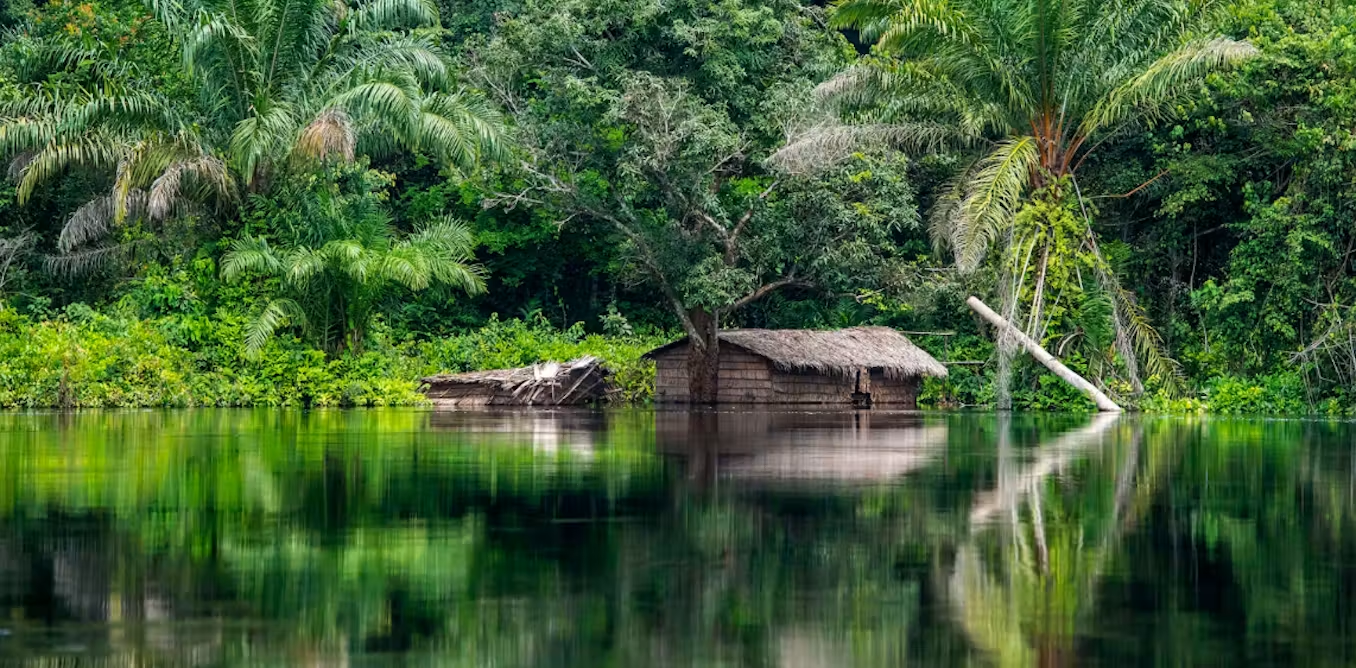
Many critical minerals are concentrated beneath the continent’s biodiverse forests.
Read more:
‘Sacred forests’ in West Africa capture carbon and keep soil healthy
We are conservation scientists researching the impacts on the environment when resources such as timber, minerals or animal species are extracted and used by people. We have spent years tracking how resource demand can reshape fragile ecosystems.
In our most recent study we set out to track exactly how much forest had been lost because of mining across sub-Saharan Africa over 20 years.
We used satellite data to identify 16,627 mining areas in the region. We tracked what happened to the land surrounding the mines between 2001 and 2020. We then compared places where mining was already taking place with similar areas that had not yet been mined but would be in the future. This allowed us to estimate how much deforestation was caused purely by a new mine setting up, rather than by other factors, such as the expansion of farms.
Read more:
Angola’s peatlands trap carbon and clean the region’s water – how we mapped this newly found landscape
Our study revealed that between 2001 and 2020, 187,000 hectares of forests were converted to mines in Africa. This is 0.03% of Africa’s forests but is still a massive area – roughly the size of Mauritius.
Mining along the Ituri River, in the Okapi Wildlife Reserve, DRC.
WCS/ICCN
This number only represents the deforestation by the mine footprint itself (the mine, its pits and tailing ponds where mine waste sludge is stored).
But mines cause far wider damage to the environment. We found that every hectare deforested within a mine’s immediate footprint triggered an additional 34 hectares of forest to be lost from the surrounding region.
Read more:
Africa has the highest rate of forest loss in the world – what the G20 can do about it
This is because of other activities directly triggered by the establishment of a mine, like road building, new urban settlements and agricultural expansion specifically to accommodate the mine.
Demand for green energy transition minerals like copper and cobalt is expected to grow 40-fold by 2040. So given the sheer quantity of key transition minerals on the African continent this growing demand poses a clear and pressing risk to African forests.
Read more:
Gabon’s large trees store huge amounts of carbon. What must be done to protect them
Healthy forests are carbon sinks; they absorb more carbon from the atmosphere than they emit. Destroying them means faster global warming and biodiversity loss that can take many decades to recover. The minerals needed for the technologies meant to save the planet from climate change (solar power and electric vehicle batteries) could speed up ecological collapse in biodiversity hotspots.
To prevent this, developers and governments must immediately integrate these large, offsite environmental impacts into regulatory processes and environmental impact assessments.
Mining’s impact on wider landscapes
A 2014 satellite image of a forest in Lualaba province, DRC. The first image is from 2014, the second in 2025. Satellite images from ESRI Wayback.
Courtesy ESRI Wayback.
Our findings uncovered that mining has a massive ripple effect through space and time. Within one kilometre of a new mine, the local deforestation rate surges by an additional eight percentage points on average compared to unmined landscapes.
The same forest pictured in 2025 after mining started.
Courtesy ESRI Wayback.
More alarming is the distance this damage travels. Elevated forest loss persists up to 20km away from the mining epicentre, and this impact continues for more than a decade after operations begin. This is likely due to both the expansion of the mine itself to follow ore deposits, and the establishment of long term communities around mines.
Read more:
Ghana’s pact with China to explore bauxite threatens a unique forest
Mines bring new roads, infrastructure, agriculture and an influx of workers. Our research found that this development triggers a wave of deforestation that is on average 34 times bigger than the mine itself. In the Democratic Republic of Congo, where half the world’s cobalt is found, this multiplier rises as high as 58.
Some mines are more destructive than others. For example, we found that mines extracting cobalt and copper, key to the green energy transition, triggered the highest rates of additional deforestation. Iron ore operations showed the largest geographic reach, triggering forest loss up to 20km away.
What needs to happen next
First, countries need to adopt a consistent minimum standard for environmental impact assessments before mines are set up (to estimate the damage they’ll cause and find ways to reduce it). Currently, not all of these assessments are equally rigorous.
In some countries, the assessment only extends one kilometre beyond the proposed mine (or a few hundred metres, as in Côte d’Ivoire). In other countries, such as Botswana, regulations cover much larger areas, especially where mines may drain the water table.
Read more:
How South Africa’s mangrove forests store carbon and why it matters
We recommend that countries must update their environmental laws to compel environmental impact assessments to include wider estimates of the damage to forests from mining roads, settlements and the population increase.
The assessments must also forecast and mitigate indirect regional risks, such as projected population influxes, worker settlements, and the agricultural expansion that follows new access roads.
Laws must also compel projects to say how they will protect forests against these risks.
Read more:
Ghana’s forests are being wiped out: what’s behind this and why attempts to stop it aren’t working
If a mine is proposed near a protected area or Indigenous territory, environmental assessments must consider the wider forest destruction that could result from roads, settlements and farming linked to the mine.
Second, global supply chains must move towards transparency and traceability from the point of supply to the consumer. International buyers, technology manufacturing giants and automotive companies must verify and audit the environmental impact of suppliers (the mines). This is similar to the zero-deforestation supply chains that have been introduced for global agricultural and meat sectors. A strict corporate standard must be set up for critical minerals.
Read more:
Senegal’s small scale gold miners still use poisonous mercury: how to reduce the harm
Third, a significant portion of the mines we analysed are unregistered, small-scale, or artisanal operations. These bypass environmental and safety regulations entirely, creating greater risk for both ecosystems and workers. International mineral supply chains cannot continue to ignore this.
Wealthy nations driving the mineral demand must provide financial and technical assistance to producing nations to uphold environmental law. They should also invest heavily in mineral recycling initiatives to reduce the need for mining.
These measures are necessary to ensure the global transition towards sustainable energy is not built on avoidable forest loss.