











Some of the world’s best investors recommend piling into gold right now, but diversification is the key to success.
Gold’s status as a store of value dates back thousands of years, which is why it’s still considered legal tender in many U.S. states today. However, you would be hard-pressed to find someone using gold to buy everyday essentials right now, given how fast the price per ounce is rising.
Gold soared in value by 64% in 2025, and it’s already up by a further 18% in 2026. The S&P 500 (^GSPC +0.77%) stock market index, on the other hand, is up just 1% this year. Investors are piling into the precious metal to hedge against the consequences of soaring government spending, a ballooning national debt, and rising economic uncertainty. Returns of this magnitude certainly aren’t typical, but conditions remain ideal for further potential upside from here.
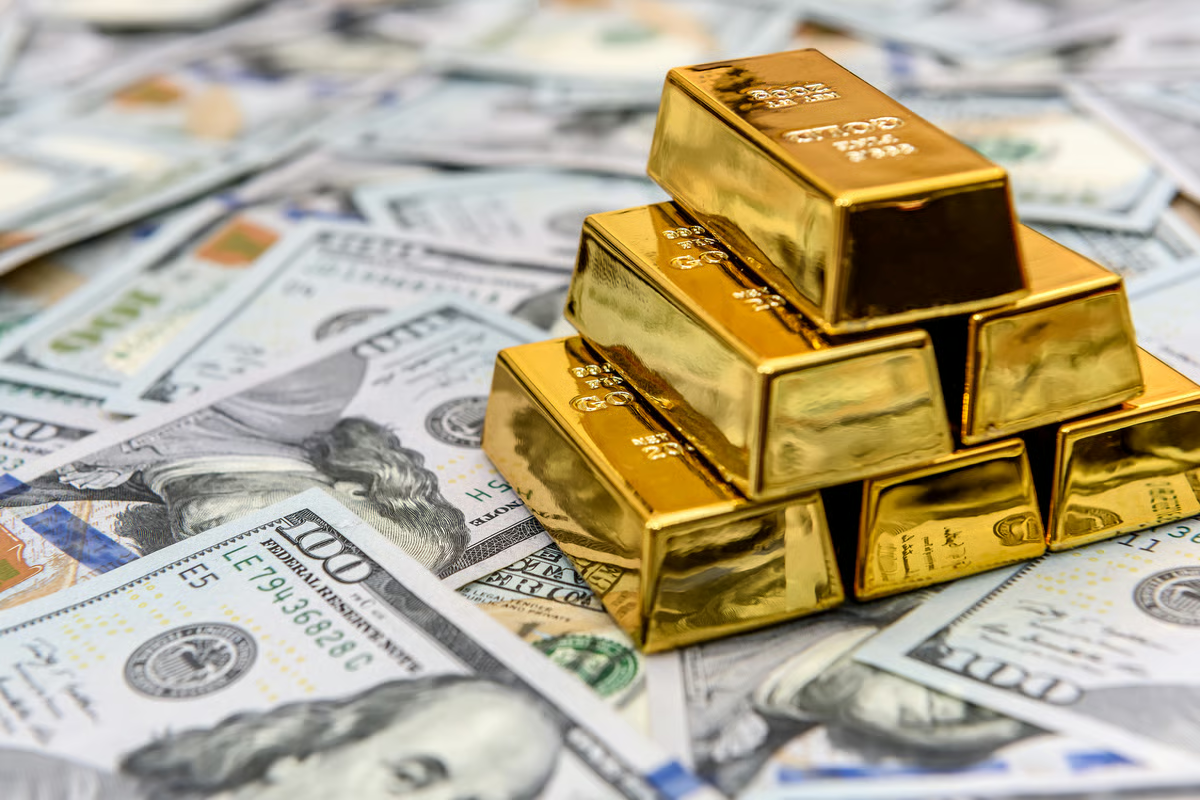
Buying physical gold is the surest way to profit as the shiny yellow metal rises in value, but purchasing an exchange-traded fund (ETF) like the SPDR Gold Shares ETF (GLD 1.39%) might be a much simpler option for most investors. It tracks the price of gold without the storage and insurance headaches that come with owning physical bullion. Here’s why it’s not too late to add some gold to your portfolio (but maintaining realistic expectations is key).
Image source: Getty Images.
A rising money supply could fuel higher gold prices
Some of gold’s reputation as a store of value is attributable to its scarcity. Only 219,890 tons have been pulled from the ground throughout human history, whereas billions of tons of other commodities like iron ore and coal have been mined. Even silver is far more abundant, with roughly 1.7 million tons extracted so far.
Gold’s value is one of the few things the entire world seems to agree on, because investors, governments, and even central banks are consistent buyers. In fact, in the past, many countries even pegged the value of their domestic currency to the shiny yellow metal, a policy which is often referred to as the “gold standard.” It limited the amount of paper money governments could print, because they needed to have an equal amount of physical metal to match.
The U.S. was on the gold standard until 1971, and abandoning the policy led to a very predictable outcome: an explosive increase in money supply. The U.S. dollar has since lost around 90% of its purchasing power, so even though gold doesn’t produce any revenue or earnings, its value in dollar terms has subsequently skyrocketed.
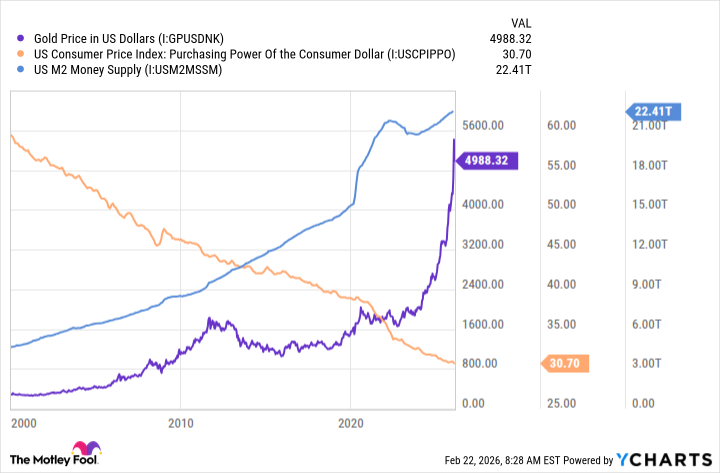
Gold Price in US Dollars data by YCharts
Over the past year, investors have bought gold at a more aggressive pace than usual, as they fear the growth in money supply will inevitably accelerate because of the U.S. government’s unsustainable fiscal trajectory. During fiscal 2025 (ended Sept. 30), the government ran a budget deficit of $1.8 trillion, which sent the national debt skyrocketing to an all-time high of $38 trillion.
Last year, hedge fund legend Ray Dalio recommended investors allocate as much as 15% of their portfolios to gold as a hedge against the current fiscal situation. Another hedge fund billionaire, Paul Tudor Jones, recently piled into the SPDR Gold ETF because he says throughout history, civilizations have always tried to “inflate away their debt” by printing more money.
Investors should temper their expectations going forward
Over the last 30 years, gold has averaged a compound annual return of around 8%, so the gains investors have enjoyed over the past 12 months probably aren’t sustainable. However, the U.S. government is on track to run another trillion-dollar budget deficit in fiscal 2026, so fears about a growing money supply probably aren’t going away.
But even if that’s true, history suggests gold isn’t necessarily the best asset to own. Although it’s crushing the S&P 500 right now, the benchmark stock market index has delivered a much higher compound annual return of 10.7% over the last three decades. As a result, investors who parked their money in the S&P 500 instead of gold back then would be much better off today.

Today’s Change
(-1.39%) $-6.67
Current Price
$474.61
Key Data Points
Day’s Range
$469.55 – $475.44
52wk Range
$261.25 – $509.70
Volume
57K
In my view, gold’s superior short-term returns and the S&P 500’s superior long-term returns simply highlight the importance of diversification. Professional investors like Ray Dalio are probably right that it’s a good idea to hold more gold in the current political climate, but stocks would still be the dominant asset class in a diversified portfolio where the yellow metal has a 15% allocation.
A simple way to buy gold
Buying physical gold comes with storage and insurance costs, and it’s also hard to sell quickly if the owner needs access to cash. That’s why the SPDR Gold Shares ETF might be the right choice for most investors. It doesn’t require storage, and it can be bought and sold through every major investing platform.
The ETF does have an expense ratio of 0.4%, which is the proportion of the fund deducted each year to cover management costs, so an investment of $10,000 would incur an annual fee of $40. However, it’s probably still cheaper than owning physical gold.