
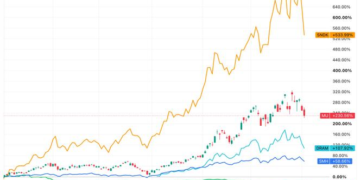























TradingKey – Recently, SanDisk’s ( SNDK) stock price has shown a clear pattern of high-level consolidation following a massive rally. As of the close on July 2, Eastern Time, SanDisk’s stock price plunged 14.13%, before rebounding slightly to $1,762.01 in after-hours trading. Since the beginning of this year, as one of the strongest AI-related stocks in the US market for 2026, SanDisk has seen a maximum year-to-date gain of nearly 900%, far outperforming most of its semiconductor peers over the same period.
From a fundamental perspective, SanDisk remains in an exceptionally strong upcycle. The company’s Q3 fiscal 2026 revenue reached $5.95 billion, up 97% quarter-on-quarter and 251% year-on-year; GAAP net income was $3.615 billion, and non-GAAP diluted EPS was $23.41. More critically, data center revenue reached $1.467 billion, up 233% QoQ and 645% YoY, indicating that demand for AI servers and enterprise-grade SSDs is rapidly reshaping SanDisk’s revenue mix. The company’s Q4 guidance is also notably strong, with projected revenue of $7.75 billion to $8.25 billion and non-GAAP EPS of $30 to $33, reflecting management’s continued confidence in NAND pricing, data center demand, and long-term customer agreements.
The core bullish thesis for SanDisk’s stock is that AI training, inference, and data center expansion are driving massive demand for persistent storage, pushing enterprise SSD and NAND prices continuously upward. More importantly, SanDisk is locking in prices, durations, and customer prepayments through new long-term supply agreements, giving investors confidence that the company’s earnings are no longer entirely at the mercy of the traditional memory cycle and instead possess much higher visibility.
However, the recent stock price correction indicates that the market has begun to question whether the gains have been overextended. From a technical perspective, SanDisk plunged over 14% on July 2, breaking below its 20-day moving average and triggering a technical sell signal for the first time in months. This decline was also tied to sector rotation out of AI and chips, as investors turned to profit-taking after a massive first-half rally, while also questioning whether data center capital expenditures will continue to accelerate.
|
Institution |
Latest Price Target |
View |
|
Bernstein |
$3,000 |
Decidedly Bullish |
|
Jefferies |
$3,000 |
Bullish |
|
Susquehanna |
$3,250 |
Among the Most Optimistic |
|
Bank of America |
$2,500 |
Leaning Bullish |
|
Citi |
$2,500 |
Leaning Bullish |
|
Morgan Stanley |
$1,750 |
Relatively Cautious |
Institutional price target forecasts for SanDisk reveal a clear divergence. Data from S&P Global and TipRanks compiled by StockAnalysis shows that the price targets of 22 analysts for SanDisk range from $1,000 to $3,250, reflecting significant market disagreement over its valuation; the average price target stands at $1,864, which is only about 6.8% above its latest closing price.
In the latest adjustments, Bernstein aggressively raised its price target from $1,700 to $3,000, and Jefferies also raised its target to $3,000, citing improved earnings stability from the new long-term agreements. The $3,250 target from Susquehanna is currently among the highest.
Bank of America raised its price target from $2,100 to $2,500, arguing that the NAND supply shortage could persist through mid-2027 and that SanDisk retains pricing power. Citi also raised its target to $2,500. Morgan Stanley remains relatively cautious with a price target of $1,750, which is close to the latest stock price, implying limited near-term upside.
SNDK stock daily chart, Source: TradingView
Looking at SNDK’s daily chart, the stock price tested the $2,300 resistance level twice consecutively, both times failing to sustain the breakout and subsequently falling back, which triggered a pullback in the stock price.
From the perspective of the overall trend, the stock price had previously been trading consistently above the 20-day moving average, and even when pullbacks occurred, it did not break below this line, indicating a strong overall upward trend. However, SNDK’s stock price plummeted by over 14% on July 2, breaking directly below the 20-day moving average. This suggests heavy market selling pressure and a short-term market sentiment skewed toward the bears. The stock price may continue to pull back downward, with the primary target likely testing the $1,500 support level. At the same time, this level is near the 60-day moving average, which could form a support confluence structure, allowing bullish investors to consider buying on dips near this area.
It is worth noting that SNDK’s 60-day moving average and 144-day moving average remain in a bullish alignment, indicating that the medium-to-long-term trend for MicroStrategy’s stock price is still bullish.
To the upside, if the stock price shows signs of bottoming out, the primary resistance level above to watch is around $1,900. If it breaks above this level and continues upward, the key resistance level at $2,300 should be monitored. If the stock price can successfully establish itself above $2,300, it will open up upside potential toward the Fibonacci 1.618 extension level at $2,930, and could even test the $3,000 psychological milestone.
This content was translated using AI and reviewed for clarity. It is for informational purposes only.
Source: Original Article