










Stock prices are soaring as the economic impact of tariffs becomes a reality.
The immediate impact of President Trump’s tariff announcements on the stock market last April was hard to miss. The S&P 500 (^GSPC +0.05%) experienced one of its worst two-day declines in history following the announcement. The Nasdaq Composite (^IXIC 0.22%) fared even worse. The only thing that prevented the indexes from falling into bear-market territory was the President’s reversal of many of the tariffs announced just days prior.
Many of the planned tariffs went into effect after a few modifications and exemptions, and the impact on the stock market hasn’t been as drastic, but it’s still quite noticeable for those paying attention. With the impact of the tariffs just starting to show up in economic data, it could have a major impact on future stock returns, as prices and valuations have continued to climb to alarming levels since the tariffs were first announced.
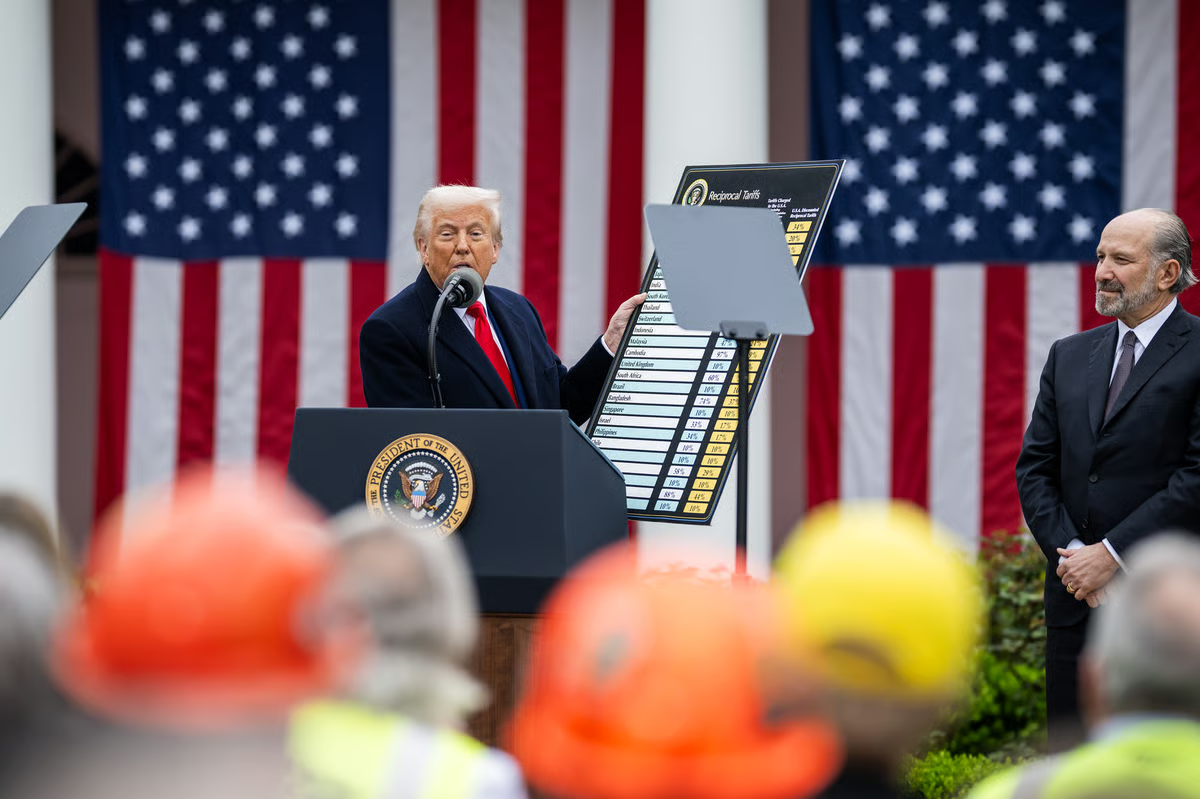
Image source: The White House.
The massive problem with President Trump’s tariffs
When President Trump announced the tariffs on just about every foreign country, he insisted those countries would pay for them. Not literally. Tariffs are taxes on importers. The U.S. business bringing goods into the country pays the government. However, Trump and his team argued that foreign suppliers would cut prices to bear the brunt of the costs of the tariffs.
Unfortunately, that isn’t how things have worked out. A study published last month from the German think tank Kiel Institute estimates that U.S. businesses and consumers pay 96% of the tariff costs. Additionally, importers reduced the volume of their shipments, suggesting fewer final sales to consumers.
The study echoes a previous study by Harvard University and the University of Chicago Business Schools, which showed that the U.S. pays 96% of the tariff costs. Goldman Sachs economists estimate U.S. consumers will absorb 55% of the tariff costs, with U.S. businesses taking on another 22%. The burden on the consumer may get worse in 2026 as more businesses push through price hikes. The Goldman Sachs analysts see consumers taking on as much as 70% of the cost, and the Yale Budget Lab estimates consumer pricing will rise 1.2% in 2026 due to the impact of tariffs alone.
The problem is that rising prices are bad for the economy and the stock market. The Yale Budget Lab estimates tariffs will result in a negative 0.4 percentage point impact on real GDP in 2026. Additionally, they’ll increase unemployment rates by 0.6 percentage points. The impact on consumers was most noticeable in the December retail sales report, which showed spending remained flat from November, well below analysts’ expectations for a 0.4% increase.
A slowing economy is generally bad news for stock prices, which are based on future expectations for earnings. But it could be especially bad news for stock prices right now because valuations are relatively expensive.
The big red flag in the stock market right now
The big challenge for the stock market in 2026 will be to prove that the valuation investors are paying for the largest companies in the United States is worth it. The S&P 500 currently trades for a cyclically adjusted P/E (CAPE) ratio of 40.
The CAPE ratio takes the average earnings of the index’s components over the last 10 years, adjusted for inflation, and divides it by the current market price. The metric removes the impact of economic cycles and earnings blips for individual companies, providing a good idea of where valuations stand in a broader historical context. With the CAPE climbing to 40, it’s sitting at a level seen only once before, near the height of the dot-com bubble at the turn of the century.
A higher CAPE ratio for the S&P 500 is historically highly correlated with lower future returns for the S&P 500. That said, investors should avoid reading too much into the historical returns based on limited sample sizes. As mentioned, there’s only been one example of the S&P 500 CAPE ratio climbing above 40 before.
But combined with the economic pressure of Trump’s trade policies, it doesn’t bode well for the market. Companies will need to grow earnings much faster than average in order to justify the current valuation, but a weakening consumer and labor market will make that particularly difficult.
What’s an investor to do?
Even though the broader stock market looks expensive right now and the economy is just starting to feel the impact of the Trump administration’s tariffs, there are still opportunities for investors. One of the immediate impacts of Trump’s tariff announcements was a weakening of the U.S. dollar relative to foreign currencies. (That may be the biggest reason why the vast majority of tariff costs have fallen on U.S. businesses and consumers.) That means companies that do a lot of business internationally have benefited.
Companies that generate the majority of their revenue outside the U.S. saw stronger earnings growth than those operating mostly in the U.S. last quarter, according to data from FactSet Insight. While investors can only rely on the foreign-exchange tailwind through mid-April, they may also benefit from foreign consumers holding up better than their American counterparts. As a result, it may still be worth exploring U.S. stocks that derive much of their revenue from abroad.
Alternatively, investors may be able to find significant value in international stocks. European and Japanese stocks don’t trade at nearly the same sky-high valuations as U.S. stocks. As a result, investors may have an easier time finding value in those markets.
Investors with a long-term focus can typically find great investments amid any market. Even with overall U.S. valuations near record highs, there are opportunities for those willing to take the long view.