













With earnings reports from most major technology companies now largely behind us, market leadership is shifting away from corporate profits and back toward macroeconomic data. As the first full trading week of August begins, global markets will face a series of key releases capable of reshaping interest-rate expectations, the US Dollar’s trajectory, and broader risk sentiment. At the center of attention is undoubtedly the US July Nonfarm Payrolls (NFP) report.
For traders, this NFP release is not merely a one-off event determined by whether job growth exceeds or misses expectations. It is a comprehensive stress test of the resilience of the US labor market, the Federal Reserve’s policy path, and whether the US Dollar can shake off the selling pressure seen at the end of July.
The US Dollar Index (DXY) is currently hovering around 99.90, a sensitive level where technical and fundamental factors converge. If this week’s employment data confirms that the US labor market remains resilient, the Dollar could be positioned for a rebound. Conversely, if the data weakens broadly, bets on a more accommodative Fed may intensify, potentially extending the Dollar’s downside pressure.
The Core Market Question: Is the US Labor Market “Cooling,” or Is It Beginning to “Stall”?
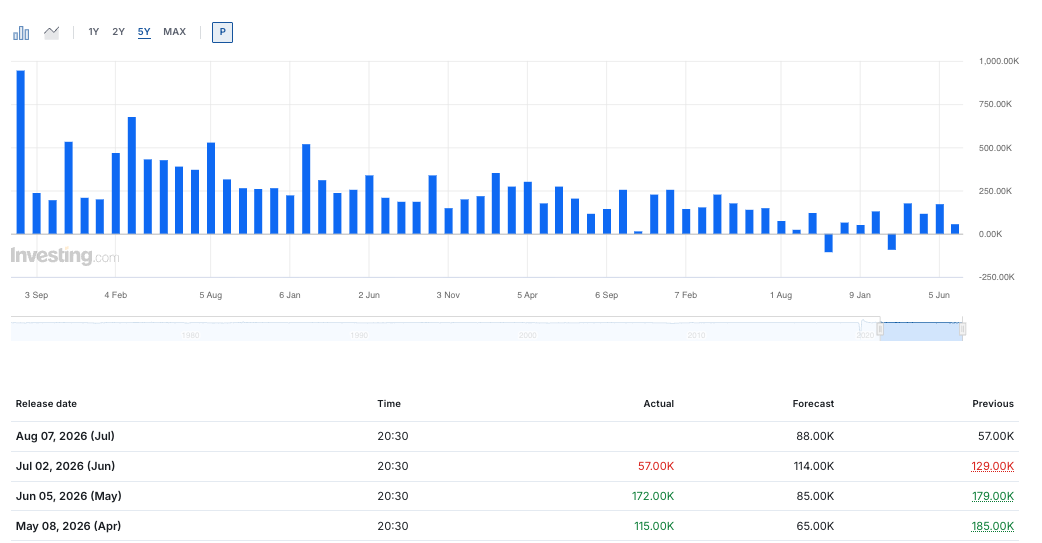
Markets currently expect US nonfarm payrolls to rise by around 91,000 in July, up from 57,000 in June. The unemployment rate is forecast to edge higher from 4.2% to 4.3%.
On its own, an increase of 91,000 jobs would not be considered particularly strong, but it would not immediately point to a recession either. What truly matters is not the headline number alone, but whether the key components of the report deliver a consistent message:
1. Whether nonfarm job growth rebounds
2. Whether the unemployment rate continues to rise
3. Whether average hourly earnings growth moderates
4. Whether labor-force participation increases
5. Whether the previous two months’ figures are revised sharply lower
June payrolls rose by only 57,000, far below market expectations, prompting investors to question whether the US labor market is losing momentum. Although the unemployment rate fell to 4.2% at the time, the combination of a lower unemployment rate and notably weak job creation does not necessarily indicate a healthy labor market. Instead, it may reflect short-term shifts in labor supply, statistical sampling, or employment composition.
Therefore, the significance of July’s data lies in determining whether June’s weakness was merely temporary noise or the beginning of a more pronounced cooling phase in the US labor market.
What Signals Will Markets Trade Before NFP?
Markets will not simply wait for Friday’s headline figure. From JOLTS job openings and ADP employment to ISM manufacturing and services PMIs, the week’s data will gradually shape expectations for NFP and could trigger volatility in the US Dollar and Treasury yields ahead of the release.
JOLTS Job Openings: How Strong Is Corporate Hiring Demand?
JOLTS job openings are a key gauge of corporate hiring demand in the United States. If vacancies continue to decline, it suggests that companies are becoming less willing to expand their workforce and that labor market tightness is easing.
For the Fed, a decline in job openings is not necessarily negative. If job vacancies cool, unemployment rises only modestly, and wage pressure eases at the same time, this could represent an ideal “soft landing” scenario. However, if vacancies fall rapidly while layoffs and initial jobless claims begin rising in parallel, markets may start to worry that the economy is shifting from cooling into a sharper slowdown.
ADP Employment: Worth Watching, But Not Taking at Face Value
The ADP employment report is often referred to as the “private payrolls” report or “mini-NFP,” and markets commonly view it as a forward-looking reference for the official payrolls release. However, historically, ADP data and official NFP figures have not always moved closely together. Traders should therefore avoid assuming that an ADP result automatically signals the same outcome for NFP.
The more valuable signal is whether ADP aligns with other labor market indicators. For example:
-
Weak ADP data, declining JOLTS vacancies, and rising initial jobless claims would generally be negative for the US Dollar;
-
Strong ADP data, stable job openings, and improving ISM employment components could encourage early positioning by Dollar bulls;
-
Conflicting ADP and JOLTS data may keep markets range-bound ahead of NFP as investors wait for a clearer answer.
ISM Manufacturing and Services: Look Beyond Jobs to Economic Momentum
This week’s ISM manufacturing and services PMIs are also critical, particularly the services data. As the US economy is primarily driven by services, trends in service-sector activity, employment components, and prices paid often provide a more reliable read on the health of domestic demand.
Traders should pay particular attention to three subcomponents:
-
New Orders: Reflect future demand and business activity;
-
Employment Index: Reflect corporate hiring and labor demand;
-
Prices Paid: Reflect whether inflationary pressure is reaccelerating.
If the services sector remains in expansion, the employment component improves, and price pressures remain elevated, the case for the Fed to retain a relatively hawkish stance would be strengthened. Conversely, if both new orders and employment weaken, markets may become more inclined to price in a shift toward easier policy.
What the Fed Truly Cares About: Not Just Jobs, but Wages and Inflation
Markets often oversimplify NFP as follows: stronger job growth means a stronger Dollar, while weaker job growth means a weaker Dollar. In reality, the Fed and institutional investors are more focused on how the labor market affects inflation.
Even if payroll growth comes in slightly below expectations, elevated average hourly earnings growth would indicate that labor-cost pressure remains in place. In that case, services inflation may not decline quickly. Under such circumstances, the Fed may not turn meaningfully dovish simply because one month’s employment figure is weak.
Conversely, if payroll growth misses expectations, unemployment rises to 4.3% or higher, and wage growth slows at the same time, markets may quickly conclude that the labor market is no longer overheating. That could increase expectations for future rate cuts or earlier policy easing.
In other words, the most tradable aspect of this NFP report is not the headline number alone, but the following combination:
Job Growth + Unemployment Rate + Wage Growth + Revisions to Previous Data
Together, these four components will determine the scale of the market’s repricing of Fed expectations.
Three NFP Scenarios: Potential Moves in the US Dollar, Gold, and Major Currencies
Scenario One: NFP Significantly Beats Expectations, Unemployment Remains Low, and Wages Are Strong
Market interpretation: The US labor market remains resilient, giving the Fed little reason to rush toward policy easing.
If job creation significantly exceeds 91,000, the unemployment rate does not rise to 4.3%, and average hourly earnings growth exceeds expectations, markets may rapidly scale back expectations for policy easing.
Potential market reactions could include:
-
The US Dollar Index strengthens and challenges levels above the 100 psychological threshold;
-
US Treasury yields rise;
-
Gold comes under pressure and pulls back;
-
EUR/USD and GBP/USD may face downside pressure;
-
USD/JPY may be supported by higher US yields;
-
US equities could initially become volatile as rates rise, with high-valuation technology stocks particularly sensitive to Treasury yields.
For CFD traders, this would favor a bullish US Dollar environment. However, it remains important to watch the initial post-release reaction closely, as false breakouts and rapid reversals are common.
Scenario Two: Data Broadly Meets Expectations and the Labor Market Cools Gradually
Market interpretation: The US economy is slowing, but not deteriorating into a recessionary downturn.
If payrolls come in close to 90,000, unemployment rises to 4.3%, and wage growth does not materially exceed expectations, markets may interpret the outcome as a gradual but manageable cooling in the labor market.
This could actually be a relatively favorable scenario for risk assets: the economy is not overheating, inflation pressures may ease, and the Fed’s future policy flexibility gradually expands.
Market reactions in this scenario could be more mixed:
-
The Dollar Index may trade in a short-term range without establishing a clear one-way trend;
-
US equities may lean positive, although gains will depend on whether Treasury yields decline;
-
Gold may remain in high-level consolidation;
-
EUR/USD and GBP/USD will likely be influenced by European data and the Dollar’s follow-through;
-
Trading attention may shift to upcoming inflation and employment data ahead of the Fed’s September meeting.
Scenario Three: NFP Misses Significantly, Unemployment Rises, and Wage Growth Slows
Market interpretation: The labor market may be doing more than simply cooling—it may be losing momentum meaningfully.
If payrolls again fall well short of expectations, potentially approaching zero growth or turning negative, while unemployment rises more than forecast and prior figures are revised lower, markets could rapidly shift into a defensive mode.
In this scenario, investors may reassess the US growth outlook and increase bets on a policy pivot by the Fed. Potential reactions include:
-
The Dollar Index breaks below support near 99.90 and extends its decline;
-
US Treasury yields fall;
-
Gold gains support from both safe-haven demand and expectations of rate cuts;
-
EUR/USD and GBP/USD may rebound;
-
Safe-haven currencies such as the Japanese Yen and Swiss Franc may strengthen;
-
US equities may not necessarily rise, as expectations of rate cuts and rising recession concerns could coexist.
This is the scenario most likely to generate extreme volatility, sharp rallies, and abrupt reversals. Traders should not rely solely on the simplistic view that “weak NFP is bullish for equities.” They must determine whether markets are trading easier policy expectations or an increasing risk of recession.
Conclusion: More Than an Employment Report—A Critical Turning Point for Fed Expectations
The real value of July’s NFP report lies in its ability to help markets answer one central question: Is the US labor market undergoing an orderly cooling process, or is it deteriorating rapidly?
If the data demonstrates resilience, the US Dollar may recover from its late-July decline, while expectations for the Fed to maintain a relatively hawkish stance could strengthen. If employment, unemployment, and wage data all weaken simultaneously, markets may accelerate bets on policy easing, leaving the Dollar vulnerable to further downside.
In a market environment characterized by high volatility and dense information flow, opportunities may not be limited to a single currency pair. They may also emerge across gold, indices, commodities, and major FX CFD instruments.
To monitor market moves around NFP, ISM, ADP, and JOLTS releases, consider using Bitget CFD to follow real-time price action in the US Dollar Index, gold, major currency pairs, and global indices, while building a trading plan aligned with your own risk tolerance. CFDs involve leverage, meaning that both potential returns and risks can increase as volatility rises. Always apply sound risk management, set stop-loss levels, and avoid chasing short-term moves with excessive leverage.
Source: Original Article