






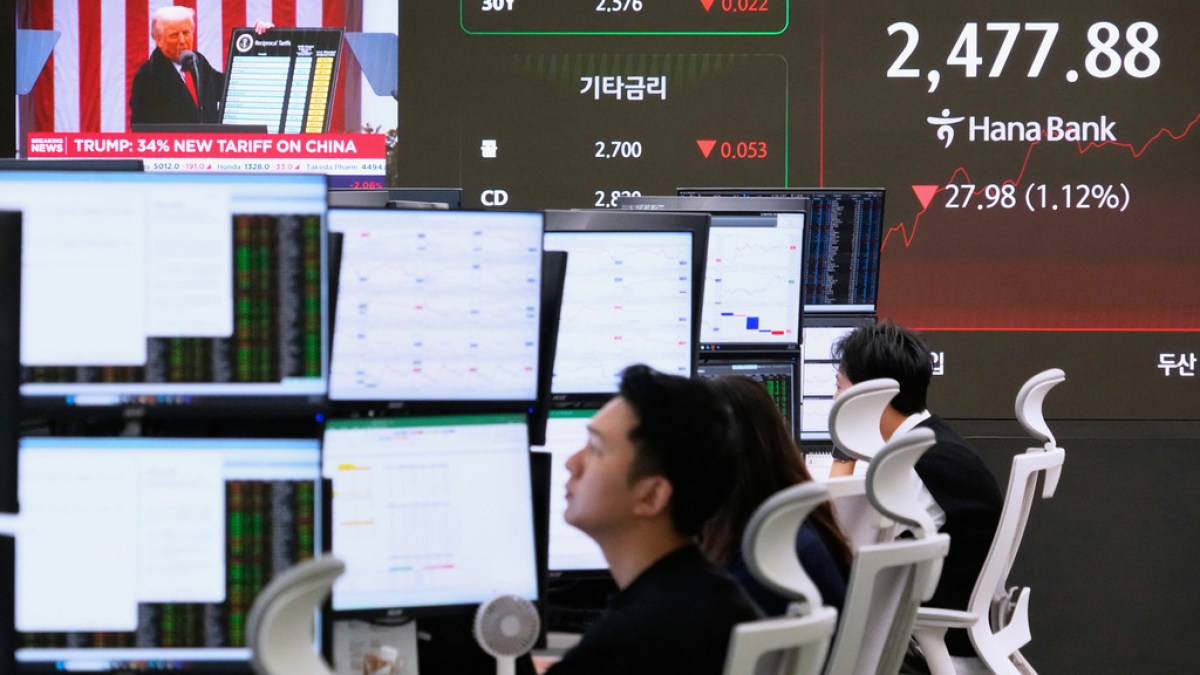
For weeks, stock markets have been falling, and the plunge accelerated after United States President Donald Trump on April 2 unveiled US tariffs on virtually every country.
Commenters on social media have said the drop in stock prices could portend a recession. Professional analysts at JPMorgan have estimated a 60 percent likelihood of a recession, while Goldman Sachs and Morningstar put the odds between 40 and 50 percent.
So what is a recession? Is there a connection between stock market declines and recessions? And would a tariff-driven recession differ from past recessions? Here are some answers.
What happens during a recession?
Several things tend to happen in recessions, none of them pleasant.
- Business investment declines, triggered by business leaders’ negative perceptions of the economic future. The classic case is the Great Recession of 2007 to 2009, which was triggered by a collapse in the mortgage market. When this happened, builders stopped building homes, which meant they stopped purchasing equipment and materials, from earth movers to refrigerators to roofing tiles; these decisions ricocheted through the wider economy.
- Amid business investment cutbacks, unemployment rises and hours worked decline. A recession in the early 1980s sent the unemployment rate almost to 11 percent, and the COVID-19 recession briefly hit almost 15 percent unemployment before falling nearly as rapidly. For now, the unemployment rate is far lower, at 4.2 percent, though that could change if economic conditions weaken. “In a typical recession, a relatively small number of people will actually lose their job, but even the threat of job loss creates anxiety,” said Steven Fazzari, an economist at Washington University, St. Louis.
- If you do manage to hold on to your job, your compensation may stagnate, because employees are less likely to find other jobs they could use to leverage pay raises.
- Consumer purchases decline. “Many families become more cautious about spending in recessions out of fear they, too, may face a layoff or some other loss of income,” said Gary Burtless, an economist at the Brookings Institution, a think tank. These factors tend to spiral, encouraging each other. For instance, declining business investment causes rising unemployment, which causes consumer spending cutbacks, which causes less business investment that causes additional increases in unemployment.
How is a recession determined?
Officially, the arbiter of recessions in the US is the National Bureau of Economic Research’s Business Cycle Dating Committee. The publicity-shy committee has been marking the start and end points of recessions for decades. It currently includes economists from Harvard, Princeton, Northwestern, the Massachusetts Institute of Technology and the University of California, Berkeley.
The committee deliberates privately, and it takes a holistic approach, rather than a checklist. But it is open about what factors it uses to determine the start of a recession, namely “a significant decline in economic activity that is spread across the economy and that lasts more than a few months”.
The most recent recession – the one caused by the COVID-19 pandemic – was arguably the most unusual, because it was brief, lasting from February 2020 to April 2020, but was deep and widely diffused among most sectors of the economy.
In media coverage, a common yardstick for determining whether a recession is under way is two consecutive quarters of declining gross domestic product (GDP), which refers to the total of all economic activity. But the committee officially weighs factors such as inflation-adjusted personal income, nonfarm payrolls, household employment data, inflation-adjusted personal expenditures, inflation-adjusted manufacturing and trade sales, and industrial production.
Notably, stock market declines are not included on this list.
Is there a connection between stock market declines and recessions?
In 1966, Nobel Prize-winning economist Paul Samuelson quipped that “Wall Street indexes predicted nine out of the last five recessions.”
He was exaggerating for comic effect, but he had a point that a stock market decline doesn’t inevitably lead to a recession, and that not all recessions produce stock market declines.
However, history shows a strong correlation between stock market declines and recessions, especially in the years since Samuelson made that remark.
Since 1950, the US has experienced 10 official recessions. Seven were accompanied by declines in the Standard & Poors 500, a broad stock market gauge, while three were not. The last time a recession didn’t also produce a notable decline in the S&P was almost a half-century ago, during the double-dip recessions of 1980 and 1982.
Of the seven recessions that accompanied stock market declines, the average loss in the S&P 500 was about 31 percent. The declines ranged from 18 percent to 55 percent, with the 55 percent drop occurring during the Great Recession.
For comparison, since the end of January 2025, the S&P is down roughly 19 percent.
The biggest stock market decline ever came during the Great Depression: Between August 1929 and July 1932, the S&P (which was then calculated a little differently) experienced an 88 percent loss.
As Samuelson said, not every notable decline in the S&P 500 has produced a recession. The period surrounding the “Black Monday” crash of 1987, which was caused by a mix of factors including international selloffs of shares, saw a 28 percent decline, but no recession followed.
More recently, during the period of 40-year-high inflation in the US, the S&P lost about 25 percent from January 2022 to September 2022. Although then-President Joe Biden’s critics argued that a recession was imminent, and JPMorgan placed the likelihood at 40 percent, it never happened.
If there’s a recession coming, how might it be different this time?
It’s too soon to say whether a recession is imminent. The stock market is an early indicator of potential economic trouble; it is based on investor perceptions of the economic future, rather than on hard data. That data needs to be released over the next few weeks and months, and then the committee can make its determination. (The fastest decisions came about four months after a recession’s start, while the slowest arrived 21 months later.)
That said, if a recession does occur in the wake of Trump’s tariff decisions, it could have different attributes than other recessions.
The biggest difference is that a recession could be accompanied by higher inflation.
During a typical recession, consumer demand drops, meaning that companies selling products and services lower their prices (or at least not raise them) in order to entice reluctant customers to spend. But Trump’s across-the-board tariffs could potentially drive price increases at the same time they send the country into a recession.
This isn’t unprecedented; it also happened during the 1970s, when an oil embargo spiked gasoline prices. The phenomenon is called “stagflation” – a combination of economic stagnation and inflation – and it’s “a lot less pleasant” than a typical recession, said Douglas Holtz-Eakin, president of the American Action Forum, a centre-right think tank. (And don’t assume that falling prices would be better: The economy could contract so forcefully that prices decline despite the tariffs, which happened during the Great Depression, after the 1930 Smoot-Hawley tariffs were enacted, Burtless said.)
Another unusual feature of a tariff-driven recession could be its simultaneous global reach, given Trump’s decision to apply at least a 10 percent tariff on virtually every country in the world.
This could lead to “a coordinated recession across the globe”, Holtz-Eakin said.
The silver lining, economists say, is that the worst-case scenarios can – at least in theory – be averted. Unlike the complicated mortgage industry problems that caused the Great Recession or the global pandemic that caused the 2020 recession, it’s within a president’s power to quickly minimize (though not eliminate) the economic impact: He could simply roll back the tariffs.
If there’s a recession, said libertarian economist Daniel Mitchell, it will be “caused by an external shock and ending – hopefully – when the external shock is undone”.